Beating Broke

Personal Finance from the Broke Perspective

  • Home
  • About
  • We Recommend
  • Contact
  • Our Editorial Commitment

Powered by Genesis

Dependent Care FSA 2027: How a Single Parent Can Keep About $1,474 More

November 16, 2026 By Beating Broke Editorial Team Leave a Comment

Daycare eats a paycheck before you see it. Open enrollment right now sets your 2027 benefits, and the pre-tax account for child care is still $7,500, up from $5,000 before 2026, so the next few weeks decide how much of next year’s daycare you pay with untaxed dollars.

The 2027 numbers

Dependent care FSA: $7,500. A dependent care FSA (a work account that pays for child care with money taken out of your check before taxes) lets you set aside up to $7,500 a year, or $3,750 if you’re married filing separately, per IRS Publication 15-B. The IRS’s 2027 inflation update, Rev. Proc. 2026-35, doesn’t change that number, so $7,500 is your 2027 limit too. It covers care for a child under 13 while you work, per the IRS’s 2026 Publication 503 draft.

Commuter benefits: $340 to $350 a month. If your job offers pre-tax transit passes or parking, you can run up to $350 a month through it in 2027, up $10 from $340 in 2026, per Rev. Proc. 2026-35 and Rev. Proc. 2025-32.

Both work the same basic way. The money skips federal income tax, and Pub 15-B says excluded fringe benefits in most cases also skip Social Security and Medicare tax (7.65% of your pay).

The math on $7,500 of daycare

Say you’re a single parent filing as head of household, earning $55,000 and paying $160 a week for daycare. That’s $8,320 a year, so you can run the full $7,500 through the FSA. At that income you’re in the 12% federal bracket, which for head of household filers covers taxable income from $18,250 to $69,650 in 2027, per Rev. Proc. 2026-35.

  • Social Security and Medicare you don’t pay: $7,500 × 7.65% = $574
  • Federal income tax you don’t pay: $7,500 × 12% = $900
  • Total: about $1,474 a year, before any state income tax savings

Per paycheck, that’s $288 going in on 26 biweekly checks. Your take-home only drops by about $231, because the taxes on that $288 disappear too.

Earning closer to $40,000? Run the same check. The 2027 head of household standard deduction is $24,925, so $40,000 of pay leaves $15,075 of taxable income, which sits in the 10% bracket. Federal tax on that is about $1,508, and the 2027 Child Tax Credit is $2,300 per child, per Rev. Proc. 2026-35. With one kid, your federal income tax is likely already $0, so the FSA saves you the $574 of Social Security and Medicare (plus any state tax), not the $900.

The math on the commuter bump

A $90 monthly bus pass is $1,080 a year. Run it through a commuter benefit in the 12% bracket and you skip 12% plus 7.65% on it, which is about $212 a year back in your pocket. Paying for parking near work at $150 a month? That’s $1,800 a year and about $354 saved.

The $10 increase only matters if you spend more than $340 a month, which is mostly big-city parking. The bigger win is signing up at all if you’re paying for transit or parking with after-tax money right now.

FSA or the child care tax credit?

The Child and Dependent Care Credit got bigger starting in 2026. The IRS says the top rate went from 35% to 50% of what you spend on care, on up to $3,000 of costs for one child or $6,000 for two or more. The rate slides down as income goes up; the 2026 Pub 503 draft puts the range at 50% to 20%, with the full 50% going to the lowest incomes.

You can’t count the same dollars twice. Money you run through the FSA comes off that $3,000 or $6,000 limit, per Publication 503. Put $7,500 in the FSA and there’s nothing left to claim the credit on, with one kid or two.

So compare:

  • One child, full FSA: about $1,474 saved at $55,000, or about $574 if you already owe no federal income tax.
  • One child, credit only: the most it can ever be is 50% of $3,000, which is $1,500, and that top rate goes to the lowest incomes. Above that tier your rate is lower.

There’s one more catch on the credit side. The credit can’t be bigger than the federal income tax you owe, and you can’t get the extra back as a refund, per Publication 503. If the Child Tax Credit already brings your bill to $0, the care credit is worth $0 to you, and the FSA’s $574 is the better deal.

Your exact credit rate is on the phaseout schedule in the Form 2441 instructions. If your income is very low, run both numbers before you pick.

How to set it up, step by step

  1. Find your open enrollment deadline today. Check your benefits email or portal. Plans generally lock your FSA amount for the year unless your situation changes, like a new baby or a new daycare cost, so ask HR what counts.
  2. Total next year’s care cost. Weekly daycare × 52, plus after-school care and day camp. Cap your election at that number or $7,500, whichever is lower.
  3. Pick a number you’ll actually spend. If daycare is $120 a week ($6,240 a year), elect $6,240, not $7,500. Ask HR what happens to money you don’t spend by the plan’s deadline; with FSAs, unused money can be lost.
  4. Divide by your paychecks. $6,240 ÷ 26 = $240 a check. Make sure the smaller paycheck still covers rent.
  5. Sign up for commuter benefits if you pay for transit or parking. Commuter benefits aren’t an FSA, so ask HR whether you can change the amount mid-year and what happens to money you don’t use.
  6. Save every daycare receipt. You’ll need the provider’s name, address, and tax ID to get reimbursed and to file.

The catch

A dependent care FSA usually reimburses you after you pay, not before. If daycare is due Monday and the reimbursement lands two weeks later, that’s a cash-flow squeeze. Ask how fast your plan pays out, and keep a small buffer in checking for the first month.

It only works if your employer offers it. Many smaller employers and gig platforms don’t, and then the credit is your main option.

None of this pays for care you can’t afford in the first place. It makes the care you’re already paying for cheaper.

What to do this week

Log into your benefits portal, find the open enrollment deadline, and price out 2027 daycare at your real weekly rate. Elect that number (up to $7,500) before the window closes. If you pay for a bus pass or parking, sign up for the commuter benefit while you’re there.

Sources

  1. Internal Revenue Service, “Rev. Proc. 2026-35” (2027 inflation adjustments) 
  2. Internal Revenue Service, “Publication 15-B (2026), Employer’s Tax Guide to Fringe Benefits” 
  3. Internal Revenue Service, “Rev. Proc. 2025-32” (2026 inflation adjustments) 
  4. Internal Revenue Service, “Working Families Tax Cuts” 
  5. Internal Revenue Service, “Publication 503 (2025), Child and Dependent Care Expenses” 
  6. Internal Revenue Service, “Publication 503 (2026), Tax Guide for Child and Dependent Care Expenses” (draft, Oct. 28, 2026) 
Filed Under: budget, budgeting, Taxes Tagged With: child care costs, commuter benefits, dependent care FSA 2027

Budgeting on an Irregular Paycheck: Build the Plan on Your Lowest Check, Not Your Average

November 13, 2026 By Beating Broke Editorial Team Leave a Comment

When your hours move every week, a budget built on last month’s number breaks the first time a short check lands. Budgeting on an irregular paycheck works when the plan runs on your lowest check and the extra gets banked to cover the next short one.

Budgeting on an irregular paycheck: why the average lies

You’re not the only one doing this math. In the Federal Reserve’s latest survey of household finances, 30% of adults said their income varied at least occasionally in 2025, and 11% said they struggled to pay bills in the past year because of it. Among people who work for someone else, 28% reported income that moved around. Variable schedules aren’t a gig-worker problem. They’re a support-job, retail, healthcare, and hourly-anything problem.

Take six paychecks (every two weeks, after taxes) from someone on a variable schedule:

  • $1,180
  • $1,340
  • $1,090
  • $1,420
  • $1,260
  • $1,150

Add them up and you get $7,440. Divide by six and the average is $1,240. That’s the number a standard budget template would have you plan on.

The problem: three of those six checks came in under $1,240. If your rent share, groceries, and gas are planned against the average, half your paydays start in the hole. That’s how a “working” budget ends in an overdraft on a Tuesday.

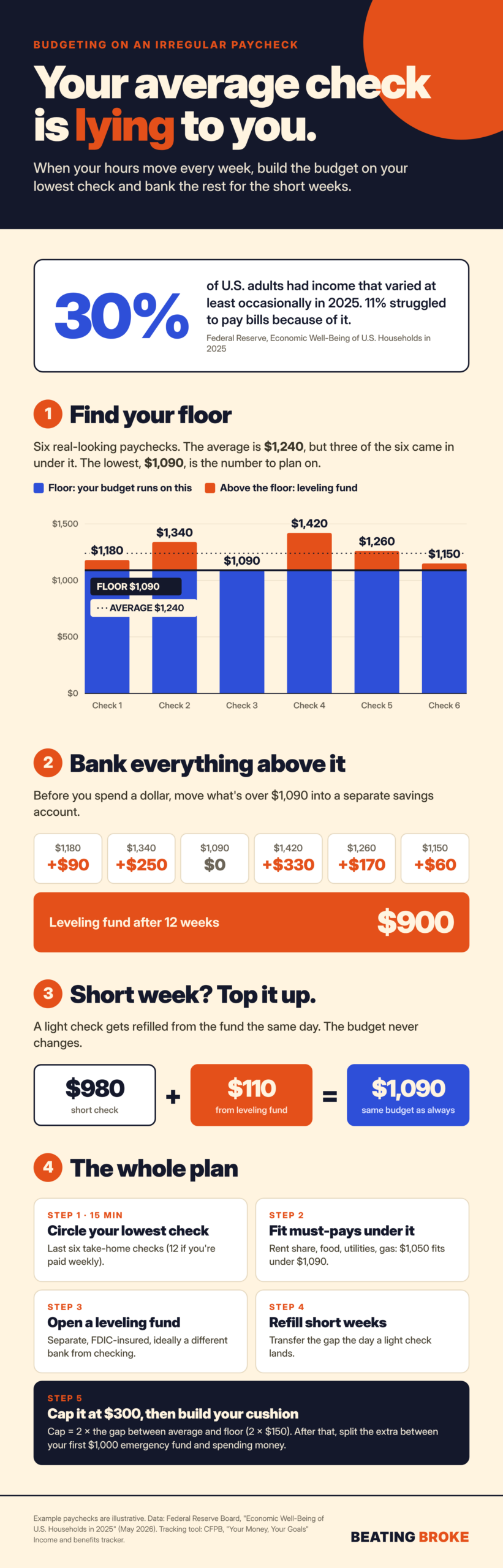
The floor in that list is $1,090. That’s the number to build on.

Average check infographic

Step 1: Find your floor (15 minutes, tonight)

Open your bank app and write down your last six take-home paychecks. If you’re paid weekly, use the last 12. Circle the lowest one. That’s your floor.

If one check was unusually low for a reason that won’t repeat (a week you were out sick, say), you can drop it and use the next-lowest. Be honest with yourself here. December often brings a short week for holiday closures, so if last December’s checks were low, count one of them.

The CFPB’s free Income and benefits tracker lays this out week by week and asks you to sort income into regular, irregular, seasonal, and one-time, so you can see “what income you can count on each month.” A spreadsheet with one column per paycheck does the same job.

Step 2: Fit the must-pays inside the floor

List what has to be paid every two weeks to keep the lights on and the car running. Using the example above, with rent of $1,300 a month:

  • Rent (half of $1,300): $650
  • Groceries: $180
  • Utilities and phone (half the monthly total): $100
  • Gas and car insurance: $120

That’s $1,050 per paycheck, which fits under the $1,090 floor with $40 to spare.

If your must-pays come in above your floor, that’s the most useful thing this exercise can tell you. It means the budget was never going to work on a short week, and it isn’t a willpower problem. Look first at the bills with due dates you can move. The CFPB’s budgeting guide points out that if you’re coming up short, “the timing for your bills and income don’t match.” Some utilities and card issuers will move a due date if you call and ask, so the big bill lands on the payday that can carry it. It costs one phone call to find out.

Step 3: Open a separate leveling fund

Every dollar above your floor goes into a separate savings account before you spend any of it. Call it your leveling fund. Its only job is to top up the short checks.

With the six checks above, the fund fills like this:

  • $1,180 check: $90 over the floor, into the fund
  • $1,340 check: $250 into the fund
  • $1,090 check: $0 (this is the floor)
  • $1,420 check: $330 into the fund
  • $1,260 check: $170 into the fund
  • $1,150 check: $60 into the fund

That’s $900 over 12 weeks that used to get spent without a plan because it felt like extra. It wasn’t extra. It was next month’s short week, showing up early.

Keep the fund at a different bank or credit union from your checking if you can, so it doesn’t show up in your spending balance. Check that the bank is FDIC-insured; the FDIC covers $250,000 per depositor, per insured bank, for each ownership category, which is far more than this fund will ever hold.

Step 4: Pay yourself back from the fund on short weeks

When a check comes in under your floor (a $980 week, say), move $110 from the leveling fund into checking that same day, so you’re spending from $1,090 like always. The budget doesn’t change. Only the source of the money does.

This is what kills the overdraft cycle. A short week used to mean a declined card or an overdraft fee. Now it’s a transfer. If overdrafts have already been eating your checks, this piece on stopping overdraft fees covers the one call that makes a short week cost a decline instead of a fee.

Step 5: Set a cap, then send the rest to your cushion

The leveling fund doesn’t need to grow forever. A good cap is two times the gap between your average and your floor. In the example, that’s $1,240 minus $1,090, or $150, times two: $300.

Once the fund holds $300, anything above the floor gets split. Put part toward your first $1,000 emergency fund and keep part as spending money for the week. That cushion matters: the Fed’s survey found that 63% of adults would cover a surprise $400 expense with cash or its equivalent, which leaves 37% who would have to borrow, sell something, or couldn’t cover it. The leveling fund handles short paychecks. The cushion handles the car battery.

The catch

This plan feels tight at first. Building on your lowest check means the good weeks don’t feel good, because the extra goes into savings instead of dinner out. Give it two months. The first short week you cover without panic is when it starts to make sense.

It also won’t fix a budget where the must-pays sit above every check you get. If your floor is $900 and the bills are $1,050, the leveling fund will drain in a few weeks. That’s a sign the math needs more income or a cheaper fixed bill, not more discipline.

And if your income swings because you’re self-employed or doing gig work, the floor method still works, but you also need to set money aside for taxes before you figure out the floor. The Fed found 58% of self-employed adults had income that varied month to month, so you’re far from alone there either.

What to do this week

Tonight, pull your last six take-home paychecks and circle the lowest one. On your next payday, move everything above that number into a separate savings account before you buy anything. Even if it’s $40, that’s $40 already waiting for your next short week.

Sources

  1. Board of Governors of the Federal Reserve System, “Economic Well-Being of U.S. Households in 2025: Income and Expenses”, May 2026 (accessed November 13, 2026)
  2. Board of Governors of the Federal Reserve System, “Economic Well-Being of U.S. Households in 2025: Savings and Investments”, May 2026 (accessed November 13, 2026)
  3. Consumer Financial Protection Bureau, “Your Money, Your Goals: Income and benefits tracker” (accessed November 13, 2026)
  4. Consumer Financial Protection Bureau, “Budgeting: How to create a budget and stick with it”, June 5, 2019 (accessed November 13, 2026)
  5. Federal Deposit Insurance Corporation, “Understanding Deposit Insurance”, April 1, 2024 (accessed November 13, 2026)

Filed Under: budget, budgeting, Emergency Fund Tagged With: budgeting on an irregular paycheck, irregular income, variable hours

Debt Snowball vs. Avalanche: The Real Math on $5,500 of Card Debt (The Gap Is $156)

November 12, 2026 By Beating Broke Editorial Team Leave a Comment

If you’re carrying balances on three cards and can’t decide which one gets the extra $100, you have company: Americans now owe a record $1.29 trillion on credit cards, according to the New York Fed’s Q3 2026 Household Debt and Credit Report. The debt snowball vs. avalanche question usually gets argued like a personality quiz, so we ran both on a realistic set of cards to show you the actual dollar gap and let you pick a method before your next payday.

What each method does

Both methods start the same way. You pay the minimum on every card, every month, no exceptions. The difference is where the extra money goes.

  • Snowball: the extra goes to the smallest balance first. When that card hits $0, its whole payment rolls onto the next-smallest.
  • Avalanche: the extra goes to the highest APR (what the card actually costs you per year) first, then rolls to the next-highest.

The CFPB’s guide to reducing debt describes the tradeoff plainly: the highest-rate method “can save you money in the long run,” while with the snowball “you’ll see progress quickly.” Both are true. The useful question is how much money, and how much quicker.

The three cards we ran

Card Balance APR Minimum
Store card $500 30% $25
Card B $1,500 20% $40
Card C $3,500 27% $90
Total $5,500   $155

Those APRs aren’t scare numbers. The Federal Reserve’s G.19 Consumer Credit release put the average rate on credit card accounts that were charged interest at 22.36% in Q3 2026. Store cards often run higher.

Walk Card C’s first month. $3,500 times 27% is $945 in interest over a year. Divide by 12 and that’s $78.75 a month. So of the $90 minimum, $78.75 goes to interest and $11.25 actually lowers the balance.

Same math on the other two: Card B costs $25 a month in interest ($1,500 × 20% ÷ 12), and the store card costs $12.50 ($500 × 30% ÷ 12). That’s $116.25 of your $155 going to interest in month one.

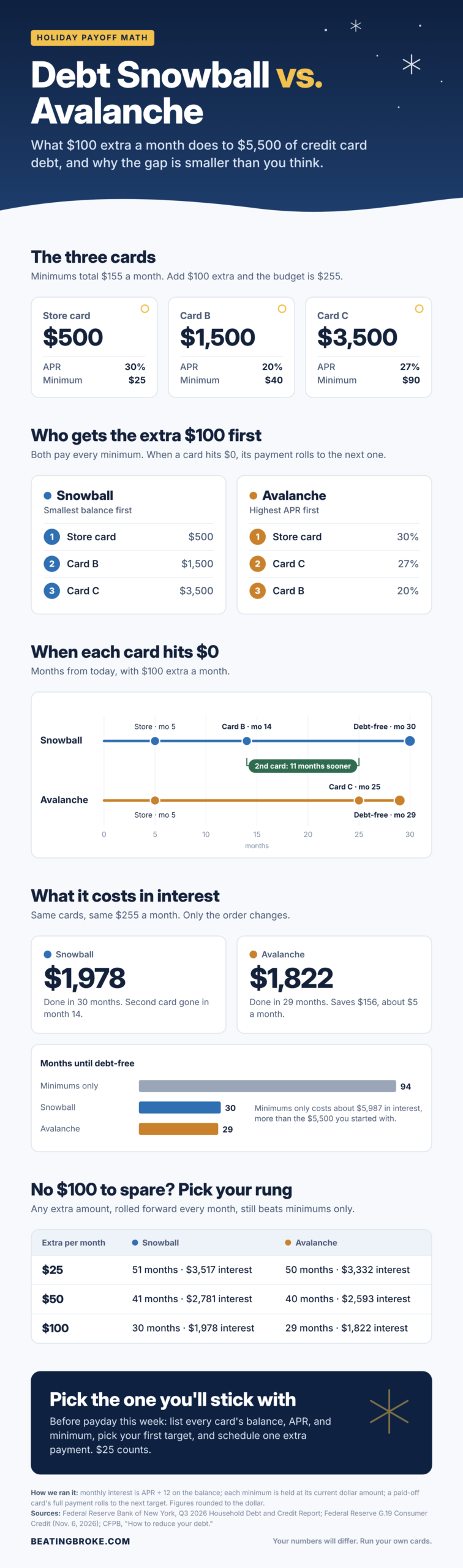
Snowball Infographic

Minimums only: 94 months

Pay exactly $155 a month, never roll a paid-off card’s payment forward, and the last card clears in month 94. That’s almost eight years, and about $5,987 in interest. More than the $5,500 you started with.

(We held each minimum at its current dollar amount. On real cards the minimum usually shrinks as the balance shrinks, which makes the minimums-only path longer, not shorter.)

Snowball vs. avalanche with $100 extra a month

Now the budget is $255 a month: $155 in minimums plus $100 extra. Every time a card hits $0, its payment rolls into the next target.

Snowball order: store card, Card B, Card C. Avalanche order: store card (it’s both the smallest balance and the highest APR), then Card C at 27%, then Card B at 20%.

  Snowball Avalanche
First card paid off Month 5 Month 5
Second card paid off Month 14 (Card B) Month 25 (Card C)
Debt-free Month 30 Month 29
Total interest $1,978 $1,822

Avalanche wins by $156 and one month. Spread over two and a half years, that’s about $5 a month.

Snowball wins on something a spreadsheet can’t price: your second card is gone in month 14 instead of month 25. That’s 11 months sooner with one less bill, one less due date, and one less statement to open.

And either method beats minimums only by about $4,000 in interest ($5,987 minus $1,978) and more than five years.

No $100 to spare? The ladder still works

Extra per month Snowball Avalanche
$25 51 months, $3,517 interest 50 months, $3,332 interest
$50 41 months, $2,781 interest 40 months, $2,593 interest
$100 30 months, $1,978 interest 29 months, $1,822 interest

Even $25 a month extra, rolled forward, cuts the timeline from 94 months to about 50 and saves roughly $2,500 in interest. Pick the rung you can hold every month, not the one that looks best.

How to pick yours

  • Pick avalanche if a debt-free date two years out is enough to keep you going. The bigger the APR gap between your cards, the more the avalanche saves.
  • Pick snowball if you’ve started a payoff plan before and stalled around month six. A card hitting $0 is fuel, and $156 over 30 months isn’t worth a plan you’ll quit.
  • If your smallest balance is also your highest APR (like the store card here), both methods agree on step one. Start there this payday and decide the rest later.

Set it up in five steps

  1. List every card tonight. Balance, APR, and minimum for each. The APR is on your statement in the interest charges section. Ten minutes.
  2. Find your extra. $25, $50, or $100 a month. Use the ladder above to see what each rung buys you.
  3. Put every minimum on autopay. One missed payment can mean a late fee, and on many cards a higher penalty rate, which wipes out the savings you’re working for.
  4. Send the extra as a separate payment on payday to your target card. Money that sits in checking until the due date tends to find another job.
  5. When a card hits $0, roll its full payment (its old minimum plus your extra) onto the next target. Don’t let it drift back into the grocery line.

The catch

Neither method works if new charges keep landing on the cards. If you have nothing set aside, one $400 car repair goes on a card and undoes four months of progress. If your cushion is under $500, split your extra between the cushion and the cards until it’s there.

This math also assumes your APRs stay put. If you can get one lowered, every number above improves; our piece on how to ask for a lower credit card APR has the script.

And if you can’t cover the minimums at all right now, a payoff method isn’t the next step. Call each card issuer and ask whether they have a hardship program before anything else.

What to do this week

Before your next payday, write down the balance, APR, and minimum for every card, pick your first target, and schedule one extra payment to it for payday. $25 counts. That’s the snowball or the avalanche started, whichever one you’ll actually stick with.

Sources

  1. Federal Reserve Bank of New York, “Household Debt Increased Moderately; Delinquency Transition Rates Remain Flat” (Q3 2026 Household Debt and Credit Report), November 10, 2026 (accessed November 12, 2026)
  2. Board of Governors of the Federal Reserve System, “G.19 Consumer Credit”, November 6, 2026 (accessed November 12, 2026)
  3. Consumer Financial Protection Bureau, “How to reduce your debt”, archived guidance, page last modified June 25, 2026 (accessed November 12, 2026)

Filed Under: credit cards, Debt, Debt Reduction Tagged With: credit card payoff, debt snowball vs avalanche, minimum payments

  • 1
  • 2
  • 3
  • …
  • 401
  • Next Page »

Improve Your Credit Score

Money Blogs

  • Budget and the Bees
  • Celebrating Financial Freedom
  • Christian PF
  • Clever Dude
  • Dual Income No Kids
  • Everybody Loves Your Money
  • Financial Panther
  • Gajizmo.com
  • Grocery Coupon Guide
  • Lazy Man and Money
  • Make Money Your Way
  • Money Talks News
  • Personal Profitability
  • PF Blogs
  • Reach Financial Independence
  • Saving Advice
  • The Savvy Scot
  • Yes, I am Cheap

Categories

Disclaimer

Please note that Beating Broke has financial relationships with some of the merchants mentioned here. Beating Broke may be compensated if consumers choose to utilize the links located throughout the content on this site and generate sales for the said merchant.

Visit Our Advertisers

Need to change careers? Consider an Accounting Certificate Program from WTI.
  • Home
  • About
  • We Recommend
  • Contact
  • Our Editorial Commitment

Subscribe to our newsletter

Please enable JavaScript in your browser to complete this form.
Loading


Beating Broke Personal Finance from the Broke Perspective

All content on Beating Broke is for entertainment purposes only. By reading this blog, you agree that Beating Broke is not responsible for any actions taken after reading this blog. For the full disclaimer.

Financial Disclaimer

Please note that Beating Broke has financial relationships with some of the merchants mentioned here. Beating Broke is funded by banner advertising, commission sales and search optimization consulting.

Copyright © 2006-2026 Novara Unlimited LLC | All Rights Reserved. |
Privacy Policy | Terms of Service
Beating Broke is operated by Novara Unlimited LLC