Beating Broke

Personal Finance from the Broke Perspective

  • Home
  • About
  • We Recommend
  • Contact
  • Our Editorial Commitment

Powered by Genesis

Knowing Your Debt is Key to Paying Off Your Debt

January 4, 2013 By Shane Ede 7 Comments

Any good anti-debt blogger (like me!) will be able to tell you all kinds of ways to pay off your debt.  There’s methods, and tips, and even a certain way to hold your nose. Ok, maybe I’m kidding about that tips bit.  Or is it the nose part?  I’m confused.  Seriously though.  There’s a debt snowball, made famous by Dave Ramsey, then a debt avalanche, then a debt blizzard, and so on.

But, the one key thing that you absolutely have to have if you want to pay off your debt is knowing your debt.  You’ve got to know the number, the type, and even the method of your debt.  If you want to overcome your debt, you’ve got to know it inside and out, upside and down.

How Much Debt

Just how much debt do you really have?  If you’ve do a budget regularly, (if not, start) take the time to write down how much you owe to everything you make a payment to.  Keep in in a spreadsheet and update it periodically.  Put a big bold total across the bottom.  Is it a high number?  Use that as motivation to pay it down.  Is it a low number?  Use that as motivation to finally get rid of it all!  Watch the total get smaller and smaller.  (If you’re an spreadsheet junkie, create a line graph for the total!)

What Kind of Debt

There’s a common argument over whether there is any such thing as good debt, or if it’s all bad debt.  I happen to think that argument is a little too black and white and that it really depends on your situation.  If you know how much debt you have (see above), now you can categorize it.  This really isn’t as hard or as complicated as it sounds.  We’re talking simple categorization here.  Is the debt on a credit card?  It’s credit card debt.  A mortgage?  Mortgage debt.  Car loan?  Car debt.  Put them all in a category, and total the categories.

How Did you Get Your Debt

This is going to sound silly, but now take a hard look at your debt and decide how you got it.  Some of it will be obvious.  You got that mortgage debt by buying a house.  The car loan by buying a car.  But, I also want you to go a bit further.  Did you buy that car (or the house) because you absolutely needed a car?  Or did you buy it because you had gotten bored with the old one?  Categorizing your credit cards this way will be a little harder.  It might be easiest to go through old statements and look at purchases.  What are those purchases?  If you’re buying groceries and other small priced consumables on your credit card, but not paying those charges off right away, that’s a good sign that you have a problem.  Determine why you’re spending the way you are, then find a way to fix it.

Now, Get Rid of Your Debt
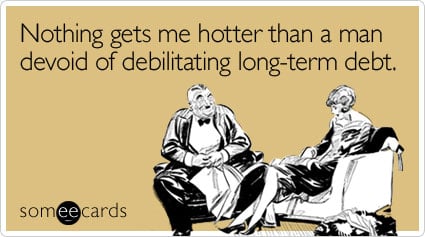
someecards.com - Nothing gets me hotter than a man devoid of debilitating long-term debt

Now you know how much debt you have, what kind of debt it is, and how you got it. Let’s get rid of it.  If you’re comfortable sharing your totals (even anonymously), joining something like the debt movement can be a great help.  There’s tools out there that can help you, like Ready for Zero.  If you want to go it alone, here’s a simple method for starting.  Go back to the list of categorized debt.  Start with the category(-ies) that are un-secured (that means they have no asset like a car or house tied to them) and start paying those off with every spare penny you have. You can sort them largest interest rate to lowest interest rate, or smallest balance to largest, or however you want, really.  Just start paying them off.  Get them taken care of, then start on the smallest of the secured (tied to assests) debts.  Rinse, recycle, reuse, repeat.

If you feel like sharing, tell us in the comments below how much debt you have.  How much have you paid off?

Filed Under: Debt Reduction, ShareMe Tagged With: debt, debt movement, debt repayment

The Debt Movement

January 2, 2013 By Shane Ede 7 Comments

I often get asked why I started this site.  And my response is always that it was a great way for me to share some of the things that I was learning as my wife and I struggled with our debt.  All of the things that we were learning through books, trial-and-error, and online that helped us, I tried to fold into some post here.  My goal in sharing these things has always been two-fold.  The first part is that I wanted someplace to record what I was learning.  The second part, and the part that keeps me writing here, is that I wanted that information to help someone else.  The more places it can be found online, the better.  I’ve always felt that it has a bit more weight when it’s coming from someone who’s lived (lives) it.  Nearly 5 years into the life of this site, we still struggle with debt sometimes.  We still have lots to learn.  Today, I’m going to share something that I think has the potential to change a lot of peoples lives.  It’s called the Debt Movement.

The Debt Movement is the brain child of Jeff Rose. Last year, he brought us the Roth IRA Movement, and the Life Insurance Movement.  Both of those were meant to bring the entire personal finance blog community together to talk about one subject on one day.  I think both went very well.  Jeff has raised the bar a bit this time around.  The Debt Movement isn’t just about educating readers on a subject.

What is the Debt Movement?

It’s a 90 day challenge.  Officially, it starts on February 1st, 2013 and will run for 90 days.  Participants, like you and me, are challenged to aggressively reduce our debt over that 90 days.  The goal is to help people payoff Ten Million dollars worth of debt in those 90 days.  It’s a lofty goal, but I think it can be done!

In addition to the challenge, Jeff has rounded up a group of sponsors who are sponsoring a Debt Movement Scholarship.  As of right now, the total is around $10,000 and is likely to grow as the movement gains speed and gathers new sponsors.  There’s an application process, as well as a few rules, but certainly something to look into.

Jeff has also partnered up with Ready For Zero.  Ready for Zero is a company that has created some pretty sweet tools for paying off debt.  Once you’ve signed up, you can enter in all of your information, along with payments, interest rates, and balances, and their software magically (or mathematically, I can never keep them straight) puts together a debt payoff schedule for you.

What do you say?  Will you come along on this journey?  Let’s pay off some debt together!

Filed Under: Debt Reduction Tagged With: debt, debt movement, debt payoff, debt repayment, jeff rose, ready for zero

Mortgage Insurance; Annoyance or Helper?

December 19, 2012 By Shane Ede 12 Comments

One of the things that I’ve learned a little bit about since we bought our house, was something that I didn’t have a clue about when we first started looking.  Heck, I didn’t even have a clue about it after we bought out house.  Mortgage insurance was just something that the mortgage officer told us we had to have, so it got added.

For a long time, I just thought it was an annoying little fee that they (the lenders) added on to the mortgage payment to squeeze a few extra dollars out of me.  In some ways, that’s correct.  Much like any other insurance, it’s really only there in the case of a real need for it.  If you don’t ever need it, it feels like you’re paying a bunch of money to someone for something you don’t need.  If you do end up needing your insurance, though, it can truly be a lifesaver.

Unlike some of the other insurances you’ll buy, mortgage insurance doesn’t really protect you.  With car insurance, or health insurance, the direct beneficiary is you.  If you get into a car accident, your car insurance will help pay for repairs, and your health insurance will help pay for medical bills. With mortgage insurance, if you need it, it’s really the lender that will benefit.  The way it works is much like any other insurance.  But, when an accident happens, and you default on your mortgage, the insurance pays off the mortgage to the lender.  It’s protection for the lender against default.

Generally, you only have to carry mortgage insurance until your loan-to-value is below 80%.  Come up with 20% down payment, and you won’t even see it.  Some lenders will automatically take it off of the mortgage once you fall below that 80% LTV, others won’t, so you need to keep an eye on the loan and make sure that it’s being removed when it should.  Most first time home-buyers will have some form of mortgage insurance on their loan.

Is mortgage insurance an annoyance or a helper?  I think it’s a little bit of both.  You’re buying insurance which only benefits you in that it may allow you to pay a lower down payment than normal.  It’ll mean that you don’t get the mortgage paid off as quickly as well since you’ll not only start with a larger loan, but have a chunk of your monthly payment siphoned off.  It also helps in that it does help you get a loan with a lower down payment because it assures the lender that the mortgage will be made good should you default.

Do you have mortgage insurance on your mortgage?  Do you think it’s more of an annoyance or a helper?

Filed Under: Home, Insurance, loans, ShareMe

  • « Previous Page
  • 1
  • …
  • 214
  • 215
  • 216
  • 217
  • 218
  • …
  • 320
  • Next Page »
  • Facebook
  • Pinterest
  • RSS
  • Twitter

Improve Your Credit Score

Money Blogs

  • Budget and the Bees
  • Celebrating Financial Freedom
  • Christian PF
  • Clever Dude
  • Dual Income No Kids
  • Everybody Loves Your Money
  • Financial Panther
  • Gajizmo.com
  • Grocery Coupon Guide
  • Lazy Man and Money
  • Make Money Your Way
  • Money Talks News
  • Personal Profitability
  • PF Blogs
  • Reach Financial Independence
  • Saving Advice
  • The Savvy Scot
  • Yes, I am Cheap

Categories

Disclaimer

Please note that Beating Broke has financial relationships with some of the merchants mentioned here. Beating Broke may be compensated if consumers choose to utilize the links located throughout the content on this site and generate sales for the said merchant.

Visit Our Advertisers

Need to change careers? Consider an Accounting Certificate Program from WTI.
  • Home
  • About
  • We Recommend
  • Contact
  • Our Editorial Commitment