Beating Broke

Personal Finance from the Broke Perspective

  • Home
  • About
  • We Recommend
  • Contact
  • Privacy Policy

Powered by Genesis

Search Results for: budget

Knowing Your Debt is Key to Paying Off Your Debt

January 4, 2013 By Shane Ede 7 Comments

Any good anti-debt blogger (like me!) will be able to tell you all kinds of ways to pay off your debt.  There’s methods, and tips, and even a certain way to hold your nose. Ok, maybe I’m kidding about that tips bit.  Or is it the nose part?  I’m confused.  Seriously though.  There’s a debt snowball, made famous by Dave Ramsey, then a debt avalanche, then a debt blizzard, and so on.

But, the one key thing that you absolutely have to have if you want to pay off your debt is knowing your debt.  You’ve got to know the number, the type, and even the method of your debt.  If you want to overcome your debt, you’ve got to know it inside and out, upside and down.

How Much Debt

Just how much debt do you really have?  If you’ve do a budget regularly, (if not, start) take the time to write down how much you owe to everything you make a payment to.  Keep in in a spreadsheet and update it periodically.  Put a big bold total across the bottom.  Is it a high number?  Use that as motivation to pay it down.  Is it a low number?  Use that as motivation to finally get rid of it all!  Watch the total get smaller and smaller.  (If you’re an spreadsheet junkie, create a line graph for the total!)

What Kind of Debt

There’s a common argument over whether there is any such thing as good debt, or if it’s all bad debt.  I happen to think that argument is a little too black and white and that it really depends on your situation.  If you know how much debt you have (see above), now you can categorize it.  This really isn’t as hard or as complicated as it sounds.  We’re talking simple categorization here.  Is the debt on a credit card?  It’s credit card debt.  A mortgage?  Mortgage debt.  Car loan?  Car debt.  Put them all in a category, and total the categories.

How Did you Get Your Debt

This is going to sound silly, but now take a hard look at your debt and decide how you got it.  Some of it will be obvious.  You got that mortgage debt by buying a house.  The car loan by buying a car.  But, I also want you to go a bit further.  Did you buy that car (or the house) because you absolutely needed a car?  Or did you buy it because you had gotten bored with the old one?  Categorizing your credit cards this way will be a little harder.  It might be easiest to go through old statements and look at purchases.  What are those purchases?  If you’re buying groceries and other small priced consumables on your credit card, but not paying those charges off right away, that’s a good sign that you have a problem.  Determine why you’re spending the way you are, then find a way to fix it.

Now, Get Rid of Your Debt
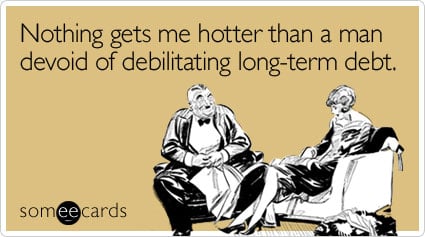
someecards.com - Nothing gets me hotter than a man devoid of debilitating long-term debt

Now you know how much debt you have, what kind of debt it is, and how you got it. Let’s get rid of it.  If you’re comfortable sharing your totals (even anonymously), joining something like the debt movement can be a great help.  There’s tools out there that can help you, like Ready for Zero.  If you want to go it alone, here’s a simple method for starting.  Go back to the list of categorized debt.  Start with the category(-ies) that are un-secured (that means they have no asset like a car or house tied to them) and start paying those off with every spare penny you have. You can sort them largest interest rate to lowest interest rate, or smallest balance to largest, or however you want, really.  Just start paying them off.  Get them taken care of, then start on the smallest of the secured (tied to assests) debts.  Rinse, recycle, reuse, repeat.

If you feel like sharing, tell us in the comments below how much debt you have.  How much have you paid off?
Filed Under: Debt Reduction, ShareMe Tagged With: debt, debt movement, debt repayment

How Much Car Insurance Coverage Do You Need?

December 8, 2012 By Shane Ede 8 Comments

Car insurance, like most insurances, can seem complicated.  Deciding just how much car insurance coverage you need is the biggest hurdle.  Of course, it’s easy to select the coverage that meets the requirements of your state and the lien holder (of you owe on a loan for the car, you’ve got a lien holder, and it’s likely the bank you borrowed from), but those aren’t the only factors to take into account when deciding on how much coverage you need. Using a free online service can quickly find cheap auto insurance companies and shows multiple competitive policies.  In the end, you’ve got to find a coverage that will meet those requirements, and also fit within your budget.

State Requirements

You’ll want to know what the state requires you to have for insurance.  Any local insurance provider should be able to tell you, but you’ll want to double check if you’re planning on using an out of state or online provider.  If you still owe on your car, the lender on your loan will likely require that you have full coverage, so the state minimums will likely only come into play if you own the car you’ll be insuring.

Lien Holder Requirements

If you owe on your car, you’ve got a lien holder.  The lien holder is whomever you borrowed the money from.  Most (if not all) lenders will require that you carry full coverage insurance on the car.  It has nothing to do with them wanting to make sure you’re safe, and all to do with making sure that should you get in an accident, that they’ll get some of their money for the loan.  While most lien holders won’t require a certain level of insurance (over full coverage), it is a good idea to find out what they require just to make sure that you’re getting the coverage that you need.

Deciding on Coverage Levels

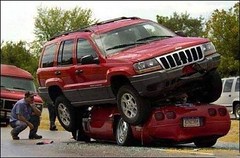
Car AccidentOnce you know the requirements of the state and any lien holders, you’ve got to decide on the level of car insurance coverage you want.  There are two ways to look at this.  The first is that you’ve got to find a coverage and provider that is affordable enough to fit into your budget.  The second is usually the forgotten way of looking at insurance.  The coverage doesn’t just have to fit into your budget, it also needs to cover you against a total loss.  If you have full coverage, but it’s only enough to cover a portion of what you owe on the car, you’ll also want to look at something that’s usually called “Gap Insurance”.  Gap insurance is aptly named in that it is designed to cover any gap between the value of the car and the remaining loan should the car be totaled before you pay it off.  Car insurance can be a combination of three coverages.  A liability coverage (usually what States require), Comp & Collision, and personal injury.  The exact levels that you need will vary based on your situation, but your insurance provider should be able to make recommendations for you.

How Much Deductible for Car Insurance

One of the easiest ways to lower the monthly cost of your car insurance coverage is to raise the deductible on your policy.  This method is a bit of a double-edged sword, however.  Raise it too high, and you might not be able to afford to have the car fixed.  Or, anything short of a major collision may fall under the amount of the deductible.  Again, your insurance provider should be able to help you compare the different deductible levels and help you find one that fits your budget without breaking you if you get in an accident.

The level of coverage that you need is going to be drastically different based on your own individual situation.  Do you own your car, or owe on your car?  Do you have sufficient savings to cover a higher deductible in an emergency?  What are the requirements of your state and any lien holders?  Make sure you know all that information before you go looking for car insurance, and remember to double check any suggestions by an insurance provider.  We’d all like to think that they are all honest, but not all of them are.  Knowing at least a little about what you’re talking about, and the information required to ask informed questions is a huge step towards not getting taken advantage of.

How much do you know about car insurance?  How much have you learned since the first time you bought insurance?

img credit:stupid.fotos on Flickr.

Filed Under: budget, Cars, Insurance, ShareMe Tagged With: car insurance, car insurance coverage, car loans, Insurance, loans

A Review of Dave Ramsey’s Revised Financial Peace University & New Speakers

December 3, 2012 By MelissaB 3 Comments

Dave Ramsey has changed thousands, if not millions, of lives with his Financial Peace University.  Now, he is looking to improve on that formula with the newly revised Financial Peace University.  While this latest version of Financial Peace University has all of the benefits of the old version, some of the material has been changed, and there are new speakers added to the mix.


The revised Financial Peace University kit includes a workbook; Ramsey’s book, The Complete Guide to Money; a welcome guide that includes a pencil, sharpener, and eraser;  an envelope system; a laminated Financial Peace University Progress Chart; a folder for Financial Peace forms; and most importantly, 10 audio CDs containing Ramsey’s lessons.

The 10 audio CDs cover the following topics:

CD #1:  Super Saving:  Common Sense for Your Dollars and Cents

CD #2:  Relating with Money:  Nerds and Free Spirits Unite!

CD #3:  Cash Flow Planning:  the Nuts and Bolts of Budgeting

CD #4:  Dumping Debt:  Breaking the Chains of Debt

CD #5:  Buyer Beware:  The Power of Marketing on Your Buying Decisions

CD #6:  The Role of Insurance:  Protecting Your Health, Family and Finances

CD #7:  Retirement and College Planning:  Mastering the Alphabet Soup of Investing

CD #8:  Real Estate and Mortgages:  Keeping the American Dream from Becoming a Nightmare

CD #9:  The Great Misunderstanding:  Unleashing the Power of Generous Giving

CD #10:  Dave’s Story:  Learn How Dave Found the Peace He Was Missing


There are three major changes I noticed in the newly revised Financial Peace University.

1.  The course has been shortened from 13 weeks to 9 weeks.  Some may say that this time frame is too short, but I think it is great.  Ramsey is such a motivational speaker, that after hearing him speak for one class people are fired up and ready to get their finances in order.  Shortening the course to 9 weeks allows them to make quicker progress and begin working on their financial situation sooner.

2.  Content that wasn’t relevant to everyone has been moved to the website.  Some content, while useful to those in a particular situation, isn’t applicable to the majority of people.  For instance, Ramsey skillfully explained exactly how to deal with harassing bill collectors in the original Financial Peace University, and that information is essential to those in that situation.  However, since the majority of FPU participants are not in that desperate situation, that content has been moved to the website.

3.  Ramsey has brought in three new speakers–Rachael Cruze (Ramsey’s daughter), Jon Acuff and Chris Hogan.  Fans of Ramsey will probably have mixed feelings about these new additions.

Rachael Cruze has the hardest job.  Ramsey is a dynamic motivational speaker who makes his job seem effortless.  People will naturally expect the same of his child.  In reality, Cruze is young and new at this business.  She is definitely not as polished as her famous father, though truthfully very few people are.  However, she offers the voice of a person who has been raised following Dave Ramsey’s principles and hearing her success is encouraging.

Jon Acuff shares Ramsey’s sense of humor, but his jokes don’t go over quite as well.  However, his tips on negotiation are good, and readers can definitely learn from him.  A few more years of working with Ramsey, and he will have the natural, relaxed attitude as Ramsey does.

Chris Hogan is the most charismatic new addition.  While he is not Dave Ramsey, he is a natural public speaker.  He gives important information about buying a home, but his lessons are peppered with humor that naturally engage the listener.

My husband and I both listened to the CDs, and I didn’t mind the addition of the new speakers and know that Ramsey is probably adding them to prepare to eventually hand over his dynasty.  However, my husband did not like the new additions and felt that most of the speakers were simply reiterating what Ramsey always says.

Overall, Dave Ramsey’s newly revised Financial Peace University is an improvement on the first version and can inspire participants to pay off debt and improve their financial situation once and for all.


Filed Under: budget, Debt Reduction, Education, Personal Finance Education Tagged With: dave ramsey, financial peace university, ramsey, total money makeover

  • « Previous Page
  • 1
  • …
  • 150
  • 151
  • 152
  • 153
  • 154
  • …
  • 175
  • Next Page »
  • Facebook
  • Pinterest
  • RSS
  • Twitter

Improve Your Credit Score

Money Blogs

  • Celebrating Financial Freedom
  • Christian PF
  • Dual Income No Kids
  • Financial Panther
  • Gajizmo.com
  • Lazy Man and Money
  • Make Money Your Way
  • Money Talks News
  • My Personal Finance Journey
  • Personal Profitability
  • PF Blogs
  • Reach Financial Independence
  • So Over Debt
  • The Savvy Scot
  • Yes, I am Cheap

Categories

Disclaimer

Please note that Beating Broke has financial relationships with some of the merchants mentioned here. Beating Broke may be compensated if consumers choose to utilize the links located throughout the content on this site and generate sales for the said merchant.

Visit Our Advertisers

Need to change careers? Consider an Accounting Certificate Program from WTI.