As part of my foray into container gardening this year, I decided that it would be fun to try my hand at growing some potatoes. I’d done a fair amount of reading, and it seemed like growing potatoes in containers was pretty workable. I’d seen several examples of people growing them in old tires stacked 4 high, fencing towers stuffed with straw, and some much more elaborate wood sided towers that allowed for taking the bottom rung off and pulling potatoes out from under the plant.
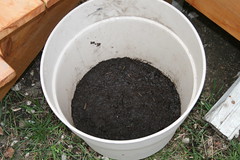
The re-purposed container that we already had, potatoes already planted.
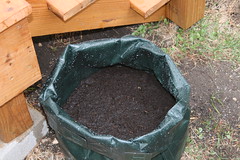
When it came time to plant my potatoes, I decided that for the first time around, I’d just use one of the larger containers that I already had laying around the yard. I’d previously used it to try and grow some flowers in, and while those turned out fine, some produce would be even better. I also found and picked up another container that I wanted to give a try with potatoes. It’s a bag made specifically for growing potatoes in, called, wait for it, Potato Planter. It’s kind of cool though. It’s made out of the same material that those blue tarps are made out of, and is designed with a velcro flap near the bottom of the bag to allow for you to open the bag and pull some potatoes out of the bottom while letting the rest of the potatoes grow near the top.
So, armed with my containers and a couple of bags of topsoil, I set about planting some potatoes!
After the plants have flowered, and the plant itself starts to yellow and die off, give the potatoes about a week to two weeks to mature, then harvest them. (This step and the ones following are purely from my research, and not from experience yet. I could be way off!)
When you harvest the potatoes, set them out in a warm, dry place to dry. This is supposed to allow the skins to harden up a bit for better storage. (One downside here is that the second the potato gets to a harvested state, the natural sugars in the potato begin converting to starch. I’ll be trying a few fresh from the ground and some that have been “hardened” and see how much of a difference there is.)
Repeat next year!
So far, I’ve gotten as far as planting, and adding soil to the potato containers. I’ve got one more batch of soil to add to the containers to fill them up with soil, then it’s just a waiting game as the plants grow potatoes and I wait for harvest time. This year is a bit of an experiment, as it’s our first year of dedicated container gardening, as well as the first time I’ve ever grown potatoes. Rather than add too many variables to the mix, I just planted some seed potatoes that I got from our local grocery store. If I recall, they were the Red Pontiac variety.
Next year, should this year be a success (and it’s looking like it will be), I would like to order some seed potatoes of different varieties. In particular, some purple potatoes. Mostly, just because I think they look cool! I’d like to try a few of the heritage/organic varieties too, and see if there’s much of a difference.
Have any of you ever successfully grown potatoes in your gardens or in containers? Got any hints or tips for me? Suggestions for varieties to grow next year?
Shane Ede is a business teacher and personal finance blogger. He holds dual Bachelors degrees in education and computer sciences, as well as a Masters Degree in educational technology. Shane is passionate about personal finance, literacy and helping others master their money. When he isn’t enjoying live music, Shane likes spending time with family, barbeque and meteorology.
There are many people around the country that seem to think that Ramit Sethi is the worlds answer to their financial problems. If you aren’t familiar with Ramit and his platform, it’s a platform that is based off of a no-nonsense mantra. Instead of pushing people to count their lattes and create budgets, he pushes them to find ways to make more money. He does that through several classes, groups, and even a book. In a way, he’s the polar opposite of Dave Ramsey. Full of ego, and unabashed vigor for his product, he’s unafraid to let someone know when he has no use for them, or to tell them to get lost because they aren’t the readers he wants. There’s nothing wrong with that, really. He knows who he’s most likely to help, and knows that he’s unlikely to offend any of them with his ranting.
Earlier this week, he posted his Big Wins Manifesto. I’ll warn you now, it’s a manifesto, which apparently means that it needs to be fairly long. Like most of what Ramit writes, this manifesto grates at me. First, he starts off by comparing two fellows who are trying to get themselves a better financial life. The first, “John”, is his example of someone trying to improve his financial life by way of budgets, latte reductions, and penny pinching.
John, 28, earns $62,000/year as a project manager. He used to have $8,200 in credit card debt from overspending, but he’s been slowly paying it down over the last two years and now it’s at $6,400. How? He tried all the typical personal-finance advice: He set up a budget, he tried to cut back on his daily lattes, and he made sure to make a list of goals he wanted to achieve. Yet last week, he took an honest look at his life and realized he’s still treading water. Despite paying off part of his debt, he still has years ahead of being in debt — plus no real savings, no investment, and something always comes up, causing him to yo-yo back and forth on his goals.
Are you kidding me? The dude makes $62,000 a year and only managed to reduce his credit debt by $1800 in 2 years?!? That’s barely the minimum payment. If that’s the best you can do on $62,000 a year, you aren’t even trying. And, Ramit? That’s one of the worst examples you’ve ever used. I understand you’re using some psychological sales pitch or whatever, but at least make it realistic. Seriously? You’re trying to tell us that the dude used a budget, cut his lattes, set goals, and he only managed to reduce his debt by $75 a month? That’s got to be the most self-destructive example you could come up with.
Then, his counter example.
Chris, 32, earns approximately $120,000. Four years ago, Chris was making about $60,000/year but he was barely getting by — he had $50,000 of student-loan debt and, most days, would eat the free snack bars at his office instead of buying lunch. Yet within 4 years, Chris paid off $50,000 of debt, amassed a savings account of tens of thousands of dollars, and more than doubled his salary. To do this, he set up automated systems to pay off his debt. He turned his skills into a side income to earn over $1,000/month on the side. He knew he was slightly socially awkward, so he spent time joining courses to improve his social skills and ended up negotiating multiple salary increases — including over a $50,000 raise two months ago.
Chris is the MAN! Can you believe he paid off all of that debt, and increased his income by that much!?! OMG! It gets better though. As you can guess, Ramit would have you believe that Chris did all of that while doing actions that he prescribes in his book, or any of his programs. The funny thing, in both examples, is that Ramit never once talks about anything other than the people’s financial situation. Here’s John, his financial situation, and how terrible he did at setting a budget and sticking to his new spending habits. Here’s Chris, his financial situation, and how AWESOME he did when he followed Ramit’s teachings! But, when you really get down to it, Chris worked his butt off, both in his full-time job, but also in a side job (the $1000/month on the side), and then spent time taking courses to improve his social skills. How ambitious. Parts of me wonder how much free time he found himself with during that time. Or how much he finds himself with now that he’s successfully negotiated multiple salary increases. Can anyone give me an example of any place that would give you a $50,000 a year raise where your responsibilities at work wouldn’t increase at least on the same scale? I’ve got news for you. Nobody is going to pay you twice as much to do the same amount of work. They’ll just fire you and hire John instead. But, hey, if you’re only objective is to make a ton of money so you can say you have a ton of money, then by all means, follow Chris in his journey.
But, the manifesto isn’t about the life quality. It’s about “BIG WINS”! It’s about making changes that produce results, now! By far, the best part is towards the end.
Next time you hear the same old tired advice of keeping a budget, or cutting back on $2 lattes, ask yourself: Has that really worked for the millions of people who’ve tried it? Are they really not “trying hard enough”? Or is there perhaps a systemic problem urging people to waste their limited cognition on near-meaningless tasks with little reward…and should we instead focus them on high-leverage areas that will result in massive payoffs?
Define reward, Ramit. Also, while I’m sure you can find plenty of people for whom a budget and cutting back on lattes hasn’t worked, you can also find plenty that it has worked for. Many of whom are the experts that you so easily scoff at for suggesting others do the same.
Now, I’ll be plain, I’m not Ramit’s target audience. I’m in my early 30’s, with a family, a house, and a dog. I choose those things over the freedom to be as mobile as I would have to be to take advantage of most any of the methods that Ramit professes. I choose to have quality time with my family over working the hours it would take to negotiate anything resembling a significant raise. I don’t let money have that kind of control over me. If it has that kind of control over you, I suggest you think twice about that. Money has plenty of use, but not at the expense of the quality of life that I desire. Further, Ramit likes to paint the picture in black and white. He rails against budgets, cutting back on lattes, and basically any of the advice that doesn’t fit into his “Big Wins” philosophy. Just like the rest of the world, the world of personal finance isn’t black and white. What works for you, might not work for me, and what works for me, might not work for you. And, what works for Ramit doesn’t work for me.
Here’s the bottom line, folks. A budget, cutting back on lattes, and pinching pennies can, and does, work. It isn’t instant. It takes hard work and dedication. The same hard work, and dedication that anything that Ramit teaches does. In fact, I’d say a combination of the two is likely a good solution. But, to write off one for the other is very much like saying that a bicycle won’t get you the same place as a motorcycle. They both go the same places, it’s just that the method, effort, and reward are slightly different.
Shane Ede is a business teacher and personal finance blogger. He holds dual Bachelors degrees in education and computer sciences, as well as a Masters Degree in educational technology. Shane is passionate about personal finance, literacy and helping others master their money. When he isn’t enjoying live music, Shane likes spending time with family, barbeque and meteorology.
Ah, summertime. If you are a foodie, summertime brings so many food joys—fresh, ripe strawberries, juicy blueberries, crunchy asparagus. There are many food delights that are available in summer that aren’t available for most of the country for most of the year.
Sure, you can buy strawberries shipped in from a foreign country in January, but they are often devoid of taste and don’t taste nearly as good as those you can buy in June near your home.
Since there are likely farmers in your area who grow the seasonal produce you crave, why not take a trip out to the farm to pick some of the produce on your own? Taking such a trip is a great way to spend time together as a family, plus you benefit both nutritionally and financially. Not only will you get to enjoy produce at the peak of ripeness, but you will also likely save substantially by buying at the farm. An added bonus is that your kids will more likely enjoy eating the produce and learning how it grows.
We recently went as a family to an organic strawberry farm near our home. None of us had ever picked strawberries before, and we didn’t know that strawberries got there name from the straw surrounding the berries so they don’t sit on the ground but the straw instead. We picked 7.5 pounds, bought 10 pounds and bought another 27 pounds of seconds (berries not pretty enough to sell for the full asking price). We spent approximately $91 for our haul (about $2.00 a pound which is a great price for organic strawberries), and froze 4 large bags of strawberries and made 21 pints of jam. The kids still talk about the experience, and now they are more educated about how strawberries grow (as are we).
If you would like to look for a farm in your area, try localharvest.org for organic farmers or farmvisit.com. If you use farmvisit.com, you can choose between organic and conventional farmers.
If you do not regularly visit farms to pick your fruits and veggies, here are some tips:
Call the farm ahead of time. The farmer can let you know picking conditions as well as when the busiest times are and the quietest times. We always try to plan our visits around the quiet times because it is easier with small kids.
Bring your own containers. Farmers may have large containers for you to take your produce home in, but you will usually have to pay for them. Bring your own containers instead and save the money. Use cardboard boxes or even large pots and pans.
Bring plenty of water and sunscreen. Picking produce makes you hot, so bring plenty of water as well as sunscreen to prevent a burn.
Bring a lunch. If you will be picking for awhile or will have a drive a distance to get out to the farm, bring your lunch with you so you can have a picnic or eat while traveling.
Wear appropriate shoes and clothes. Tennis shoes are usually best, and wear sloppy clothes because you will probably get dirty.
Have a plan for what to do with your produce. Decide ahead of time if you will only pick enough to eat right away or if you plan to preserve some of it by freezing or canning it. If you are canning it, going to the farm is just the first step to a long (but worthwhile) day of picking and preserving.
A trip to the farm can be a great experience for your kids and save you money on fresh produce picked at the peak of ripeness. If you go a step further and freeze or can some of the produce you pick, you can enjoy local fruit at a great price all year long, straight from your stockpile.
Melissa is a writer and virtual assistant. She earned her Master’s from Southern Illinois University, and her Bachelor’s in English from the University of Michigan. When she’s not working, you can find her homeschooling her kids, reading a good book, or cooking. She resides in New York, where she loves the natural beauty of the area.