Beating Broke

Personal Finance from the Broke Perspective

  • Home
  • About
  • We Recommend
  • Contact
  • Our Editorial Commitment

Powered by Genesis

Escrow Accounts: A DIY Primer

May 17, 2010 By Shane Ede 2 Comments

Quick!  What’s the first thing that pops into your head when I say “escrow account”?  It’s that account that’s associated with your mortgage, isn’t it.  That’s the first thing that come to me when I hear the word.  But, that isn’t all that an escrow account is.

At it’s very basic beginnings, an escrow account is nothing more than a savings account.  Of course, the usage of the money in that savings account is designated.  So, it’s a designated funds savings account.  Simple.  More commonly, it’s used in conjunction with a mortgage.  The escrow account that is tied to a mortgage usually holds the funds designated for taxes, insurance, and other non-monthly fees.  Each mortgage payment you make has a small portion of it that gets deposited into the escrow account.  At the end of the year, that account has enough money in it to pay your property taxes, and any other things that the funds are set aside for, such as homeowners insurance.  Yet another use is in the execution of a large purchase.  Say you’re buying a car on eBay.  You want to make sure that you’re not getting taken.  So, you use an escrow account.  You put the money for the purchase into an escrow account, and the buyer gives you the car.  Once you’ve confirmed that the car is what it was supposed to be, you can release the funds in the escrow account and the buyer is free to withdraw them.

What does all this have to do with you?  You can use escrow accounts in your personal finance as well.  Remember that an escrow account is really just a savings account where the funds are designated.  Many of you probably already have one of those.  If you’re particularly saving savvy, you likely have several.

Here’s what you need.  A goal, and a savings account.  Let’s start with a goal.  I’ll pick tires for the car.  You know you’ll need to buy some in about 6 months.  You know they’ll cost you a little less than $600.  If you had to come up with that all at once, you’d be flat broke.  In fact, some of you would just throw it on a credit card.  (I used to too, I understand.)  Instead, let’s set up an escrow savings account for it.  Get yourself a savings account.  Many banks and credit unions have them.  Many of them will allow you to give them nicknames.  If you’re bank or credit union allows nicknames, name it Tires.

All set?  Ok.  We know we need $600 in 6 months to purchase tires.  So, we take the $600 and divide it into 6 equal amounts.  (I’m no math genius, which is why I’ve got some simple numbers here.)  We end up with an amount of $100.  Each month, deposit $100 into the savings account, Tires.  At the end of the 6 months, you’ll have $600 in the account.  You can then purchase the tires with CASH!  How awesome is that?  And, if you’re any good at bargaining, you might end up with a deal when you start waving around all those benjamins.

You can apply the same principle to just about any planned purchase.  And it’s repeatable.  If you know you’ll need more tires in 6 months, you can just repeat and continue on with the escrow account.  I used to think that escrow accounts were these fancy, complicated accounts.  But, in reality, all they are is a savings account with funds that are designated for something.  There is one small difference in that usually, the money is out of your control after you deposit it and until it’s released for use.  You could replicate that, if you have a family member or very close friend that you trust that could be the controlling account holder.  If you’re even slightly afraid that they might run off with your money, though, you might just have to have some self control and do the account control yourself.

Shane Ede

Shane Ede is a business teacher and personal finance blogger.  He holds dual Bachelors degrees in education and computer sciences, as well as a Masters Degree in educational technology.  Shane is passionate about personal finance, literacy and helping others master their money.  When he isn’t enjoying live music, Shane likes spending time with family, barbeque and meteorology.
www.beatingbroke.com

Filed Under: General Finance, Personal Finance Education, Saving, ShareMe Tagged With: diy, ebay, escrow, escrow accounts, mortgages

Picking Yourself Back Up Again

May 5, 2010 By Shane Ede 5 Comments

Inevitably, you’re going to screw up.  You’re going to make a mistake and it’s gonna cost you.  If you’re lucky, it’s only going to cost you a few dollars or a bit of bruised pride.  If you’re not so lucky, it could cost you much more than that.

Let me tell you a little secret.  We’ve all been there.  In all likelihood, we’ll all be there again.  But, some of us will get back up, dust ourselves off, and get back to doing what it was we were doing in the first place.  The rest will sit on the ground where they landed, beaten and broken, and never get back up.  They’ve given up.  The world got the best of them, and they have lost the will to try again.

Getting back up isn’t the hard part.  Gathering the will to get back up is.

None of us who have fallen and gotten back up have any greater aptitude for it than anyone else.  Sure, we may be better at some things than other people, but when we fail, we are all the same.  Here’s a little bit more of a secret.  Some of us are better prepared for the fall.   We’ve done what we can to soften the blow, not because it’s inevitable, but because it could happen.  Think of it this way; you don’t buy health insurance because your sick, (well most don’t) you buy it in case you get sick.  You don’t wear a helmet while bicycling because you know you’re going to fall, you wear it in case you do fall.  Sometimes situations are out of our control.  We certainly don’t choose to get sick.  And we don’t choose to fall off of our bikes on to the hard concrete below.  But, sometimes it happens.  And the better prepared you are for it, the easier it is to get back up and get going.

An example.

Many years ago (something like 7), I drove a old pickup (older than I am).  One particularly cold day, then engine refused to start.  It refused to start the next day despite having a charger on it and attempts to pull start it.  I couldn’t go without a car, so what was I to do?  I had no savings, and no means of coming up with any extra money.  I had fallen.  In order to get myself up and out of the hole I had dug, I was forced to take on a massive (for me at the time) car loan on a used car.  The bank wouldn’t finance much without a down payment, so I took what I could get.  It was a terribly low spot for me, financially.  I went from having no car payment at all, to having a car payment of a little under $200 a month.  I could afford it, but just barely.  If anything had happened to my income or if an emergency of some sort had arisen, I would have fallen that much farther (and harder).  To be honest, I didn’t learn all that much from that particular episode.  But, I did get back up and back on the road.

A week or so ago, my car sprung an oil leak.  The repair wasn’t horribly expensive (only about $150), but enough that it could have been very damaging if I had been in the same situation as I was before.  But, I’m not.  I’m prepared.  I have a small emergency fund that can easily cover an expense of that magnitude.  The fall wasn’t nearly as bad.  It wasn’t as bad of a situation as it was before, either.  But, because I had prepared, the fall was very short and I was able to recover quickly.  In fact, it was less of a fall than it was just a little bump.

Preparing for an emergency isn’t a bad thing.  It doesn’t mean that you are expecting to have an emergency any more than having health insurance means you’re expecting to get sick, or wearing a bike helmet means you’re expecting to fall.  But it cushions you against the fall.  Getting sick is less stressful if you have insurance that you know will pick up part of the bill.  You’ll have less road rash if you’re wearing a helmet.  And, if you have an emergency fund, more falls will become bumps.

Do yourself the favor.  Prepare now, so that when you do fall, you’ve got some cushioning to land on.

Shane Ede

Shane Ede is a business teacher and personal finance blogger.  He holds dual Bachelors degrees in education and computer sciences, as well as a Masters Degree in educational technology.  Shane is passionate about personal finance, literacy and helping others master their money.  When he isn’t enjoying live music, Shane likes spending time with family, barbeque and meteorology.

www.beatingbroke.com

Filed Under: Emergency Fund, Financial Truths, Saving, The Beating Broke Story Tagged With: car loan, emergency, emergency fund, oil leak, used car

The Great Kitchen Remodel

April 28, 2010 By Shane Ede 11 Comments

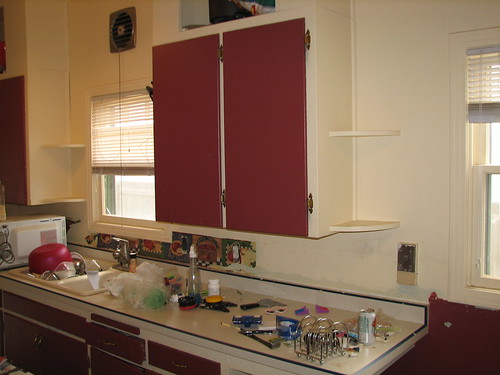
As I mentioned before, part of what were doing with our tax refund is to remodel our kitchen.  Our kitchen was in a bit of rough shape, as some of it was likely original to when the house was built in 1950.  The linoleum had been added, as had the carpet and the counter-top, but there was little evidence that anything else had been upgraded in 60 years.  I don’t know about you, but that just screams for updating.  We’d put up with it for almost 6 years, and it was one of the “must do” items on our list of things that had to be done in order for us to eventually sell the house and upgrade to something a bit bigger.  When the opportunity came in the form of our tax refund, we felt that it was a justifiable usage of the money. Here, I’ll let the picture speak for me.  That’s all the old stuff.  Built in place.  The doors on the cabinets had been painted so many times (I counted 6 layers of paint) that they wouldn’t close.  The drawers had the same issue, except that they rubbed on their cases and dropped dust from that rubbing onto all of the pans and such that were in the lower cabinets.

Old Kitchen

Could we have lived with that for a couple of more years?  Probably.  But there’s a limit where saving, budgeting, and repaying debt become a true detriment to your happiness.  When you reach that limit, you can become truly miserable.  We could have used the money we spent on the kitchen on debt repayment.  That would have felt good, but not nearly as good as it is to not have that kitchen any more!  So, that just about covers the why of our kitchen remodel.  Let’s move on to the how.

We didn’t (obviously) want to spend a whole lot of money on the kitchen, but just merely update it.  We hit the not-so-local (100 miles) Menard’s and went about ordering the pieces for delivery.  Also, we managed to squeeze in a dishwasher that was on clearance.  It wasn’t really part of the original plan, but it was actually cheaper than the cabinet that would have had to go where it went.

Here’s how the cost on that broke down.

  • Cabinets: ~$1700 (They are the budget models, but have solid Oak facing and doors and look quite nice.)
  • Dishwasher: ~$180 (again, it was on clearance and was the last one they had.)
  • Flooring: ~$450 (laminate that was on sale to replace the chipping linoleum and stained carpet.)
  • Delivery: ~$180 (it’s a long ways, and it wouldn’t fit in our car.)

All told, that first trip cost us a shade over $2300.  I didn’t go out and compare, but I think that’s a pretty good deal.  Once all the parts and pieces were delivered, my dad came out to help out over a long weekend.  He lives about 950 miles away, so it was quite the trek for him.  And I must admit, the remodel would have likely turned into a small disaster had he not came.  He’s a contractor, so he’s done a few of these before. And there were a few unforeseen issues that would have caused me a huge problem without the knowledge and help.

In the end, the four day weekend turned into a 5 day weekend.  It was more like a 5 day workweek, but with far more physical labor than I normally do.  But, it got done.   There’s only a little bit of trim that I’ve got to put up, and it will be 100% finished.  I’m hoping that I can find the parts for that here in town this weekend and get that wrapped up.

And now, for the grand unveiling!  Here, in all it’s splendor, is our new kitchen.

New Kitchen

What do you think?  Quite the change, isn’t it?  After it was all said and done, we added around $600 more to the bill with odds and ends that we needed throughout making the total bill come in at around $2900.  Of course, if we had had to pay for labor, it would have significantly raised the costs.  Yet another reason to at least try DIY.  You’ve got to know your limits of course.  I got lucky and my dad was able to come help, otherwise this would have easily turned into an example of what happens when you don’t know your limits.  But, it didn’t.  We’re extremely happy with the way it turned out and even though the space is still very small, the luxury of the new cabinets and drawers along with the dishwasher makes it all seem just a tad bigger.

Side note: While my dad was here, he was telling us a story about a remodel he recently worked on where the kitchen alone came in at about $100k.  Incredible.  The client put in solid granite counter-tops that cost $20k!  Even if I won the lottery, I don’t think I could bring myself to spend that much money on something like that.

Shane Ede

Shane Ede is a business teacher and personal finance blogger.  He holds dual Bachelors degrees in education and computer sciences, as well as a Masters Degree in educational technology.  Shane is passionate about personal finance, literacy and helping others master their money.  When he isn’t enjoying live music, Shane likes spending time with family, barbeque and meteorology.

www.beatingbroke.com

Filed Under: Frugality, Home, Saving, Taxes Tagged With: diy, diy kitchen, diy kitchen remodel, frugal kitchen, frugal remodel, kitchen, remodel

  • « Previous Page
  • 1
  • …
  • 81
  • 82
  • 83
  • 84
  • 85
  • …
  • 92
  • Next Page »
  • Facebook
  • Pinterest
  • RSS
  • Twitter

Improve Your Credit Score

Money Blogs

  • Celebrating Financial Freedom
  • Christian PF
  • Dual Income No Kids
  • Financial Panther
  • Gajizmo.com
  • Lazy Man and Money
  • Make Money Your Way
  • Money Talks News
  • My Personal Finance Journey
  • Personal Profitability
  • PF Blogs
  • Reach Financial Independence
  • So Over Debt
  • The Savvy Scot
  • Yes, I am Cheap

Categories

Disclaimer

Please note that Beating Broke has financial relationships with some of the merchants mentioned here. Beating Broke may be compensated if consumers choose to utilize the links located throughout the content on this site and generate sales for the said merchant.

Visit Our Advertisers

Need to change careers? Consider an Accounting Certificate Program from WTI.