Beating Broke

Personal Finance from the Broke Perspective

  • Home
  • About
  • We Recommend
  • Contact
  • Privacy Policy

Powered by Genesis

The Smell of Napalm

November 13, 2013 By Shane Ede 12 Comments

Napalm is a sticky, flammable substance that was invented in the 40’s, and used in several wars.  Because of it’s stickiness, it attaches itself to everything, then burns at somewhere over 800 degrees.  When it’s done, there’s no more jungle.  No more enemies walking around.  It’s vile enough, that it’s use on concentrations of civilians was declared a war crime by the UN in 1980.

By now, you’re probably wondering why a site about personal finance is discussing Napalm. Well.  Here’s the thing.  Debt is a funny thing.  Most of us have it.  Some of us have quite a bit.  And most of us would like to get rid of it.  In fact, most of us would just love to Napalm our debt.  One fell swoop.  Drop some sticky burning substance on it and have it gone in a few short minutes.  We’d like that so much that we buy lottery tickets, raffle tickets, and buy books and products that promise some get rich quick scheme.  People with debt are always looking for the debt Napalm.

We like to fantasize about what we would do if we won a couple million in the lottery and set our debt on flames.  Erasing it, with one fell swoop, while getting rich at the same time.  Much like Kilgore in Apocalypse Now, we love the “smell of [debt] napalm in the morning.”
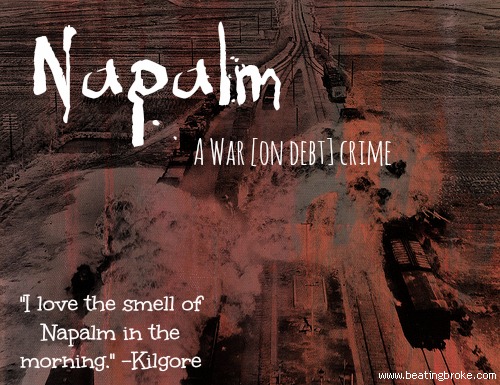
Napalm: War on debt Crime

Instead, we’re given the “debt snowball“, or the “debt avalanche.”

The truth is that debt is so easily gained, we want to find a solution to it that is just as quick.  An afternoon with a credit card and a shopping mall can add thousands to the total. Thousands that could take us years to pay off.  We wish we could find the Napalm to incinerate our debt.

Some people think that bankruptcy is that Napalm.  But, as quickly as a bankruptcy can eradicate your debt, it doesn’t leave you without any scars.  For many years afterwards, you, and your credit score, will suffer the consequences of the bankruptcy.  Credit will be nearly impossible to attain.  Prospective landlords and employers are even running credit checks before renting or hiring people.

We need to stop looking for the Napalm.  We need to stop assuming that all is lost.  We need to take some responsibility, find ways to make more money, save more money, and pay down more debt.  We need to stop adding more debt.

If you want to get rid of your debt, it’s a slow burn, not a Napalm strike.  Even in the world of personal finance, Napalm is a war crime.

Original image credit: korea by the U.S. Army, on Flickr

Shane Ede

Shane Ede is a business teacher and personal finance blogger.  He holds dual Bachelors degrees in education and computer sciences, as well as a Masters Degree in educational technology.  Shane is passionate about personal finance, literacy and helping others master their money.  When he isn’t enjoying live music, Shane likes spending time with family, barbeque and meteorology.

www.beatingbroke.com

Filed Under: Debt Reduction, Emergency Fund, Saving, ShareMe Tagged With: bankruptcy, debt, debt avalanche, Debt Reduction, debt snowball, napalm, war on debt

Are You Tracking Your Debt?

January 9, 2013 By Shane Ede 5 Comments

I think we can all agree that most debt is bad.  Some of us might even agree that all debt is bad.  Nearly all of us will also agree that nearly all of us have debt.  It’s not a comfortable thing to have usually, and, since you’re reading this, I can only assume that you’re dedicated to paying it off like I am.

Like the debt conquistadors before us, we’ve learned that knowing your debt is key to besting your debt.  You can’t win a race without knowing where it starts and where it ends.  But, somehow, you’ve also got to be able to track yourself along the way.  You’ve got to track your debt, and track your progress in paying it off.

Many of my indebted blogging friends have gone so far as to track their debt on their blog.  Many of them have even gone so far as to create a nice progress bar that we can easily see how far they’ve made it.  I don’t do that.  Not because I’m embarrassed by the debt, or the progress we’ve made, but because I decided years ago that I wanted to keep it private.  You don’t need to know how much debt I have any more than I need to know how much you have.  We aren’t in a race against each other, and I surely don’t want anyone feeling badly about how much debt I have and trying to catch up. 😉

debt line graphNo matter how you go about it, keeping track of your progress as you pay off your debt is important.  If you’ve been reading Beating Broke for long, you’ve probably gathered that I’m a fan of budgets. I think they’re a useful tool to help people like me keep track of what they spend and where they spend it.  Budgets have helped me get control of my finances and move them in the right direction.  So, it’s only natural that I use my budgeting software (YNAB) to keep track of how much I owe and where.

There are tools all over the place to help you track your debt.  One of the sponsors of the Debt Movement, Ready for Zero, is a great tool to not only help you keep track of what you owe, but to also help you plan how you’ll pay it off.  Tools like Mint also do a really good job of giving you an online tool to track your debt (and other accounts).  I don’t use any of them.  Mostly because I haven’t come across one that actually connects to all of my accounts.  My local accounts at a credit union that is small enough to not be fully integrated (I guess) with the services that those sites and apps use to update accounts.

If you want to go really frugal, a simple spreadsheet can do the trick.  Just list out all of your accounts, how much you owe on them and then update it as you make payments.  Want to make it fancier?  Track them monthly, then make a colorful line graph of your progress.

It doesn’t matter what tool you use.  The point is that you track your debt.  Know where you started with your debt, and then track your progress as you make your payments and pay it down.  Even if you aren’t paying off accounts every month, it helps with motivation to keep going.

How do you track your debt?

img credit:blamevaraia on Flickr

Shane Ede

Shane Ede is a business teacher and personal finance blogger.  He holds dual Bachelors degrees in education and computer sciences, as well as a Masters Degree in educational technology.  Shane is passionate about personal finance, literacy and helping others master their money.  When he isn’t enjoying live music, Shane likes spending time with family, barbeque and meteorology.

www.beatingbroke.com

Filed Under: budget, Debt Reduction, ShareMe Tagged With: debt, Debt Reduction, tracking your debt

Knowing Your Debt is Key to Paying Off Your Debt

January 4, 2013 By Shane Ede 7 Comments

Any good anti-debt blogger (like me!) will be able to tell you all kinds of ways to pay off your debt.  There’s methods, and tips, and even a certain way to hold your nose. Ok, maybe I’m kidding about that tips bit.  Or is it the nose part?  I’m confused.  Seriously though.  There’s a debt snowball, made famous by Dave Ramsey, then a debt avalanche, then a debt blizzard, and so on.

But, the one key thing that you absolutely have to have if you want to pay off your debt is knowing your debt.  You’ve got to know the number, the type, and even the method of your debt.  If you want to overcome your debt, you’ve got to know it inside and out, upside and down.

How Much Debt

Just how much debt do you really have?  If you’ve do a budget regularly, (if not, start) take the time to write down how much you owe to everything you make a payment to.  Keep in in a spreadsheet and update it periodically.  Put a big bold total across the bottom.  Is it a high number?  Use that as motivation to pay it down.  Is it a low number?  Use that as motivation to finally get rid of it all!  Watch the total get smaller and smaller.  (If you’re an spreadsheet junkie, create a line graph for the total!)

What Kind of Debt

There’s a common argument over whether there is any such thing as good debt, or if it’s all bad debt.  I happen to think that argument is a little too black and white and that it really depends on your situation.  If you know how much debt you have (see above), now you can categorize it.  This really isn’t as hard or as complicated as it sounds.  We’re talking simple categorization here.  Is the debt on a credit card?  It’s credit card debt.  A mortgage?  Mortgage debt.  Car loan?  Car debt.  Put them all in a category, and total the categories.

How Did you Get Your Debt

This is going to sound silly, but now take a hard look at your debt and decide how you got it.  Some of it will be obvious.  You got that mortgage debt by buying a house.  The car loan by buying a car.  But, I also want you to go a bit further.  Did you buy that car (or the house) because you absolutely needed a car?  Or did you buy it because you had gotten bored with the old one?  Categorizing your credit cards this way will be a little harder.  It might be easiest to go through old statements and look at purchases.  What are those purchases?  If you’re buying groceries and other small priced consumables on your credit card, but not paying those charges off right away, that’s a good sign that you have a problem.  Determine why you’re spending the way you are, then find a way to fix it.

Now, Get Rid of Your Debt

someecards.com - Nothing gets me hotter than a man devoid of debilitating long-term debt

Now you know how much debt you have, what kind of debt it is, and how you got it. Let’s get rid of it.  If you’re comfortable sharing your totals (even anonymously), joining something like the debt movement can be a great help.  There’s tools out there that can help you, like Ready for Zero.  If you want to go it alone, here’s a simple method for starting.  Go back to the list of categorized debt.  Start with the category(-ies) that are un-secured (that means they have no asset like a car or house tied to them) and start paying those off with every spare penny you have. You can sort them largest interest rate to lowest interest rate, or smallest balance to largest, or however you want, really.  Just start paying them off.  Get them taken care of, then start on the smallest of the secured (tied to assests) debts.  Rinse, recycle, reuse, repeat.

If you feel like sharing, tell us in the comments below how much debt you have.  How much have you paid off?

Shane Ede

Shane Ede is a business teacher and personal finance blogger.  He holds dual Bachelors degrees in education and computer sciences, as well as a Masters Degree in educational technology.  Shane is passionate about personal finance, literacy and helping others master their money.  When he isn’t enjoying live music, Shane likes spending time with family, barbeque and meteorology.

www.beatingbroke.com

Filed Under: Debt Reduction, ShareMe Tagged With: debt, debt movement, debt repayment

  • « Previous Page
  • 1
  • …
  • 5
  • 6
  • 7
  • 8
  • 9
  • …
  • 15
  • Next Page »
  • Facebook
  • Pinterest
  • RSS
  • Twitter

Improve Your Credit Score

Money Blogs

  • Celebrating Financial Freedom
  • Christian PF
  • Dual Income No Kids
  • Financial Panther
  • Gajizmo.com
  • Lazy Man and Money
  • Make Money Your Way
  • Money Talks News
  • My Personal Finance Journey
  • Personal Profitability
  • PF Blogs
  • Reach Financial Independence
  • So Over Debt
  • The Savvy Scot
  • Yes, I am Cheap

Categories

Disclaimer

Please note that Beating Broke has financial relationships with some of the merchants mentioned here. Beating Broke may be compensated if consumers choose to utilize the links located throughout the content on this site and generate sales for the said merchant.

Visit Our Advertisers

Need to change careers? Consider an Accounting Certificate Program from WTI.