Beating Broke

Personal Finance from the Broke Perspective

  • Home
  • About
  • We Recommend
  • Contact
  • Our Editorial Commitment

Powered by Genesis

Sharebuilder Returns Update

January 20, 2012 By Shane Ede 7 Comments

As I mentioned in my last post, I’ve been taking 10% of my income from my online ventures and splitting it between my Lending Club account and my Sharebuilder account.  It’s been a bit of an experiment.  Nothing scientific, but a test to see if I drop the same amount of money into each account, what the returns and stability would look like.  My returns on Lending Club have been very good, and the stability has been good so far.  Let’s take a look at the Sharebuilder account.

So far, I’ve got about $264 put into the account.  (Yep, I’m a heavy hitter. 🙂 )  So far, I’ve got six investments that I’ve split the money between.  There’s also about $50 that is in cash at the moment.  I’ll explain why that is in a bit.

  • ARCC
  • CIM
  • LTC
  • MAIN
  • NRGY
  • TICC

If you’re like me, you’ve likely never heard of any of those.  You’re probably more familiar with symbols like WMT, MSFT, APPL, or C.  One thing they have in common, is that they’re all dividend paying stocks.  I like that.  As time goes on, I’ll be balancing out these lesser known stocks with some other, more familiar dividend paying stocks. For now, that’s what the portfolio looks like.  They’re all pretty evenly split as far as portion of portfolio invested.  So far, the only one that is in the green is MAIN, and just barely.

Currently, my Sharebuilder account is showing a -13.30% return.

The Sharebuilder account is getting a bit of a bad rap here.  Part of the reason that the return is so abysmal is that I’ve got a $260 portfolio split up into 6 stocks. Each purchase comes with a $4 fee.  So, right away, the investments have to overcome a $24 loss.  Take that $24 out of the equation, and the account is only down a few bucks, and the return, while still negative, is far less so.  That also brings us to the cash that’s sitting in the account.  Previously, I would make a purchase when the balance got over $34, so that, once the $4 fee was taken, I was still buying $30 worth of the stock.  After seeing what that was doing to the results, I’ve changed that, and will likely start making purchases in $50-$60 lots.  It will take longer to build the portfolio, but the impact of the fee will be lessened.

Overall, there really isn’t much comparison of the returns between the Lending Club and Sharebuilder accounts.  Taken on their face, Lending Club wins hands down.  I have to add, however, that the investments available in the two are very different.  For the most part, you won’t lose an investment in Sharebuilder.  Unless you invest in the next Enron, that is.  With Lending Club, the risk is higher, because a borrower could default on the loan and you could lose all of that money if they do.  But, there’s an obvious trade-off here.  For the higher returns of Lending Club, you have higher risk.  Less risk, with Sharebuilder, gets you less returns.  Simple as that.  I’ll likely continue doing both, for a while and see what the 1 year comparison looks like in July.

Have you ever used Sharebuilder?  Where do you put your investments?  Do you have a “fun” account like my Sharebuilder account?

Shane Ede

Shane Ede is a business teacher and personal finance blogger.  He holds dual Bachelors degrees in education and computer sciences, as well as a Masters Degree in educational technology.  Shane is passionate about personal finance, literacy and helping others master their money.  When he isn’t enjoying live music, Shane likes spending time with family, barbeque and meteorology.

www.beatingbroke.com

Filed Under: Investing, Passive Income Tagged With: ARCC, CIM, Investing, investing returns, LTC, MAIN, NRGY, sharebuilder, sharebuilder returns, TICC

Lending Club Returns Update

January 18, 2012 By Shane Ede 30 Comments

As I mentioned before, I’ve been taking the normal 10% contribution amount that most would be putting into their retirement accounts and splitting it between my lending club account, and a sharebuilder account.  It’s been a bit of an experiment.  I happen to think that lending club is a relatively safe investment option for a portion of your portfolio.  I’ve still got my 401(k) from my old job, so the investments that I’ve made at lending club and in the sharebuilder account don’t even really make up 5% of my total investments.  In short, I can afford to get a bit risky with the money.  So far, it’s been anything but risky, however.  I’ll update on the sharebuilder account in another post.  Let’s take a look at what my lending club account has done.

To date, my investments look a little like this:

  • Total loans invested in: 24
  • Total loans paid off:5
  • Total loans defaulted: 0

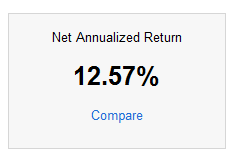
Lending Club Net Annualized ReturnWith only 24 loans, it could be that I’ve just been lucky thus far.  I’ve had a couple of the loans go past due by 10-15 days, but nothing that hasn’t been caught up and made current.  And no defaults.  As I continue, I expect that I’ll see one or two.  With all the doom and gloom about the economy recently, I fully expected to see one already.

To date, I’ve deposited $257.20 into the account.  That includes money from before this experiment started, so it’s not all recent.  With that 257.20, I’ve invested in $511.36 in loans.  The math savvy of you will notice that the invested amount is quite a bit more than the deposited amount.  That just means that the money has turned over almost 100% since being invested.  The more recent money, which accounts for about 50% of the account hasn’t had a chance to turn over yet, or that number might be higher.  My total income, minus fees, is $36.26.

My portfolio breaks down like this:

  • 39% of the loans are D grade
  • 25% of the loans are B grade
  • 15% of the loans are C grade
  • 9% of the loans are F grade
  • 7% of the loans are E grade
  • 4% of the loans are A grade

As you can see, I’ve gone a bit riskier and weighted the portfolio towards the higher grades, but is still heavily centered around the C/C+ grade.  (Read this to see how I select loans)That keeps my return a bit higher, while also keeping the risk a bit lower.  Speaking of return, what is mine?

According to lending club, my net annualized return is 12.82%.

I like that.  It’s far better than any bank or credit union is going to pay me for my money.  To get that, I give up the liquidity of the money (I’d have to sell my notes to get the cash), and I give up some of the stability of the money (it’s riskier than a savings account or CD).  Because this isn’t my emergency fund, or normal savings, I’m ok with giving up both of those things, in exchange for an above average return.

Do you invest with peer-to-peer lending?  Do you use Prosper? Lending Club? Both?  How’s your return?

Shane Ede

Shane Ede is a business teacher and personal finance blogger.  He holds dual Bachelors degrees in education and computer sciences, as well as a Masters Degree in educational technology.  Shane is passionate about personal finance, literacy and helping others master their money.  When he isn’t enjoying live music, Shane likes spending time with family, barbeque and meteorology.

www.beatingbroke.com

Filed Under: Investing, Passive Income Tagged With: investment, lending, lending club, lending club returns, lendingclub, peer to peer lending

What is Passive Income

September 26, 2011 By Shane Ede 11 Comments

One of the terms that is always circulating the personal finance area is the term “Passive Income”.  What is passive income?  Why do we keep talking about it?  How do we get it?

What is Passive Income

Passive Income is income that you don’t have to actively work to attain.  Residual income like royalties on a book, dividends on dividend stocks, and interest earned are all examples of different kinds of passive income.  Some would argue that the work you have to put into all of those to write the book, purchase the stocks, or earn the money to make the interest make those less than passive, but in my definition, any income you earn that is new income, even if it is earned off of old income that wasn’t passive, is passive.

Why Passive Income

Income taxThe reason that we all want passive income is pretty self-explanatory.  It’s additional income that you don’t output any work for.  You purchase the stocks, and the company just sends you a dividend check every quarter.  You write a book, and then the publisher sends you a check based on it’s sales.  You deposit your money, and it accrues interest.  Beyond that initial setup, you do no work to continue the income stream.

How to Make Passive Income

The how of passive income is usually where people hit the brakes.  You see, when people think passive income, they immediately think “easy money”.  But, the truth of it is that there is nothing “easy” about it.  You do have to put in the work to set it up.  Some passive income ideas are easier to set up than others.  If you’ve already got the money, you can pretty easily set up a passive income interest stream.  Or a dividend stock income stream.  But, unless you’ve already written several books, you’ll still have to write the book to set up the royalty stream.

The more passive income streams you have, the less work you have to do to maintain the level of income you have.  With some hard work to set them up, you can stop thinking about side income jobs, and thinking about how you’ll spend your “passive” time building more passive income streams.  It isn’t easy, but it can be very rewarding once you’ve got the streams all set up and working for you.  And, even if you have to do a little bit of minimal maintenance once in a while, you’ll still be earning far more for your time than you would on any non-passive income stream.

photo credit: alancleaver_2000

Shane Ede

Shane Ede is a business teacher and personal finance blogger.  He holds dual Bachelors degrees in education and computer sciences, as well as a Masters Degree in educational technology.  Shane is passionate about personal finance, literacy and helping others master their money.  When he isn’t enjoying live music, Shane likes spending time with family, barbeque and meteorology.

www.beatingbroke.com

Filed Under: Investing, Passive Income, ShareMe Tagged With: dividend stocks, interest, interest income, passive income, royalties

  • « Previous Page
  • 1
  • …
  • 12
  • 13
  • 14
  • 15
  • 16
  • …
  • 20
  • Next Page »
  • Facebook
  • Pinterest
  • RSS
  • Twitter

Improve Your Credit Score

Money Blogs

  • Budget and the Bees
  • Celebrating Financial Freedom
  • Christian PF
  • Clever Dude
  • Dual Income No Kids
  • Everybody Loves Your Money
  • Financial Panther
  • Gajizmo.com
  • Grocery Coupon Guide
  • Lazy Man and Money
  • Make Money Your Way
  • Money Talks News
  • Personal Profitability
  • PF Blogs
  • Reach Financial Independence
  • Saving Advice
  • The Savvy Scot
  • Yes, I am Cheap

Categories

Disclaimer

Please note that Beating Broke has financial relationships with some of the merchants mentioned here. Beating Broke may be compensated if consumers choose to utilize the links located throughout the content on this site and generate sales for the said merchant.

Visit Our Advertisers

Need to change careers? Consider an Accounting Certificate Program from WTI.
  • Home
  • About
  • We Recommend
  • Contact
  • Our Editorial Commitment