Beating Broke

Personal Finance from the Broke Perspective

  • Home
  • About
  • We Recommend
  • Contact
  • Our Editorial Commitment

Powered by Genesis

Selecting Lending Club Investments – How I do it

August 24, 2011 By Shane Ede 22 Comments

As I mentioned in my previous post on finding a Real Rate of Return for My Lending Club Portfolio, I am unable to invest directly into the loans on Lending Club.  There’s some regulatory issue between Lending Club and my state that makes it that way.  So, I have to purchase my investments through their note trading system called foliofn.  Not a huge deal, but it makes it a bit more interesting.

Using the Lending Club foliofn Search

First, I have to search for available investments.  They’ve got a decent search, but it’s missing a few key things that really would make it top notch.  Here’s what you’ve got as far as filters for the search, and, also how I usually set it up when I do a search.

Lending Club foliofn search options

I don’t like seeing anything that’s been late, or is currently late.  Late payments don’t show any intention of improving your situation, so I’m not going to take a risk on you if you don’t take it seriously enough to pay on time.  You’ll notice that I also change the remaining payments to 56.  The max is 60, but it’s hard to eliminate those who have been late if they haven’t had the chance to be late, so this makes it so that a few payments have to have been made.  Of course, there are shorter term loans available in Lending Club, so you’ve got to keep an eye out for those.  I don’t really limit the rates at all.  I’ll explain why in a moment.  Here’ s a sample of the results you’ll see when you do a search (click to see bigger).
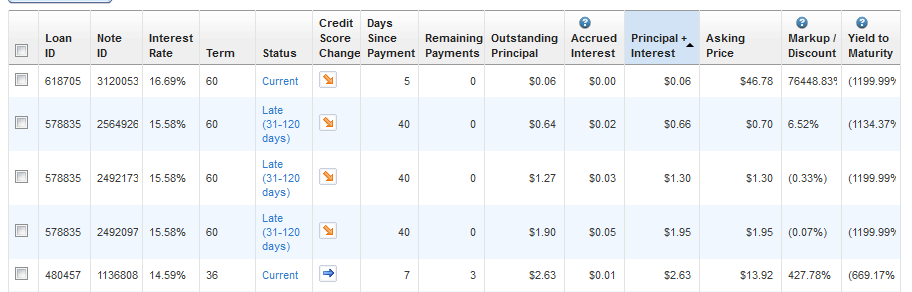
Lending Club foliofn search results

Selecting Lending Club Investments

As you can see you get a really basic overview of the available loans.  They’re all sortable.  I usually sort by Asking Price because I usually have a set amount of available funds in my account and I want to purchase investments that will come as close as possible to exhausting those funds.  There are three things that I pay very close attention to when I’m shopping for investments here.  The first is the Credit Score Change.  This is a visual indicator of whether the borrower’s credit score has gone down, up, or stayed the same since the loan was issued.  I only buy loans where the credit score has gone up.  It’s indicated by a green arrow that points up and to the right.  Again, this is a personal preference, but I want borrowers who are want to improve their situation.  It’s what this site is about, and something that I feel strongly about.  I like to think of it as ethical investing.

The second thing that I look closely at to compare the term of the loan with the remaining payments.  This goes back to the late/never late thing.  I’m able to eliminate loans that have been late through the search if the term of the loan is 60 months, but not if it’s anything shorter than that.  I’m looking for loans that have made at least 2-3 payments.  Finally, and most importantly, I look at the Yield to Maturity field.  If I could change one thing about the search on foliofn, it would be to add a way to filter by this field.  Here’s why.  Because foliofn is a secondary market for these investments, you aren’t necessarily paying the price of the remaining principle.  The seller is able to set his own price for the investment.  So, the interest rate on the loan isn’t necessarily what you will earn on the loan.  The Yield to Maturity field shows what the yield on the loan will be when it is paid off.  This field will vary. That’s also why I don’t limit the interest rate in the search, although you could if you were looking for a certain credit level of loan to invest in. If you look at the example above again, you’ll see that the investments shown would be very, very bad choices.  Where you draw the line for the yield will vary based on your personal preferences, but I usually won’t buy any of them unless they are at least 5%.

Further Thoughts and My Results

My goal is to maintain a higher interest rate than any savings account, while maintaining a medium-high risk level.  This means that my portfolio is weighted towards the C-D range loans.  I still keep it diversified amongst the different rate levels, but it’s heavier in that area.  You’ll notice that the results don’t show what range the loan is.  For that reason, it’s handy to know, generally, what the interest rate ranges are for each of the loan credit ranges.  Using the interest rate (not the yield to maturity) field, you can guess where the loan lies.
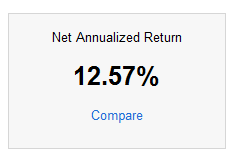
Lending Club Net Annualized ReturnSo, all that goes into it.  I look for an investment that has a upward trending credit score, that hasn’t been late and has made at least 2-3 payments, and that has a Yield to Maturity of greater than 5%.  My portfolio is still rather small, so I try to keep individual investments to a $20-$40 range.  I just don’t want to put too much of the portfolio in one loan and then get caught with my pants down if it defaults.  As the portfolio grows, I’ll likely increase the upper end of this range.  So far, I have had 4 of the investments paid off.  Two of them have been paid off early.  I have had no defaults. That’s a screen grab of my real return on the left.  Adjusted for inflation, using the formula in my previous post, it’s still above 10%.  Try and get that anywhere right now.  My 401(k) is at -0.85% YTD, and my local bank pays 0.25% on savings accounts. Sure, it’s riskier, but I feel the increased return outweighs the increased risk, and I think it will keep it’s place as part of my investment strategy.

I feel that I should make a disclaimer here.  I’m not an investing professional.  None of this should be taken as advice, but merely an amateur sharing information on my portfolio.  See an investing professional if you’re looking for advice.  Otherwise, feel free to share your stories in the comments!  And, as always, if you liked the post, please take a moment to share it using the bar on the left hand side, or at the bottom of the post.

Need an account? Sign up for Lending Club.

Shane Ede

Shane Ede is a business teacher and personal finance blogger.  He holds dual Bachelors degrees in education and computer sciences, as well as a Masters Degree in educational technology.  Shane is passionate about personal finance, literacy and helping others master their money.  When he isn’t enjoying live music, Shane likes spending time with family, barbeque and meteorology.

www.beatingbroke.com

Filed Under: Investing, loans, Passive Income, ShareMe Tagged With: foliofn, lending club, lending club investing, p2p investing, p2p lending

Calculating a Real Rate of Return on My Lending Club Portfolio

August 22, 2011 By Shane Ede 14 Comments

For the past month or so, I’ve been performing a bit of an experiment.  I’ve been taking 10% of all income from this and my other sites and splitting it between an investment account and my Lending Club portfolio.  The idea, of course, is to see which performs better.

In order to do that, I needed to find a good way to calculate what the real rate of return to me is.  Here’s the formula I settled on.

(1- (Total Deposits / ((Total Deposits + (Total Interest Received – Fees Paid))*.97)))

I should qualify the rest of this by saying that I’m not the best at math, so there may be flaws here.  Feel free to let me know in the comments.  Also, if there’s a better way to go about this, please let me know in the comments as well.

Golden Guy Balancing RiskSo, let’s break that down a bit.  The *.97 part is  meant to give some accounting for inflation.  It takes 3% right off the top as an inflationary cost.  Is 3% enough?  That’s debatable, but it seems like a fair average, historically.  This bit: (Total Interest Received – Fees Paid) is merely the total income on the portfolio.  I’m missing a small bit here, as the cost of the principle is not equal to the actual principle of the portfolio.  That’s because I live in a state where Lending Club doesn’t have the right permissions to allow me to directly invest in the loans.  So, I’m having to go through their foliofn note trading platform to buy my notes and there is usually a small premium on the notes.  I haven’t decided on a good way to really include that in, or if it really should be.  The next bit, (Total Deposits / ((Total Deposits + that previous bit is basically determining the % growth.  Total deposits divided by current “balance”.  The 1- part at the beginning just gives the cleaned up decimal percentage.

Let’s walk some numbers through it. We’ll use these:

Total Deposits = $1000

Total Interest Received = $25

Fees Paid = $5

So, plugging those numbers in we get: (1-(1000/((1000+(25-5))*.97)))

We’ll do this old school and solve as we go, showing our work.  Parenthesis get priority, followed by addition and subtraction.  So, we next end up with (1-(1000/(1020*.97))).  Then, we end up with (1-(1000/989.4)).  Next step, 1-1.011 = -.011.  So, we get a return of -1.1%.

Seems logical right?  In the case of my portfolio, the result comes back as 10%.  That’s a pretty good number, if you ask me.  I haven’t had any defaults yet, and I’ve had loans in my portfolio since January of 2010.  (the experiment I talked about earlier only began in July, however, but previous portfolio is included for easy of calculations)

I’m sure there’s some much more complicated formula that would take in risk of default on remaining invested principle, and a way to get the most accurate number, but really, I’m not sure that I want to take it that far.  This will never get to the point, I don’t think, of having a majority of my overall portfolio in it.  It’s not nearly safe enough for that, and my retirement accounts will remain in more traditional markets.

But, with results like 10%, and the current state of the stock market, one has to begin to wonder if the stock market is the safer of the two markets.  The stock market certainly isn’t showing returns of 10% recently.

photo credit: lumaxart

Shane Ede

Shane Ede is a business teacher and personal finance blogger.  He holds dual Bachelors degrees in education and computer sciences, as well as a Masters Degree in educational technology.  Shane is passionate about personal finance, literacy and helping others master their money.  When he isn’t enjoying live music, Shane likes spending time with family, barbeque and meteorology.

www.beatingbroke.com

Filed Under: General Finance, Investing, Passive Income, ShareMe Tagged With: Investing, lending club, p2p lending, rate of return, return on investment, stock market

Bye, Bye Pension; Your Opinion Needed

November 10, 2010 By Shane Ede 14 Comments

We were recently told that our defined benefits plan was being taken away.  For those that are confused, a defined benefits plan is what is normally called a pension.  For me, I haven’t been around long enough for it to really affect me.  Some, who have been around for a very long time and are nearing retirement, it will mean a rather significant chunk of the money that they thought they would have for retirement will be gone.  To their credit, our employer is doing it the right way.

Rather than just declaring the fund bankrupt, or letting it run until it was bankrupt, they’ve decided to shut it down gracefully.  What that means is that those of us who are vested in the plan will receive a payout of the amount we have vested.  And, as part of that, we need to decide what to do with that money.  We have four options:

  1. Buy an Annuity.  Annuities basically work like this: You give them a lump sum of money, and they agree to pay you a monthly amount back.  The total of the payments is equal to some amount greater than the amount that you gave them.  It’s usually based on current interest rates.
  2. Roll the money into the company 401(k).  I’m already participating in the 401(k), so this would be a logical place to go with it.
  3. Roll the money into an IRA.  Also a logical way to use the money.  Could be rolled over into a Roth IRA as well.  Either way, I have far more control of the money than I would in my 401(k).  Also, I don’t believe I’d have to worry about IRA Contribution Limits if I roll it over.
  4. Take a cash payout.  They’d just write me a check, minus the 10% early withdrawal penalty from the IRS.

I’ve ruled out option 1 as it doesn’t make any sense to do with the interest rates where they are.  Most likely, I’ll be using option 2.  But, I just can’t come to a concrete solution.  If I take option 2, I add a significant amount of money to my 401(k).  More is always better.  But, I have no more control of that money than I do with the current money that’s in there. Wall Street's Cut of Your 401(k) Pie If I take option 3, I still retain the same amount of money in a retirement account, plus I have far more control of where the money is invested than I do in the 401(k).  That’s also the con of this option though.  I’m no investment expert.  I could look to invest in a stocks and shares ISA but as a general rule, most of the investments I’ve made aren’t all that great.  Which means it would have to be limited to EFTs and Mutuals which doesn’t afford that much more control than in the 401(k).  The final option would be to take the money in a check.  The big downside there is that the IRS takes 10% off the top as a penalty.  Then, it’s counted as income which gets taxed as income.  In our tax bracket, that could mean an extra 15% in tax liability.  If it bumps us up into a new bracket, it could mean some of it could be 25% in tax liability.  So, I’d pay an instant (or nearly so) 25-35% if I took a check.  But, that still means I would receive a lump sum of several thousand dollars.  That money could be used to pay off at least one credit card, if not two, and alleviate some of the monthly burden that our debt gives us.

I know that the safest (rightest) answer is to put it into one of the retirement accounts, but having the cash to dump some of our debt would also be very advantageous.

What would you do?  If you were in my situation, would you play it safe and roll the money into your 401(k)?  Would you take the cash and pay something off to reduce your monthly expenses?  Tell me how you would handle this!

photo credit: House Committee on Education and Labor

Shane Ede

Shane Ede is a business teacher and personal finance blogger.  He holds dual Bachelors degrees in education and computer sciences, as well as a Masters Degree in educational technology.  Shane is passionate about personal finance, literacy and helping others master their money.  When he isn’t enjoying live music, Shane likes spending time with family, barbeque and meteorology.

www.beatingbroke.com

Filed Under: budget, General Finance, Investing, Retirement Tagged With: 401k, defined benefit, ira, irs, pension, Retirement, roth ira

  • « Previous Page
  • 1
  • …
  • 13
  • 14
  • 15
  • 16
  • 17
  • …
  • 20
  • Next Page »
  • Facebook
  • Pinterest
  • RSS
  • Twitter

Improve Your Credit Score

Money Blogs

  • Budget and the Bees
  • Celebrating Financial Freedom
  • Christian PF
  • Clever Dude
  • Dual Income No Kids
  • Everybody Loves Your Money
  • Financial Panther
  • Gajizmo.com
  • Grocery Coupon Guide
  • Lazy Man and Money
  • Make Money Your Way
  • Money Talks News
  • Personal Profitability
  • PF Blogs
  • Reach Financial Independence
  • Saving Advice
  • The Savvy Scot
  • Yes, I am Cheap

Categories

Disclaimer

Please note that Beating Broke has financial relationships with some of the merchants mentioned here. Beating Broke may be compensated if consumers choose to utilize the links located throughout the content on this site and generate sales for the said merchant.

Visit Our Advertisers

Need to change careers? Consider an Accounting Certificate Program from WTI.
  • Home
  • About
  • We Recommend
  • Contact
  • Our Editorial Commitment