Beating Broke

Personal Finance from the Broke Perspective

  • Home
  • About
  • We Recommend
  • Contact
  • Our Editorial Commitment

Powered by Genesis

Mortgage Insurance; Annoyance or Helper?

December 19, 2012 By Shane Ede 12 Comments

One of the things that I’ve learned a little bit about since we bought our house, was something that I didn’t have a clue about when we first started looking.  Heck, I didn’t even have a clue about it after we bought out house.  Mortgage insurance was just something that the mortgage officer told us we had to have, so it got added.

For a long time, I just thought it was an annoying little fee that they (the lenders) added on to the mortgage payment to squeeze a few extra dollars out of me.  In some ways, that’s correct.  Much like any other insurance, it’s really only there in the case of a real need for it.  If you don’t ever need it, it feels like you’re paying a bunch of money to someone for something you don’t need.  If you do end up needing your insurance, though, it can truly be a lifesaver.

Unlike some of the other insurances you’ll buy, mortgage insurance doesn’t really protect you.  With car insurance, or health insurance, the direct beneficiary is you.  If you get into a car accident, your car insurance will help pay for repairs, and your health insurance will help pay for medical bills. With mortgage insurance, if you need it, it’s really the lender that will benefit.  The way it works is much like any other insurance.  But, when an accident happens, and you default on your mortgage, the insurance pays off the mortgage to the lender.  It’s protection for the lender against default.

Generally, you only have to carry mortgage insurance until your loan-to-value is below 80%.  Come up with 20% down payment, and you won’t even see it.  Some lenders will automatically take it off of the mortgage once you fall below that 80% LTV, others won’t, so you need to keep an eye on the loan and make sure that it’s being removed when it should.  Most first time home-buyers will have some form of mortgage insurance on their loan.

Is mortgage insurance an annoyance or a helper?  I think it’s a little bit of both.  You’re buying insurance which only benefits you in that it may allow you to pay a lower down payment than normal.  It’ll mean that you don’t get the mortgage paid off as quickly as well since you’ll not only start with a larger loan, but have a chunk of your monthly payment siphoned off.  It also helps in that it does help you get a loan with a lower down payment because it assures the lender that the mortgage will be made good should you default.

Do you have mortgage insurance on your mortgage?  Do you think it’s more of an annoyance or a helper?

Shane Ede

Shane Ede is a business teacher and personal finance blogger.  He holds dual Bachelors degrees in education and computer sciences, as well as a Masters Degree in educational technology.  Shane is passionate about personal finance, literacy and helping others master their money.  When he isn’t enjoying live music, Shane likes spending time with family, barbeque and meteorology.
www.beatingbroke.com

Filed Under: Home, Insurance, loans, ShareMe

Is the Housing Market Making a Comeback?

December 9, 2012 By Shane Ede 5 Comments

The housing market has been in a slump, since it crashed in 2008.  Here we are, three plus years later, and it just might be showing signs of making a bit of a comeback.

I’ve got to admit that, here in North Dakota, we never really directly felt the housing market crash.  With all the oil flowing in the western half of the state, and the resulting high demand for housing, our market has remained pretty close to level.  In the western part of the state, there’s such a demand for housing that the home builders can’t keep up, and prices have gone up by quite a bit.  Here in the eastern half, our market has kept steady, with only some minimal gains, but the number of homes available has stayed low.

Other parts of the country weren’t as lucky to have an oil boom going on at the same time as a major market correction, however, and certainly felt the crash a whole lot more than we did.  Recently, I’ve read several articles on the increase in inventory churn in some key areas.

Housing Market Key Factors

I’m no expert in the housing market, but I think that there are several key factors that might be contributing to a market comeback.  Interest rates remain low around the country, with many qualified buyers getting home loans with loans that are below 4%.  As a comparison, the home loan rates in Australia are near 6%.  As a further comparison, when my wife and I bought our house in 2004, the rate we got on the house was almost 7%.  Another key factor, in my opinion, has been the rising of new home construction.  As the market crashed, the rates dropped, but the number of people who still qualified under new, stricter lending policies dropped too.  The lower number of qualified buyers meant that there were less houses being bought, and built.  Rates are still low, but the number of new homes constructed has gone up several months in a row.  The people who survived the crash without bankruptcy are building homes.  That also means that they are likely selling their old homes, if they have them, and putting more lower cost houses into the market.  Those lower cost houses in the market could lead to more people buying houses and becoming first time homeowners.  The final factor that I think is contributing to a resurgent housing market is the leveling off of the job market.  With several months of gains in the job market, the employment situation appears to have leveled off some which should make people feel more secure in their employment situation and decide to make the jump into home-ownership.

Should you Buy a House?

Anytime we start talking about the housing market, the inevitable question comes up of whether a person should buy a house now or not.  I’m not trying to avoid the question, but it really comes down to your personal situation.  Your primary home still isn’t an investment.  Your local market should also be taken into account.  What are the rental rates in your area?  What would the mortgage payment on a house be?  Is the rent for a similar house more or less?  Is your financial situation stable?  Do you have savings for a down payment?  With enough left over to pay closing costs?  Do you have an emergency fund in place to pay for any unforeseen emergencies that might occur after you move in?  Spending thousands of dollars isn’t something that anyone should rush into.  Run the numbers on your financial situation, then run them again.  Sleep on it for a while, and then decide if now is a good time for you to consider buying a house.

What’s the housing market like in your area?  Did your market feel the crash?

Shane Ede

Shane Ede is a business teacher and personal finance blogger.  He holds dual Bachelors degrees in education and computer sciences, as well as a Masters Degree in educational technology.  Shane is passionate about personal finance, literacy and helping others master their money.  When he isn’t enjoying live music, Shane likes spending time with family, barbeque and meteorology.

www.beatingbroke.com

Filed Under: loans Tagged With: home loans, housing, housing market

Lending Club Update 3Q2012

October 3, 2012 By Shane Ede 18 Comments

Lending Club is a great tool for making some very nice passive income.  I’ve been using my account to invest some funds and see what I can do as far as a return, as well as to learn more about the service and what can be done with it.  As someone who lives in a state where the direct investing isn’t allowed (state laws that need changing), I use the FolioFN trading platform within Lending Club to make my investments.  This eats into my return a bit, as I pay a small premium to the original investor when I buy the investment.  However, I’m finding that even with that small premium, my return is still far above what I am making in any savings account.  If you’d like to start at the beginning of the year, you can read my 1Q2012 and 2Q2012 updates first then come back to this one.

Lending Club Returns Growing

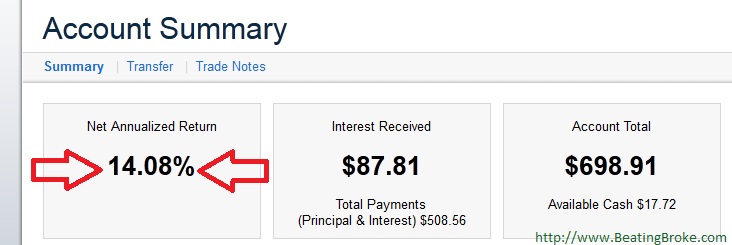
After the last update, in July, I made the decision that I could increase the risk level a bit on the my portfolio and still safely be in a place where it wasn’t too high.  While I don’t have a direct history of working at a commercial lender, I did work in I.T. at a Credit Union.  (Also, I did not sleep at a Holiday Inn Express last night.)  In my position there, I learned a few things about the way the backend of an institution works.  And, what I can tell you is that the credit scores that are getting C and even D ratings on Lending Club would be the average borrowers at a commercial brick-and-mortar institution.  What that tells me is that even the C and D rating loans at Lending Club are still a pretty safe investment.  After all, if the banks and credit unions couldn’t make money on them, they wouldn’t loan to them.  So, I increased my lending in the C and D ranges and have now moved the middle of my portfolio into the C/C- range.  It’s weighted a bit riskier, but the reward is a bit higher as well.  At the end of 2Q2012, my rate was stated on my dashboard as 13.58%.  At the end of 3Q2012, that rate has increased to 14.08%.

Lending Club 3Q2012 Returns update

A half a percent increase doesn’t sound like much, but it’s twice what my local savings account pays!  If I’d have dumped that money into my savings account instead, I’d be making half of just the increase I made last quarter.  Sad, no?

Delinquencies and Diversification on Lending Club

If you read the 2Q2012 update, you’ll know that I had two loans that have entered into the delinquency statuses.  One of which, I was able to immediately sell on FolioFN for the outstanding principle.  I lost the interest, but also lost the risk of it becoming a written off loan.  The other had a very low principle balance on it, so I decided to keep it to see what would happen, and to force myself through the collection process should it have gone that far.  It did not.  The loan went so far as to become 31-120 days past due and then a payment was made that brought it current.  It has remained current since then.

This is a good time to talk about diversification too.  As you can see from the above screenprint, I have just under $700 in my Lending Club account.  Nearly all of that (except the $17.72 in available cash) is invested into loans.  All told, I have investments in 37 loans currently.  That’s an average investment of about $18.50 per loan.  Obviously, some of them are nearing payoff, and others are nearer funding, so the actual amount per loan varies wildly between $0 and $25.  I do try and keep each investment to about $25-$30 to maintain that diversification.  If any one of the loans were to go into collections and then be written off, I’m only loosing a small fraction of my overall portfolio, and the hit would be minimal.

Much like any other investment, whether it be in stocks, real estate, etc, diversification can greatly improve your risk tolerance.  The risk of having one or two loans that go bad is far outweighed by the fact that you’d still have 10, 20, 30, or more loans that are in a current status.  I’ll continue to monitor for loans that go past due and then decide individually whether to keep them or to try and liquidate them through the FolioFN trading platform.

Other notes

Over the last quarter, my Lending Club account has reached a point that the principle payments combined with the interest payments exceed $25 a month.  What that means is that part of my experiment is complete.  I’ve been able to create a portfolio of self-sustaining investments.  I can stop putting any new funds into the account, and be able to reinvest the returns each month without having a whole lot of dead money sitting around waiting on me to invest it.  At most, any funds from payments should only sit around for a maximum of about 30 days.  It’s not ideal, but it’s far better than it could be.

I don’t intend to completely stop adding funds to the account either.  I want the portfolio to grow at a slightly faster clip than it would with just the returns and payments, so I’ll continue making deposits into it.  I like the way the portfolio is currently balanced, so will likely try and keep it that way.  What that likely means is that I shouldn’t expect to see any major movement on the rate of return.  I’m happy with the 14% I’m currently getting though, so that isn’t really a problem for me.

How many of you have not invested in a P2P lending account like the mine at Lending Club or at Prosper?  Why not?

Shane Ede

Shane Ede is a business teacher and personal finance blogger.  He holds dual Bachelors degrees in education and computer sciences, as well as a Masters Degree in educational technology.  Shane is passionate about personal finance, literacy and helping others master their money.  When he isn’t enjoying live music, Shane likes spending time with family, barbeque and meteorology.

www.beatingbroke.com

Filed Under: Investing, loans, Passive Income Tagged With: lending club, lending club returns, lending club update

  • « Previous Page
  • 1
  • …
  • 4
  • 5
  • 6
  • 7
  • 8
  • …
  • 10
  • Next Page »
  • Facebook
  • Pinterest
  • RSS
  • Twitter

Improve Your Credit Score

Money Blogs

  • Budget and the Bees
  • Celebrating Financial Freedom
  • Christian PF
  • Clever Dude
  • Dual Income No Kids
  • Everybody Loves Your Money
  • Financial Panther
  • Gajizmo.com
  • Grocery Coupon Guide
  • Lazy Man and Money
  • Make Money Your Way
  • Money Talks News
  • Personal Profitability
  • PF Blogs
  • Reach Financial Independence
  • Saving Advice
  • The Savvy Scot
  • Yes, I am Cheap

Categories

Disclaimer

Please note that Beating Broke has financial relationships with some of the merchants mentioned here. Beating Broke may be compensated if consumers choose to utilize the links located throughout the content on this site and generate sales for the said merchant.

Visit Our Advertisers

Need to change careers? Consider an Accounting Certificate Program from WTI.
  • Home
  • About
  • We Recommend
  • Contact
  • Our Editorial Commitment