Beating Broke

Personal Finance from the Broke Perspective

  • Home
  • About
  • We Recommend
  • Contact
  • Privacy Policy

Powered by Genesis

How Big Is Your Circle Of Support?

April 2, 2013 By MelissaB 6 Comments

You’ve likely heard the phrases, “No man is an island, entire of itself” and “It takes a village to raise a child.”  What these phrases get at is the importance of having a circle, a group you can depend on.  Although we like to think we can do it all alone, life is generally much easier if we get through it with support from others.

Years ago, before people moved frequently, their circle consisted of family members, neighbors, and friends.  Their circles were large and included not only their own family and friends, but their parents’ friends.

Now, people move frequently, and we are connected more through social media rather than in person.  It’s increasingly easier to be isolated (and many people are), yet we still ultimately need a circle of those close to us.  The larger your circle, the more advantages you have and the healthier you’ll be.

Why We Let Friendships Lapse

In our busy world, friendships and connections often fall by the wayside because they require time.  You need to spend time nurturing your friendships, connecting, and helping others.  Some days you may be so busy that you feel that you don’t have time for yourself, let alone others, but ultimately, nurturing your circle will reward you in multiple ways.

The Benefits of Having a Large Circle of Support
How big is your circle of supportThere are multiple benefits to having a circle of support.

1.  A healthier life.  Time recently reported that those who have strong social ties are more likely to live longer than those who don’t.  In fact, researchers at Brigham Young University and the University of North Carolina at Chapel Hill found that “a healthy social life may be as good for your long-term health as avoiding cigarettes” (Time).

2.  More likely to get a job.  The larger your circle is, the more people who can help you find a job.  Mashable argues, “People get jobs through other people, not computers.  By having a personal connection to the company you’re applying for, your chances of getting a job multiply.”

I saw this first hand in the 1980s when my dad was unemployed for nearly two years.  My mom babysat at home, and one of the moms of the children she babysat for, Carla, was able to get my dad a job interview at the company where she worked.  When the man interviewing my dad started to smoke during the interview, my dad did, too, which was enough for the boss to decide not to hire him.  Carla was able to smooth things over, and my dad was ultimately hired.  Without Carla in our circle, who knows how much longer my dad would have been unemployed.

3.  More likely to feel secure.  If you have a difficult decision to make, you can bounce ideas off your friends and those in your circle.  If you run into hard times, you know your circle of connections can help support you.  Having a safety net, so to speak, in the form of friends and family, can make you feel more safe and satisfied with your life.

4.  Feel better about yourself.  Giving to others can make us feel better about ourselves and our own life.  If you’re part of a circle, you’re expected to give back.  They help you; you help them.  As you help friends and family, you also feel better about yourself.

In our society, it’s increasingly easy to let personal relationships fall by the wayside.  Resist the urge and take the time to nurture your friendships and family connections.  You’ll benefit financially, medically and personally.


Filed Under: General Finance, ShareMe Tagged With: circle of support, friends, support

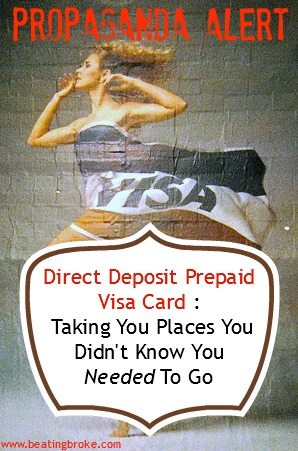
Propaganda Alert: Visa Direct Deposit Prepaid

March 29, 2013 By Shane Ede 15 Comments

There I was driving home from work, when an ad on the radio catches my attention.  It was an ad for a Visa Direct Deposit Prepaid card.  Apparently not satisfied with a plethora of prepaid cards that are terrible for users (some are O.K., just not most), Visa would now like you to believe that it’s the next best thing to sliced bread to have your paycheck direct deposited to a prepaid visa card.  Yeah, you read that right.

Prepaid Direct Deposit

The radio ad is the voice of a woman, and she talks about how she has her paycheck direct deposited to a Visa prepaid card.  She goes on to talk about how she doesn’t have to drive all the way downtown and stand in a line at her bank to cash the check.  Not content to simply portray the card as a time saver, the ad goes on for the woman to say that because she’s not driving all the way downtown and standing in line, she now has so much more time with her daughter.  Now, the prepaid direct deposit card is not only a time saver, but a family bringer-togetherer.  No, that’s not an actual word/phrase.  I don’t care.

I have a friend from college that used to make fun of infomercials by saying that all they really did was demonstrate how terribly impossible common everyday tasks can be and then show you a miraculous new gadget to “fix” that impossibility. The problem is that most of those every day tasks aren’t all that impossible.  Most able-bodied humans can do them easily without any help from the gadget.  It loses a little something without his “demonstration” of the whole situation.  Obviously, the tactic works though, or we wouldn’t have those infomercials.

Welcome to the Infomercial-ization of Prepaid Cards

Not that we haven’t seen some of this done before.  Heck, the level of celebrity endorsements of prepaid cards with outrageous fees is still amazing to me.  But, this goes a level further.  They aren’t just banking (see what I did there?) on your needing a card with Justin Bieber’s face on it anymore.  No, they’re going right for your heartstrings.  After all, what parent among us doesn’t desire to spend more time with our children?  And this card can deliver it to you!  (You should read that last sentence in your best Billy Mays voice.  R.I.P. Billy.)  In fact, maybe they need the Sham-Wow guy to do the next voice-over for a commercial!

Visa Direct Deposit Prepaid : Solution to a Problem that Doesn’t Exist

Visa Direct Deposit Prepaid Card

Much like those infomercials, the problem that they claim the card fixes just doesn’t exist.  Direct deposit isn’t a new service.  Most employers offer it.  In fact, most actually require it now.  It’s just easier for them.  No lost checks to try and track down.  No delay in mailing a check from a payroll service.  And, most of the time, if they direct deposit the check, it gets deposited into a checking account.  And, do you know what most of those checking accounts have attached to them as a service?  A debit card!  It’s exactly like a prepaid visa card, but without most of the fees!  Mine has no fees.  I’m not sure there are many places that do have fees, in fact.

Maybe I’m wrong.  Maybe there’s a whole population of the country who’ve been waiting patiently for someone to come along and solve this very problem.  Maybe they still bank at an institution that keeps their account records on old green ledger books.  If that’s so, I’d like to introduce them to the amazing egg shell separator that I’ve created.  Yes, it looks exactly like the lip of a mixing bowl.  But, it doesn’t have the added bulk of the bowl!  It’s just a convenient shard sized device that helps you separate your egg shells without having to have the whole mixing bowl there!  Yes, I came up with the idea when the bowl I was cracking eggs into suddenly grew heavy in my arm and fell to the ground, breaking into lots of small pieces.  And one of those pieces was the prototype for the amazing egg shell separator!

What do you think?  Am I wrong?  Was there a need for a product like this?  Or is Visa just pulling on emotional strings to get more cards in peoples’ wallets?

original img credit: classic visa (the inception of the “we’ve got you covered” campaign) : london underground ad (1988) by torbakhopper, on Flickr

Filed Under: Consumerism, credit cards, Propaganda Tagged With: credit cards, direct deposit, prepaid credit card, prepaid visa, visa

In a Car Accident? Should You Pay Out of Pocket for Repairs?

March 13, 2013 By MelissaB 11 Comments

Our Chicago winter this year has been a lot less like a Midwest winter–the snow storms have been few and far between.  A few weeks ago we finally got hammered by a storm that dumped 10 inches over the city.  At the height of the snow storm I had to pick up my son from school.  As I waited at a stop sign, the driver behind me bumped into my bumper.

Luckily, the damage wasn’t bad.  When I took it to a repair shop for an estimate, they thought it would cost between $580 and $1,200 to fix depending on if there was any damage inside the bumper when they take it off to repair it.

Surprisingly, the woman who hit me decided she wanted to pay out of pocket rather than go through insurance.  When I told her that the repair would take 2 to 3 days and we’d need a rental car during that time, she agreed to cover that cost, too.

This is the second time I’ve been rear-ended in 5 years, and both times the repairs were less than $2,000.  Both times the drivers opted to pay out of pocket.

If you’re in a minor fender bender, should you pay out of pocket rather than going through insurance?

Reasons You May Want to Pay Out Of Pocket

Pay out of Pocket for Repairs1.  If you have a high deductible.  If you have a deductible of $1,000, for example, paying out of pocket if the repair is just a few hundred dollars over that amount may make sense.  You’ll save yourself from an increasing premium.

2.  If your insurance premium will increase substantially.  Each insurance company is different, but rest assured that if you cause an accident and file a claim, your insurance will increase.  Some insurers increase your premium by 10% and others by 20%.  You may be able to call your insurer and ask how much the premium will go up before you decide to pay a claim or not.

3.  If this is your second accident.  While you’ll pay an increased premium for one accident, if you file two claims within a few years of one another, the increase is substantial.  For instance, State Farm generally charges a 10% increase in premium for the first claim, but that amount increases to 45% for the second claim.  While it may hurt your budget to come up with a thousand or two to pay out of pocket for the repairs, that may be the better option if you’re facing a substantial increase that could last several years.

4.  If your insurance doesn’t have an accident forgiveness clause.  Some insurers offer an accident forgiveness clause, meaning, if you’ve been with the company for a certain number of years (usually 5 to 9) with no accidents, the insurance company won’t increase your premium on the first accident you file.  Again, though, you may want to save this benefit for a more substantial accident that you can’t afford to pay out of pocket rather than when the repair is relatively minor.

If you cause an accident, don’t automatically file a claim.  There are benefits to paying out of pocket.  You just need to understand your insurance policy as well as know exactly how much the repairs will cost before making a decision.

If you’ve caused an accident, did you pay out of pocket rather than filing a claim?

Original img credit: Oops, by fortes on Flickr

Related articles
  • Why Purchasing Rental Car Insurance Isn’t Necessarily a Waste of Money
  • How Much Car Insurance Coverage Do You Need?
  • How Trying to Save $100 Cost Me $500
  • 10 Travel Expenses to Think Twice About
  • How Much Life Insurance Do I Need?

Filed Under: Cars, Insurance, ShareMe Tagged With: accident, car insurance, cars

  • « Previous Page
  • 1
  • …
  • 207
  • 208
  • 209
  • 210
  • 211
  • …
  • 319
  • Next Page »
  • Facebook
  • Pinterest
  • RSS
  • Twitter

Improve Your Credit Score

Money Blogs

  • Celebrating Financial Freedom
  • Christian PF
  • Dual Income No Kids
  • Financial Panther
  • Gajizmo.com
  • Lazy Man and Money
  • Make Money Your Way
  • Money Talks News
  • My Personal Finance Journey
  • Personal Profitability
  • PF Blogs
  • Reach Financial Independence
  • So Over Debt
  • The Savvy Scot
  • Yes, I am Cheap

Categories

Disclaimer

Please note that Beating Broke has financial relationships with some of the merchants mentioned here. Beating Broke may be compensated if consumers choose to utilize the links located throughout the content on this site and generate sales for the said merchant.

Visit Our Advertisers

Need to change careers? Consider an Accounting Certificate Program from WTI.