Beating Broke

Personal Finance from the Broke Perspective

  • Home
  • About
  • We Recommend
  • Contact
  • Our Editorial Commitment

Powered by Genesis

Start Your Summer Right—Go Straight to the Farm for the Best Produce

June 11, 2012 By MelissaB 6 Comments

Ah, summertime.  If you are a foodie, summertime brings so many food joys—fresh, ripe strawberries, juicy blueberries, crunchy asparagus.  There are many food delights that are available in summer that aren’t available for most of the country for most of the year.

Sure, you can buy strawberries shipped in from a foreign country in January, but they are often devoid of taste and don’t taste nearly as good as those you can buy in June near your home.

019_edited-1 © by Michael Bentley

Since there are likely farmers in your area who grow the seasonal produce you crave, why not take a trip out to the farm to pick some of the produce on your own?  Taking such a trip is a great way to spend time together as a family, plus you benefit both nutritionally and financially.    Not only will you get to enjoy produce at the peak of ripeness, but you will also likely save substantially by buying at the farm.  An added bonus is that your kids will more likely enjoy eating the produce and learning how it grows.

We recently went as a family to an organic strawberry farm near our home.  None of us had ever picked strawberries before, and we didn’t know that strawberries got there name from the straw surrounding the berries so they don’t sit on the ground but the straw instead.  We picked 7.5 pounds, bought 10 pounds and bought another 27 pounds of seconds (berries not pretty enough to sell for the full asking price).  We spent approximately $91 for our haul (about $2.00 a pound which is a great price for organic strawberries), and froze 4 large bags of strawberries and made 21 pints of jam.  The kids still talk about the experience, and now they are more educated about how strawberries grow (as are we).

If you would like to look for a farm in your area, try localharvest.org for organic farmers or farmvisit.com.  If you use farmvisit.com, you can choose between organic and conventional farmers.

If you do not regularly visit farms to pick your fruits and veggies, here are some tips:

  1. Call the farm ahead of time.  The farmer can let you know picking conditions as well as when the busiest times are and the quietest times.  We always try to plan our visits around the quiet times because it is easier with small kids.
  2. Bring your own containers.  Farmers may have large containers for you to take your produce home in, but you will usually have to pay for them.  Bring your own containers instead and save the money.  Use cardboard boxes or even large pots and pans.
  3. Bring plenty of water and sunscreen.  Picking produce makes you hot, so bring plenty of water as well as sunscreen to prevent a burn.
  4. Bring a lunch.  If you will be picking for awhile or will have a drive a distance to get out to the farm, bring your lunch with you so you can have a picnic or eat while traveling.
  5. Wear appropriate shoes and clothes.  Tennis shoes are usually best, and wear sloppy clothes because you will probably get dirty.
  6. Have a plan for what to do with your produce.  Decide ahead of time if you will only pick enough to eat right away or if you plan to preserve some of it by freezing or canning it.  If you are canning it, going to the farm is just the first step to a long (but worthwhile) day of picking and preserving.

A trip to the farm can be a great experience for your kids and save you money on fresh produce picked at the peak of ripeness.  If you go a step further and freeze or can some of the produce you pick, you can enjoy local fruit at a great price all year long, straight from your stockpile.

Filed Under: Frugality, Green, Saving Tagged With: CSA, farm visits, farming, frugal produce, pick strawberries, pick your own, produce

Trying a Container Garden This Year

June 7, 2012 By Shane Ede 9 Comments

In years past, we’ve tried futilely to grow a variety of vegetables, fruits and flowers in our designated garden areas of our yard.  Each year, some part of that has been a tremendous disappointment.  Part of the issue is the soil itself.  We have a large evergreen tree in the back yard that provides and excess of shade, an excess of protection from rainfall, and an excess of needles that lend a terrible acidity to the soil.  Between not getting enough shade, not getting enough rain and poor nutrient values in the soil, everything we plant has a terrible time trying to grow.

We’ve tried several things over the last few years.  Much more regular watering helps, obviously.  We’ve added better quality soil to try and make the soil better for growing.  We’ve even fertilized the plants. Each year, something happens to throw the wrench in the cogs.  Last year, we had a major slug infestation, and what did grow was quickly eaten by the slimy creatures.  With each year’s problems, we learn something new that we won’t repeat in future years.  Last year, we learned that, while fallen leaves do provide good insulation for plants over the winter, a abnormally wet spring makes them a wonderful breeding bed for slugs.  Maybe, after we’ve learned enough lessons, we’ll finally get a decent crop out of our garden.  Until then, we’re changing it up a bit.

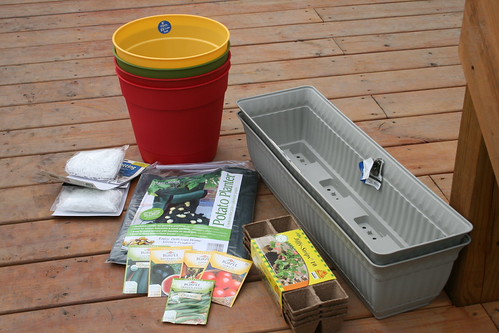
This year, we’re giving a container garden a go.  We purchased several (8-10) containers of various sizes and shapes, filled them with potting soil and topsoil and purchased all the seeds we thought we might need for the year.

Gardening Supplies © by thatedeguy

I started the seeds nice and early (perhaps a bit too early) and quickly encountered my failure for the year. Not only did very few of the seeds sprout, but those that did quickly died and began to mold. Nothing that I grew in that first batch of seeds is currently still with us. I bought some different seed starting supplies, and tried again. I got slightly better results, and a majority of those seeds survived. Any that still didn’t grow, I replaced with plants from a nursery.

So far, we’re only a few weeks into the growing season, but several of our containers are doing quite well.  The potato planters are growing very well, and the onions (note: all not seeds that I started.)  are doing well.  Of the things that I started as seeds, the only things that are really doing well so far are the carrots.  But, the other stuff is growing, and hopefully, will continue to.

I’d be remiss if I didn’t discuss the financial side of all of this a bit.  When you stop to consider the burden of having to buy most of the supplies this first year, it would have been far more economical to just buy the produce from the farmer’s market.  But, should we pull it off, and produce a good enough crop, we’ll continue it in future years.  Each successive year will make it a bit cheaper, as most of the containers and supplies are reusable.  This year, it’s probably creeping up to about $100 in total expenses, but next year will likely be a lot closer to the $20-$30 mark.  For $20-$30, the produce grown will be very cheap compared to what we could get it for at the farmer’s market.  Plus, it will have that little extra bit of flavor that gets added from having grown it yourself.

How do you garden?  Do you have the luxury of a large plot for a garden, or do you make do with containers?  Do you have any great tips for container gardening (or gardening in the presence of a evergreen) that you’d care to share?


Filed Under: Frugality, Home Tagged With: container garden, container gardening, garden, gardening

How Higher Education is Ruining the Economy

June 5, 2012 By Shane Ede 20 Comments

The last thing you probably expected, today, was a post about how higher education is ruining the economy. After all, aren’t personal-finance bloggers supposed to be all about advancing yourself, spending wisely, and earning all that you can? Perhaps, but I’m of the personal belief that one can still advance yourself, spend wisely, and earn all that your worth without having to go to college. Before I get off on a tangent let me explain just what it is that I mean. Higher education has its place. If you want to be an engineer, a doctor, social worker, or even a teacher, you’ll likely need to have a college degree. For those professions that require a college degree there simply isn’t any other way around it. But, that doesn’t mean you need to go to a college whose tuition costs exceed several years worth of the expected salary for the profession that you wish to have. After all, the idea is to learn a profession so that we can earn more money, not learn a profession so that we can spend more money.

Higher Student Loan Debt is Burdensome.

How does all that relate to the economy? The effects of the high cost of tuition are far-reaching. The added debt of college loans can create a cyclical debt treadmill. A recently graduated student may have a small window of time to get his or her affairs in order, but is quickly saddled with a student loan payment. Newly minted professional usually work extra hours to make extra money to pay off the large student loans they’ve accumulated. The combination of less free time with higher debt repayment figures creates a vacuum whereby the money earned never gets a chance to enter into the economy. And everyone knows that the quickest way for money to enter into the economy is through consumer spending.

Exaggerated Educational Requirements are Exaggerated.

But, the added debt isn’t the only reason that higher education is ruining the economy.  Heck, it isn’t even the student loan interest rates.  Our economy has always had an informal hierarchical system.  When I say that, I don’t mean that the people with the degrees got the better jobs, either.  Not so very long ago, the people who got the better jobs were the people who were best suited to it.  For many positions, that meant that the people getting the better jobs were the people with the most experience, and the most aptitude for the position.  Somewhere along the way, the people in charge of hiring decided that a higher education degree could replace some level of experience.  More and more companies decided that this was a good thing.  And now, many job openings require that you have a degree of some sort.  Real world experience in a position has been surpassed by classroom experience.  Entry level jobs that could just as easily be done excellently by a person with a high-school diploma are suddenly closed off to anyone without a degree.  Anyone that aspires to hold such a position is thereby required to attend college for a minimum of two years rather than spend those two years gaining experience and job skills for the position.  Worse, for the economy anyways, is that that person is then effectively taken out of the economy for at least two more years.  Instead of earning money, paying taxes, and contributing to the economy, that person is racking up the debt while taking so many credits that they can’t even afford the time to take on a part-time job.

How do we fix higher education?

College Fund © by Tax Credits

I think, first and foremost, we need to stop pretending that a degree is a “requirement”.  Stop pushing our children to attain a degree, and instead push them to get the minimal required training to attain the job/position that they desire.  Kids will be kids and they’ll do what they please, but they shouldn’t feel like their being pushed into a college education because their parents want them to get one.

We need to stop requiring degrees for positions that clearly don’t really need one.  In my particular field (IT for those curious among you), very little of what I learned in college has been applied in my work experience.  And yet, each of the positions I’ve had (with the exception of my most recent part-time job) has required a four year degree in the field.  Let me tell you, anyone with an aptitude for IT, and a willingness to learn on the job could have easily fulfilled all of the duties that I performed.  It’s a fact. How many other positions are there that are the same way?  Lots and lots, I’d wager.

From a strictly financial perspective, we have to do a better job of educating our children about how to go about getting a degree if that’s what they choose to do.  There are numerous tools that can help us out, in this internet age.  Our own government has a plethora of information to help, and there are plenty of other resources, like Big Future, that have lots of information too.

We also have to properly express what a fiscally responsible adult should do.  I can’t count the number of my fellow students (myself included) who took the maximum allowable student loans out, despite not needing that amount, so that they would have the extra funds available to do what they pleased with.  Yes, it’s some of the cheapest money you will ever borrow, but unless you’re planning on investing in a guaranteed rate account while you attend college, it’s still debt.  And every penny of it will make your financial life harder once you graduate.

Finally, we have to stop this idea that we are all entitled to a college education.  We aren’t.   It’s a privilege that we pay grandly for.  Just because you can spend $50,000 a year to get your library sciences degree, doesn’t mean you are entitled to, or should.

Do you have a degree?  Was it required for your position?  Should it have been?  How would you fix higher education?

Filed Under: Children, Consumerism, economy, Education, ShareMe, Student Loans Tagged With: college, debt treadmill, economy, higher education, student loan interest, Student Loans

  • « Previous Page
  • 1
  • …
  • 232
  • 233
  • 234
  • 235
  • 236
  • …
  • 320
  • Next Page »
  • Facebook
  • Pinterest
  • RSS
  • Twitter

Improve Your Credit Score

Money Blogs

  • Budget and the Bees
  • Celebrating Financial Freedom
  • Christian PF
  • Clever Dude
  • Dual Income No Kids
  • Everybody Loves Your Money
  • Financial Panther
  • Gajizmo.com
  • Grocery Coupon Guide
  • Lazy Man and Money
  • Make Money Your Way
  • Money Talks News
  • Personal Profitability
  • PF Blogs
  • Reach Financial Independence
  • Saving Advice
  • The Savvy Scot
  • Yes, I am Cheap

Categories

Disclaimer

Please note that Beating Broke has financial relationships with some of the merchants mentioned here. Beating Broke may be compensated if consumers choose to utilize the links located throughout the content on this site and generate sales for the said merchant.

Visit Our Advertisers

Need to change careers? Consider an Accounting Certificate Program from WTI.
  • Home
  • About
  • We Recommend
  • Contact
  • Our Editorial Commitment