Beating Broke

Personal Finance from the Broke Perspective

  • Home
  • About
  • We Recommend
  • Contact
  • Privacy Policy

Powered by Genesis

How Higher Education is Ruining the Economy

June 5, 2012 By Shane Ede 20 Comments

The last thing you probably expected, today, was a post about how higher education is ruining the economy. After all, aren’t personal-finance bloggers supposed to be all about advancing yourself, spending wisely, and earning all that you can? Perhaps, but I’m of the personal belief that one can still advance yourself, spend wisely, and earn all that your worth without having to go to college. Before I get off on a tangent let me explain just what it is that I mean. Higher education has its place. If you want to be an engineer, a doctor, social worker, or even a teacher, you’ll likely need to have a college degree. For those professions that require a college degree there simply isn’t any other way around it. But, that doesn’t mean you need to go to a college whose tuition costs exceed several years worth of the expected salary for the profession that you wish to have. After all, the idea is to learn a profession so that we can earn more money, not learn a profession so that we can spend more money.

Higher Student Loan Debt is Burdensome.

How does all that relate to the economy? The effects of the high cost of tuition are far-reaching. The added debt of college loans can create a cyclical debt treadmill. A recently graduated student may have a small window of time to get his or her affairs in order, but is quickly saddled with a student loan payment. Newly minted professional usually work extra hours to make extra money to pay off the large student loans they’ve accumulated. The combination of less free time with higher debt repayment figures creates a vacuum whereby the money earned never gets a chance to enter into the economy. And everyone knows that the quickest way for money to enter into the economy is through consumer spending.

Exaggerated Educational Requirements are Exaggerated.

But, the added debt isn’t the only reason that higher education is ruining the economy.  Heck, it isn’t even the student loan interest rates.  Our economy has always had an informal hierarchical system.  When I say that, I don’t mean that the people with the degrees got the better jobs, either.  Not so very long ago, the people who got the better jobs were the people who were best suited to it.  For many positions, that meant that the people getting the better jobs were the people with the most experience, and the most aptitude for the position.  Somewhere along the way, the people in charge of hiring decided that a higher education degree could replace some level of experience.  More and more companies decided that this was a good thing.  And now, many job openings require that you have a degree of some sort.  Real world experience in a position has been surpassed by classroom experience.  Entry level jobs that could just as easily be done excellently by a person with a high-school diploma are suddenly closed off to anyone without a degree.  Anyone that aspires to hold such a position is thereby required to attend college for a minimum of two years rather than spend those two years gaining experience and job skills for the position.  Worse, for the economy anyways, is that that person is then effectively taken out of the economy for at least two more years.  Instead of earning money, paying taxes, and contributing to the economy, that person is racking up the debt while taking so many credits that they can’t even afford the time to take on a part-time job.

How do we fix higher education?

College Fund © by Tax Credits

I think, first and foremost, we need to stop pretending that a degree is a “requirement”.  Stop pushing our children to attain a degree, and instead push them to get the minimal required training to attain the job/position that they desire.  Kids will be kids and they’ll do what they please, but they shouldn’t feel like their being pushed into a college education because their parents want them to get one.

We need to stop requiring degrees for positions that clearly don’t really need one.  In my particular field (IT for those curious among you), very little of what I learned in college has been applied in my work experience.  And yet, each of the positions I’ve had (with the exception of my most recent part-time job) has required a four year degree in the field.  Let me tell you, anyone with an aptitude for IT, and a willingness to learn on the job could have easily fulfilled all of the duties that I performed.  It’s a fact. How many other positions are there that are the same way?  Lots and lots, I’d wager.

From a strictly financial perspective, we have to do a better job of educating our children about how to go about getting a degree if that’s what they choose to do.  There are numerous tools that can help us out, in this internet age.  Our own government has a plethora of information to help, and there are plenty of other resources, like Big Future, that have lots of information too.

We also have to properly express what a fiscally responsible adult should do.  I can’t count the number of my fellow students (myself included) who took the maximum allowable student loans out, despite not needing that amount, so that they would have the extra funds available to do what they pleased with.  Yes, it’s some of the cheapest money you will ever borrow, but unless you’re planning on investing in a guaranteed rate account while you attend college, it’s still debt.  And every penny of it will make your financial life harder once you graduate.

Finally, we have to stop this idea that we are all entitled to a college education.  We aren’t.   It’s a privilege that we pay grandly for.  Just because you can spend $50,000 a year to get your library sciences degree, doesn’t mean you are entitled to, or should.

Do you have a degree?  Was it required for your position?  Should it have been?  How would you fix higher education?

Shane Ede

Shane Ede is a business teacher and personal finance blogger.  He holds dual Bachelors degrees in education and computer sciences, as well as a Masters Degree in educational technology.  Shane is passionate about personal finance, literacy and helping others master their money.  When he isn’t enjoying live music, Shane likes spending time with family, barbeque and meteorology.

www.beatingbroke.com

Filed Under: Children, Consumerism, economy, Education, ShareMe, Student Loans Tagged With: college, debt treadmill, economy, higher education, student loan interest, Student Loans

How High is Inflation

March 14, 2012 By Shane Ede 9 Comments

© by snowlepard

The commonly used rate of inflation, 3%-4%, is used in so many formulas for retirement, investing, and “cost-of-living” increases.  But, is that the right number?  A recent news story released by the American Institute for Economic Research claims that the real rate of inflation is closer to 8%.

I won’t pretend to understand all of the economic talk in that article.  What I do understand is that they are claiming to be using numbers that are more reflective of the average American’s spending habits.  More importantly, if their research is even partially correct, it means that the rate of inflation could be significantly higher for some parts of the populace.  Not only does this affect the available funds for saving and spending, it could affect the numbers that many people are using for estimated retirement needs.

The research is still fairly new, as it doesn’t appear that they have that much historical data to back up their claims.  But, they do present a strong argument for a change in what we assume inflation to be, and where we get that information from.

How would a 8% inflation rate affect your finances?


Shane Ede

Shane Ede is a business teacher and personal finance blogger.  He holds dual Bachelors degrees in education and computer sciences, as well as a Masters Degree in educational technology.  Shane is passionate about personal finance, literacy and helping others master their money.  When he isn’t enjoying live music, Shane likes spending time with family, barbeque and meteorology.

www.beatingbroke.com

Filed Under: economy Tagged With: cpi, economy, inflation, rate of inflation

Do Politics Have Any Place in Personal Finances?

February 24, 2012 By Shane Ede 11 Comments

First, this is a personal finance blog.  As such, I try very hard to not comment too much on politics and keep them out of my articles.  But, should I?  Do politics have a place in personal finance?  Do our financial beliefs have any bearing on who and how we vote?  Should they?

I think the short answer is yes.

Whether we like it or not, politics and politicians play a significant part in how our finances play out.  The laws and regulations that they enact have the ability to cause widespread change in how we earn, spend, and save money.  Some examples:

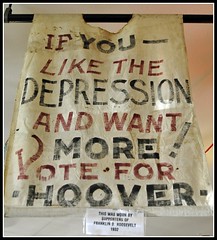
Hoovervilles: 1932 Do-Nothing EconomicsPolitics Changes How We Earn

Recent legislation has raised the minimum wage so that many of the workers who were making minimum wage are now earning more per hour than they were before.  The legislation, in effect, gave many of those workers a pretty big raise.  Of course, the opposite can be true where many companies, feeling the pinch of having to pay that much more per hour, were forced to reduce hours or the number of workers causing some to make less than before. Temporary reductions in payroll taxes have added dollars to our paychecks.  Proposed changes to Social Security could change that again, and could change the way retirees earn their SS funds back.

Politics Changes How We Spend

The most obvious example of how politics can change how we spend money is taxes.  The tax rates that we pay, both federally and locally, can cause us to spend less on some items.  They can also cause us to spend a bit more when we receive a refund each year.  Another good example is the recent legislation that changed the way interchange fees work and caused many banks to raise fees to compensate.  Instead of compensating, many of us moved our accounts to Credit Unions that weren’t charging the new fees.  State sales taxes can drive sales across borders, especially when a bordering state has no sales tax.  Tax credits and deductions have caused millions to be spent on home improvements, energy efficient appliances, electric and hybrid cars, and even the birth of children.

Politics Changes How We Save

Regulations and laws determine the methods of investment for most every investment vehicle publicly available today.  With each new legislative session, new regulations and laws are passed that affect how investments and savings vehicles are able to operate and function.  Any new scandal, like the recent Madoff Ponzi scandal, or the less recent Enron failing, causes a flurry of new regulations and laws that are meant to prevent similar situations from happening, but also result in increased administrative costs that get passed down to the investor.  Tax incentives for certain retirement savings accounts cause added funds to be added to retirement accounts as a tax shelter.

I don’t think that there’s any doubt that politics and the politicians that play them play a huge part in our personal finances.  The laws and regulations that they enact each session make changes to the entire financial field.  Especially in the last few election cycles, there’s been a lot of focus put on the economy as a whole, and how the recent slump has been caused by this politician, or that politician.  There’s lots of blame going around, but in the end, I think it took a concerted effort by a bunch of folks.

As this election cycle heats up with local primary elections this spring and the presidential elections in November, I urge you to take a good look at who your choices are, and inform yourself on their stances on ALL the important areas of your life.  Too often, we look at a politician and judge them based on just one of their platform stances.  “That one is Pro-Choice! I can’t vote for him”.  I think that’s a mistake.  You’re unlikely to find any politician that agrees 100% with all of your views.  Find one that agrees with the most of your viewpoints, and vote for that one.  If you don’t know where they stand, find their campaign website and find out.  Contact them if you have to.  But, educate yourself before you blindly go into the voting booth.  The worst thing you can do is vote based on a gut feeling, or vote blindly without knowing who you are voting for.  Your finances may depend on it!

photo credit: Tony the Misfit

Shane Ede

Shane Ede is a business teacher and personal finance blogger.  He holds dual Bachelors degrees in education and computer sciences, as well as a Masters Degree in educational technology.  Shane is passionate about personal finance, literacy and helping others master their money.  When he isn’t enjoying live music, Shane likes spending time with family, barbeque and meteorology.

www.beatingbroke.com

Filed Under: economy, Financial Miscellaneous, ShareMe Tagged With: Personal Finance, politics, voting

  • « Previous Page
  • 1
  • …
  • 4
  • 5
  • 6
  • 7
  • 8
  • …
  • 12
  • Next Page »
  • Facebook
  • Pinterest
  • RSS
  • Twitter

Improve Your Credit Score

Money Blogs

  • Celebrating Financial Freedom
  • Christian PF
  • Dual Income No Kids
  • Financial Panther
  • Gajizmo.com
  • Lazy Man and Money
  • Make Money Your Way
  • Money Talks News
  • My Personal Finance Journey
  • Personal Profitability
  • PF Blogs
  • Reach Financial Independence
  • So Over Debt
  • The Savvy Scot
  • Yes, I am Cheap

Categories

Disclaimer

Please note that Beating Broke has financial relationships with some of the merchants mentioned here. Beating Broke may be compensated if consumers choose to utilize the links located throughout the content on this site and generate sales for the said merchant.

Visit Our Advertisers

Need to change careers? Consider an Accounting Certificate Program from WTI.