Beating Broke

Personal Finance from the Broke Perspective

  • Home
  • About
  • We Recommend
  • Contact
  • Privacy Policy

Powered by Genesis

American Economy on the Brink of Collapse?

February 10, 2014 By Shane Ede 22 Comments

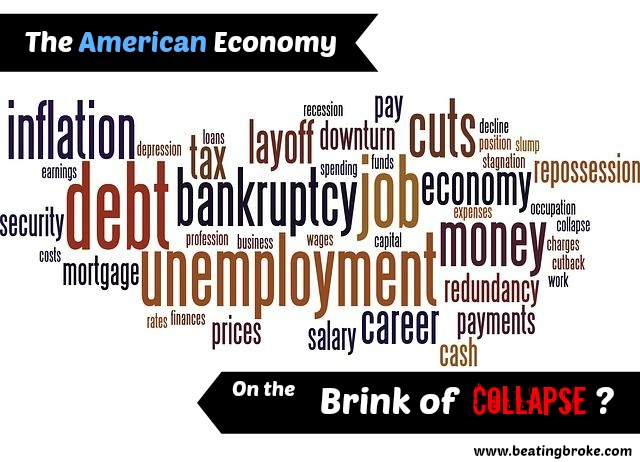
I think it’s normal, during hard times, to consider what might happen should the worst happen.  A recent post by Crystal, asking “Will You See the Collapse of America“, brought the question to the forefront for me.  Is the American Economy on the Brink of Collapse?  Will we see the collapse of America?

First, the optimist in me immediately says no.  There are too many good things going on in our country for it to collapse completely.  The stock market just came off of a really good year.  The job market is, if not rising, holding somewhat steady and certainly isn’t gushing jobs like it was in 2008-2009.  And, up here in North Dakota, we’re working on providing lots and lots of oil.  We just need a little bit more refining capacity to do even better.

But, those aren’t the only indicators.  Crystal points to the slow degradation of our rights, and our ever increasing consumerism as reasons that America might collapse in 100-200 years.  While the loss of rights is something that we have to do something about, our consumerism had shown signs of slowing down.  With the crash of the housing market, the average saving rate had been rising.  From a low in 2005 of 1.5%, to a rate of 5.4% in 2008.  Since then, it’s begun to slowly work it’s way lower, but is still close to 4%.  At the same time, the average consumer debt held has continued to decline.  Maybe, just maybe, we’re making a difference and a better educated population is starting to make the changes that are necessary to be more financially stable.  Now, if only we could convince the government to do the same.

An Economy, Broken.

And, really, when we start talking about the American economy, it’s going to be the government that makes it or breaks it.  After all, you and I can save 100% of our income, but it won’t do a bit of good against a $17 Trillion dollar (and growing) debt.  The truth is, with debt that increases by several Billion each day, the rate of personal savings won’t do a bit of good.  At some point, the countries of the world that use the Dollar as a basis for trade will cease to do so.  The continual weakening of the dollar against the other world currencies (even BitCoin), makes for a potentially disastrous recipe.  It’s very possible that, if spending (and that debt) don’t come down, that the American economy could find itself between a rock and a hard place very soon.  And that could spell a major recession or depression.  How the government reacts to such a thing could be the only indicator of whether the economy ever comes back out of it, and, ultimately, whether the America we know and love continues to exist.

Like Crystal, I think the eventual collapse of the economy is unavoidable.  The government hasn’t made any meaningful steps to reduce debt or spending.  And the majority of the population either don’t see it, or believe that the people that we are electing are going to save us.  Frankly, without a major overhaul of the government, and some changes to who we elect, it may be too late.  Really, it just comes down to how quickly the collapse will come.

Crystal thinks it’s 100-200 years from now.  She may be right as far as the collapse of America.  The country itself might last that long.  The Roman empire lasted for many years before finally collapsing completely, but the signs were there for a very long time.  If I’m being optimistic, I think we might have 4 or 5 years before we see any major collapse of the economy.  But, we’ll start seeing signs even sooner than that.
American Economy on the Brink of Collapse

Signs of the Collapse

What signs, you ask?  There are some broad indicators, like the overall housing market and the stock market.  The rate of inflation as well.  But, unless you’re heavily invested in the stock market, that indicator might not make much difference to you.  Watch for more simple indicators.  The price of gas.  The cost of a gallon of milk.  The cost of produce.  When you combine all the simple indicators that you notice every day with the overall indicators, you should be able to make a pretty good guess which direction the economy is heading.

What next?

Let’s say that I’m right.  In 4-5 years, the American economy collapses.  Maybe it’ll be gradual, or maybe it’ll be a crash for the ages.  Either way, what can you and I do about it?  On the grander scale, not much.  We’re not going to stop the collapse by ourselves.  But, we can push it further off, and we can prepare.

Delaying the Collapse

I’m already taking some steps to delay the collapse of the economy.  How?  By talking about it.  By making people aware of how to best handle their money.  You are too!  By being a good steward of your money, and telling your money how to work for you instead of your money telling you what to do, you’re making your own contribution to the betterment of the overall economy.  We can get involved in politics (I know that sounds like a lot of fun… or not.)  and push our representatives to work harder to reduce debt, reduce deficit spending, and to get it done without any partisan politics.  Just don’t hold your breath that it will happen.  We can also help by not only helping our own finances out, but by also helping our friends and family get their financial houses in order.  It’s a touchy subject, but, ask yourself this; how many of your friends and family do you want knocking on your door when the economy collapses?

Preparing for the Collapse

Even with all that work, the collapse might (probably will) still come. Surviving it will depend wholly on your preparation for it.  I’m not saying you have to go out today and become a prepper.  What I am saying, though, is that you need to start taking steps to be ready.  Start learning how to be more self-reliant.  Learn how to grow some of your own food.  Then learn how to can it and preserve it.  Yes, that might mean creating a little bit of a stockpile like a prepper, but I happen to think we could all do with a bit more sustainability in our lives.

Most of all, have a plan.  What happens in an emergency?  Even if it isn’t caused by the economic collapse of America?  If you were without power for days, how would you keep warm?  How would you eat?  What would you do for a bathroom?  These questions don’t require anything more than a little thought, and maybe some research on solutions!  Have a plan.

What do you think?  Is the American economy on the brink of collapse?

Shane Ede

Shane Ede is a business teacher and personal finance blogger.  He holds dual Bachelors degrees in education and computer sciences, as well as a Masters Degree in educational technology.  Shane is passionate about personal finance, literacy and helping others master their money.  When he isn’t enjoying live music, Shane likes spending time with family, barbeque and meteorology.

www.beatingbroke.com

Filed Under: economy, ShareMe Tagged With: american economy, economy

5 Ways a Better Credit Score Leads to Better Finances

August 30, 2013 By Shane Ede 14 Comments

BookkeepingEverybody knows that you want to have the best credit score you can.  Why?  Because the better your credit score, the better the rates you can get on your loans, of course!  But, did you know that there are other reasons to try and improve your credit score?  In fact, here’s five ways that having a better credit score can lead to better finances.

  1. More money.  This is the obvious one.  A better credit score leads to better rates on loans (see above), and better rates lead to less interest paid over the life of the loan.  And less interest paid leads to…  (wait for it) a  better bank balance!
  2. Better rentals.  It’s a sad fact that many landlords are doing credit checks on prospective tenants these days.  They’ve got assets to protect, so it’s a smart move for them, but the fact that there are so many landlords out there getting burned that it’s become necessary is sad.  But, having a good credit score can help make sure you don’t get turned down for that great apartment down by the beach!
  3. Quicker payoff.  This one goes really closely with the first point.  With those lower rates, and lessened interest also comes the ability to pay the loan off quicker.  And, of course, a quicker payoff means a much better financial situation.  Especially if you avoid any new loans afterward.
  4. Any loan you like.  If you must loan money, at least do it smartly.  With the current state of affairs, you can’t just walk in and get a loan that has a pulse as it’s only requirement.  In fact, many banks and credit unions are cutting way back on their sub-prime lending for anything.  (P.S. the term “sub-prime” doesn’t just apply to mortgage loans) If you have poor credit, it’s much more likely, today, that you’ll get turned down for a loan altogether.  Better credit means that if you really need a loan, you probably can have one.
  5. Less fees.  We all hate fees.  Well, all of us except the financial institutions.  A growing number of them are making a growing amount of their revenues from fees.  And many have moved to an account structure that is based off of risk.  And risk is determined by credit score.  A lower credit score could mean an account with higher fees, or with monthly fees that some accounts might not have, while a higher credit score might qualify you for a different account without those fees.

So, you see, having a good credit score can really send your finances in the right direction.  And, having a bad credit score can really send them into the dumps in a hurry too!  Unless you’re very dedicated to the extreme frugaler lifestyle, and never plan on really using money, it still pays to have a good credit score.  It doesn’t take much to build it, and you might be glad you did someday.

photo credit: o5com

Shane Ede

Shane Ede is a business teacher and personal finance blogger.  He holds dual Bachelors degrees in education and computer sciences, as well as a Masters Degree in educational technology.  Shane is passionate about personal finance, literacy and helping others master their money.  When he isn’t enjoying live music, Shane likes spending time with family, barbeque and meteorology.

www.beatingbroke.com

Filed Under: budget, Credit Score, Debt Reduction, economy, loans, Saving, ShareMe Tagged With: credit, Credit Score, finances, lending, loans

Eminent Domain as a Mortgage Fixer?

August 12, 2013 By Shane Ede 7 Comments

The housing crash of 2008 is still sitting heavy on many homeowners.  Many who bought a house during the peak of the market were left with houses that they’d bought at nearly twice the current value of the home.  Much has been said about the dilemma that those homeowners find themselves in.  As the economy receded, so too did their jobs, and their pay, causing many to simply walk away from their homes when they could no longer afford the mortgage.

Foreclosure is a bit of a messy deal.  The bank takes the home back, and then sells it, attempting to recoup some of the value of the mortgage.  We’ve seen many different methods of attempting to avoid the bulk foreclosure of homes in America.  From Government sponsored programs that help with restructuring of the loan, to banks voluntarily restructuring the loan, to what is a rather disturbing new program in Richmond, CA.

The program is laid out in this recent article on CNN Money. (California city’s drastic foreclosure remedy: seizure)  In the article, the City has started a program to attempt to purchase the mortgages of many underwater loans in the city.  It’s an attempt to avoid the decline of low-income neighborhoods, and those neighborhoods already hit hard by the economy.  Seems pretty normal, until you read a bit further.

But if the holders of the loans, who are mostly investors, refuse to sell by Aug. 14, the city said it will invoke eminent domain to seize the mortgages so it has more control over the process of making them affordable.

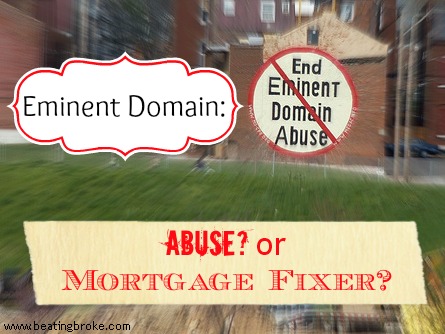
Eminent Domain Mortgage FixerThat’s right.  If the investors refuse to sell by August 14th, the city will invoke eminent domain and seize the mortgages in order to bring those mortgages into the program.

There are several things at play here.  I don’t argue that there are many who are nearing foreclosure, and that in many cases, they were preyed upon by the banks and investors by being given loans for houses they couldn’t afford in the first place.  I don’t think that excuses the buyers from not knowing that they couldn’t afford the mortgage.  I’m sure there are those that could afford the house at the time of purchase, but have since fallen on hard times.  In some cases, I do think that there should be something in place to help people ease the pain of their mortgage.  But, that’s another article.

Back to Richmond, CA, and their silly new program.  They plan on using eminent domain to seize the mortgage.  As is pointed out in the CNN Money article, eminent domain is usually used by public entities to seize physical properties to make way for public parks, malls, and right-of-ways for transportation initiatives.

[Tweet “The city of Richmond, CA is threatening to use eminent domain to seize the mortgages of home nearing foreclosure.”]

The article alludes to the fact that eminent domain, to be legal, must be used for that are in the public interest.  Meaning that the people of the city (or neighborhood) must have something to gain from the seizure. I think this is a bit of a grey area, and is likely to end up in court.  It’s legality, in the seizure of only certain mortgages, and not the mortgages of the entire neighborhood, makes its usage for the public interest somewhat shaky.  After all, who among us wouldn’t want to participate in a program that cut our mortgage in half and reduced the payments by the same?  Absolutely!  But, who among us has anything to gain by having our neighbor across the street participate in the program, and not us?  Yeah.  Even if I can afford my mortgage, I’d be a bit jealous.  If I really wanted to cause a scene, I’d sue the city.

Legality aside, I still think the program is a mistake.  Many places around the country are facing the same dilemma, and many are trying to find innovative solutions to fix the problem.  The city of Detroit just declared bankruptcy because the population of the city, and thus it’s tax-base, has dropped so drastically over recent years.  Perhaps the city of Richmond fears the same problem.  What they should be spending their time fixing, however, is their local economy.  They’ll spend all kinds of money executing this program, then defending it in court, only to still have the same economy.

If they can find ways to improve the economy by pushing local businesses, promoting local producers, and making improvements to the structures to do so, I think they’ll find that many of those foreclosures start getting picked up by new homeowners.

Maybe I’m wrong.  I’m certainly not an expert in economics, least of all economics in California.  What do you think?  Is the usage of eminent domain here a valid one?  Will it be challenged legally?  How would you feel if your city had a program like this?

Original image credit: End Eminent Domain Abuse by Paparutzi, on Flickr

Shane Ede

Shane Ede is a business teacher and personal finance blogger.  He holds dual Bachelors degrees in education and computer sciences, as well as a Masters Degree in educational technology.  Shane is passionate about personal finance, literacy and helping others master their money.  When he isn’t enjoying live music, Shane likes spending time with family, barbeque and meteorology.

www.beatingbroke.com

Filed Under: economy, Financial News Tagged With: eminent domain, foreclosure, mortgage

  • « Previous Page
  • 1
  • 2
  • 3
  • 4
  • 5
  • 6
  • …
  • 12
  • Next Page »
  • Facebook
  • Pinterest
  • RSS
  • Twitter

Improve Your Credit Score

Money Blogs

  • Celebrating Financial Freedom
  • Christian PF
  • Dual Income No Kids
  • Financial Panther
  • Gajizmo.com
  • Lazy Man and Money
  • Make Money Your Way
  • Money Talks News
  • My Personal Finance Journey
  • Personal Profitability
  • PF Blogs
  • Reach Financial Independence
  • So Over Debt
  • The Savvy Scot
  • Yes, I am Cheap

Categories

Disclaimer

Please note that Beating Broke has financial relationships with some of the merchants mentioned here. Beating Broke may be compensated if consumers choose to utilize the links located throughout the content on this site and generate sales for the said merchant.

Visit Our Advertisers

Need to change careers? Consider an Accounting Certificate Program from WTI.