
Beating Broke

Personal Finance from the Broke Perspective

  • Home
  • About
  • We Recommend
  • Contact
  • Privacy Policy

Powered by Genesis

Renting or Buying a Home?

April 18, 2011 By Shane Ede 11 Comments

Which is the better way to go? There are several arguments for both sides with people arguing that the added costs of homeowner-ship making renting the more expensive or that rent paid is money lost that could have been going towards building equity in your home. I’m on the homeowner side of things. We own our home. And, we do have a mortgage.

There are several reasons that we own a home.  One of the biggest is cost.  Our mortgage, taxes, PMI, and insurance all come to only about $500 a month.  To rent a home of equal size, in our area, would cost at least $650, if not more.  It’s more cost effective for us to own, if you only take that into account.  There are added costs to owning a home.  Repairs and maintenance are an added cost that is unavoidable, but I look at it as another investment into the place I live.  And, many of the improvements that we’ve done (see kitchen for instance) would have never been done had the house been a rental, and they’ve greatly improved the livability of the house. When it comes down to it, buying a home just makes sense.

I can clearly see the argument, in some parts of the country (and world) for renting over buying.  I can also see situations where renting is just the smarter thing to do.  But, for most, I just don’t see how it can work out in your favor.  Why put money into someone elses pockets, when you could be putting it into yours?  Even if your house doesn’t appreciate in value at all (or, even depreciates) you’ll still be left with something of some value when you’re done with it.  Over those same 15-30 years of renting, what will you have?  Nothing but a good renter history.

The mathematics of the rent vs. buying can get a bit complicated when people start talking about lost gains on investments and throw in interest, appreciation/depreciation, and the like.  I found this cool calculator that does most of that for you.  Hit the deluxe tab to really throw in a ton of variables.  If you’re a homeowner, punch in your numbers and see if it is worth it for you to buy or to rent.  I put our numbers in (that’s them in the picture), and, as I suspected, it’s better for us to buy vs. rent.  I have played a bit with it, and I think it’s a bit skewed towards buying vs renting, but not so much so that it makes it not fairly accurate.

I think another good thing that the calculator does, is give you a better idea of what the different variables can do to the situation.  Try playing with the appreciation numbers, or the return on investment number, or the length of mortgage, and see what that does to your situation.

Where are you on the rent vs. buy spectrum?  Do you own?  Why, or, why not?

Shane Ede

Shane Ede is a business teacher and personal finance blogger.  He holds dual Bachelors degrees in education and computer sciences, as well as a Masters Degree in educational technology.  Shane is passionate about personal finance, literacy and helping others master their money.  When he isn’t enjoying live music, Shane likes spending time with family, barbeque and meteorology.
www.beatingbroke.com

Filed Under: Home, ShareMe Tagged With: buy, calculator, Home, homeowner, rent

Early Morning Reality Check

March 10, 2011 By Shane Ede 13 Comments

Early yesterday morning, I awoke to my wife jumping out of bed.  “Do you smell smoke?” She asked.  Let me tell you, there are few things that will pull you out of that just woke up groggy state than a question like that.  And, sure enough, I did.  A quick check told me that there was no visible fire or smoke in the upstairs portion of our house.  It wasn’t clear what the source of the smell was.  I quickly ran downstairs to check the rest of the house, fully expecting to find a smoldering spot somewhere.  Nothing.  Down to the basement.  Nothing.  Back upstairs.  Still nothing, but the smell is still there.  I went from room to room, floor to floor, sniffing the air trying to pinpoint where the smell was strongest.  The good news was that it wasn’t getting any stronger, but I still didn’t have  source for it. The only thing that I can find is that the furnace doesn’t seem to be working.

By this point, my wife has gotten the kids up, and is working on getting them dressed just in case we have to make a hasty exit from the house.  There isn’t any immediate danger, I don’t think, but you just never know.  It just so happens that a close friend is a member of the rural fire department here.  We’re in the city fire department district, but it doesn’t hurt to ask, so we called him for some quick advice.  I quickly fill him in, and he suggests that I call the city fire department and have them come check the house for carbon monoxide and also do a hotspot check with their thermal imager.  I certainly didn’t have to be told twice, so that’s exactly what I did.

A couple firefighters show up, give the house a quick once over and come to the same conclusion that I have.  The furnace has gone out.  And, for some reason, has filled the house with the smell that we awoke to.  They can find no hot spots, and the CO tester is not indicating any CO threat.  We cut the power to the furnace, and everyone agrees that there is no immediate threat.  We can go about our business.  Well, with the exception of calling the furnace repair folks in to figure out what’s wrong with the furnace.  Some of you might not think it’s a big deal, but we still haven’t seen 30 degrees in March.  The nightly lows are in the single digits.  In just the short time that the furnace has been out, the temperature in the house has dropped 10 degrees.

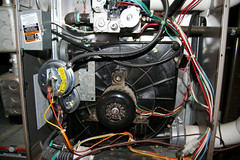
Gas Furnace Blower Motor -- IMG_9823I called the furnace repair company, and, to my surprise, they sent one out right away.  Luckily, I caught the guy as he was headed out the door for a call, so he could easily be rerouted to our house.  A couple hours later, and we had a working furnace again.  Turns out, the blower motor that pushes the air through the ductwork and into the house had stopped working.  It lost its bearings.  Literally.  The result was that it started to leak some lubricant oil and actually melted some of the electrical work in its housing which is what made the stink.  The company bills for the repair, so we only have an estimate as to what the cost of the repair will be.  The repairman thinks less than $200.

We’re lucky.  We’re lucky, because our house didn’t catch fire.  We’re lucky, because we aren’t trying to figure out how we can live out of a motel room until our fire damaged house can be repaired, or, worse, until we can find a new house to replace our destroyed house.  We’re lucky, because we aren’t trying to figure out how we’ll replace any of our belongings.  We’re lucky, because we’re safe.

But, to a lesser degree, we’re lucky, because we can afford the repair.  It wasn’t that long ago that an unexpected bill for $200 would have had us wondering if we were going to have to choose bills to go unpaid.  But, we took control of our finances.  We’ve got a long way to go, but, a $200 emergency doesn’t mean that a bill goes unpaid.  And, that makes us feel safe too.

photo credit: stevendepolo

Shane Ede

Shane Ede is a business teacher and personal finance blogger.  He holds dual Bachelors degrees in education and computer sciences, as well as a Masters Degree in educational technology.  Shane is passionate about personal finance, literacy and helping others master their money.  When he isn’t enjoying live music, Shane likes spending time with family, barbeque and meteorology.

www.beatingbroke.com

Filed Under: Financial Miscellaneous, General Finance, Home Tagged With: emergency, emergency fund, fire, furnace, furnace repair

The Cost of Not Doing it Yourself

January 19, 2011 By Shane Ede 6 Comments

The Problem

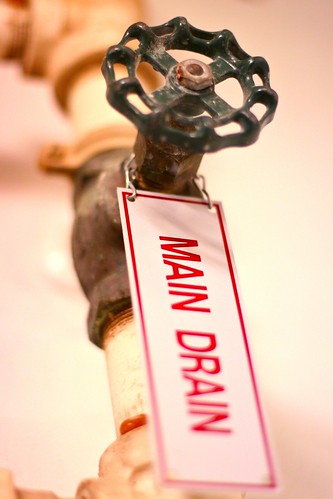
Recently, I became aware of a slight water problem (as if the word slight has any business hanging out with the words water and problem) in our basement.  Somewhere between when our house was built and when we bought it, the bathroom had been rearranged.  The plumber (or DIY’er) who did the work, rather than move the lines and start fresh, merely just capped the old water supply lines off.  The standard caps worked (and work) just fine.  However, one of the caps wasn’t really a cap.  It was a shutoff valve.  Whoever it was merely capped the output of the valve and turned the valve to the shut position and left it at the end of the line.  Any engineer will tell you that the more moving parts and connections there are, the higher the liability of failure.  Eventually, the metal of the valve began to corrode.  It corroded until it began to leak.  Which is where I come in.

While downstairs, I noticed that one of our kids’ buckets that was being stored for the winter was full of water.  There weren’t any obvious leaks, and the concrete floor around it was dry.  I couldn’t find a good reason why someone would have filled it with water and then taken it down to the basement, so I took a bit closer look.  Turns out, that valve was leaking.  Slowly enough, thankfully, that it wasn’t causing any problems.  According to my wife, who noticed the leak months ago (BAD wife!!!), it’s been leaking for a while.

November 2, 2010

The Fix

As with any issue like this, I’ve got two choices.  I can call a plumber and get it fixed, or I can attempt to fix it myself.  I’m pretty comfortable with building things and fixing most things.  Electrical and plumbing are probably the two things that I don’t like to mess with.  When we replaced the sink in our kitchen, it took 3 attempts and several months of trying before I had a working sink without any leaking.  I did manage to remodel the bathroom recently though, and replaced the toilet without any major issues.  So, going off of that, I decided to see what was involved by doing a few searches online.

After my research, I found that there are essentially only one or two ways to go about fixing the issue.  All involve cutting the pipe off, and re-capping it.  Or, properly capping it, as the case may be.  The 100% best way would be to cut the pipe, and then flux and solder on a new cap.  Done right, it’s almost impossible to break and a pretty good guarantee to never leak.  The problem here is that I’ve never done any of that and don’t own a torch, so would have to buy one of those.  They’re not expensive, but would certainly add to the cost for a tool that I have infrequent enough use for that I don’t already own one.  The second way would be to put what is called a compression fitting over the end of the cut off pipe.  The idea there is that there’s a compression ring in the fitting that, as the nuts are tightened, compresses the pipe into the fitting and creates a watertight seal.  No special tools necessary.

I hadn’t done either before, so it was still up in the air.  Add to that the fact that there is no water cutoff to that part of the house and the water to the entire house would have to be shut off once the project started and remain off until the project finished.

In the end, I did decide to give it a go myself.  My reasoning was that the worst case scenario wasn’t all that bad.  Worst case, I can’t get it fixed and have to call a plumber.  I’m out the money for the parts (~$10) and the water in the house would be off until the plumber came.  Even if the plumber is super busy, I doubt it would be more than a day of waterless-ness.  Inconvenient?  Sure. But, it could be a lot worse, so not horribly worrisome.  Worst case, it costs me some money and some water free time in the house.  We’ve got friends who live close enough that we could use their house for water activities like showering.  And a couple of gallons of filled water jugs would be enough for emergency flushing of the toilet.

How it went down.

I’ve never had the pleasure of a DIY plumbing project going right the first time.  Until now.  The procedure was certainly not an overly complicated one.

  • I turned the water off to the house.
  • I cut the old fitting off, making sure to get the cut as square as possible.  As a note, I tried to drain the pipes before cutting the old fitting, but very little water came out.  I left the drain hose open while I was cutting.  Once I had the old fitting off, the rest of the water drained from the drain hose.  I believe this was because it had created a vacuum of sorts and it was only released when I opened up the other end to vent.
  • I then took a bit of sandpaper (160 grit, I believe) and sanded all the old grime and corrosion off of the end of the pipe.  Not sure that this was really necessary for the compression fitting that I decided on, but better safe than sorry.
  • As soon as that was done, it was as simple as putting the fitting on the pipe and tightening it down.

Not only was it pretty simple and easy, but it didn’t leak when I turned the water back on.  Awesome!

The Cost of Not Doing it Yourself

There’s one other cost involved that I didn’t mention, and, it may be the most important.  It’s the cost of not doing it yourself.  Sure, it would have cost me the cost of the plumber to fix it.  But, it would have also cost me in experience.  I learned a new skill.  Granted, capping a household supply line isn’t necessarily high up there on a list of desired skills, but I won’t hesitate to do it again.  Plus, I’m now able to assist others who have a similar task and save them money too.  To me, that adds value to having done it myself.  It’s like getting paid to do it.  When you add all that up, the cost of not doing it yourself is almost always too much.

photo credit: silkolive

Shane Ede

Shane Ede is a business teacher and personal finance blogger.  He holds dual Bachelors degrees in education and computer sciences, as well as a Masters Degree in educational technology.  Shane is passionate about personal finance, literacy and helping others master their money.  When he isn’t enjoying live music, Shane likes spending time with family, barbeque and meteorology.

www.beatingbroke.com

Filed Under: Frugality, Home, ShareMe Tagged With: diy, do it yourself, plumbing

  • « Previous Page
  • 1
  • …
  • 30
  • 31
  • 32
  • 33
  • 34
  • …
  • 37
  • Next Page »
  • Facebook
  • Pinterest
  • RSS
  • Twitter

Improve Your Credit Score

Money Blogs

  • Celebrating Financial Freedom
  • Christian PF
  • Dual Income No Kids
  • Financial Panther
  • Gajizmo.com
  • Lazy Man and Money
  • Make Money Your Way
  • Money Talks News
  • My Personal Finance Journey
  • Personal Profitability
  • PF Blogs
  • Reach Financial Independence
  • So Over Debt
  • The Savvy Scot
  • Yes, I am Cheap

Categories

Disclaimer

Please note that Beating Broke has financial relationships with some of the merchants mentioned here. Beating Broke may be compensated if consumers choose to utilize the links located throughout the content on this site and generate sales for the said merchant.

Visit Our Advertisers

Need to change careers? Consider an Accounting Certificate Program from WTI.