Beating Broke

Personal Finance from the Broke Perspective

  • Home
  • About
  • We Recommend
  • Contact
  • Privacy Policy

Powered by Genesis

Saving Money by Cooking at Home

November 17, 2010 By Shane Ede 4 Comments

On the long list of things that you can do while saving money, one thing that invariably makes it’s way to the top 10 is to brown bag lunches and to cook at home.  If you’ve ever sat down and figured out how much you spend eating out each month (we have, it’s in the budget), you know that food, and dining out in particular, can be  a real drain on the budget.

One thing that really holds many people back from cooking at home and even from taking bag lunches to work is that they never really learned how to cook.  Either their parents never brought them into the kitchen to help, or their parents just never cooked at home either.  Either way, many of the simple skills that those who do cook take for granted are a complete mystery to others.  Some of those skills are being replaced with machines and such that can do the task, but those are usually expensive and if you’re trying to save money, aren’t really an option.
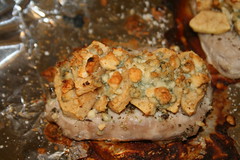
Pork Chop with Apples and Blue CheeseBut, it’s not an excuse!  You can learn those skills rather easily.  Need to know how to boil an egg?  Search for “boil an egg” on the internet.  Anyone who can read, can make their own food.  With the internet at our fingers, you can easily search for recipes.  Stuffing?  How about Pineapple Stuffing.  Chicken?  Here’s a whole list of chicken breast recipes! Here’s instructions on how to make beef jerky!  Most have pretty detailed instructions.  And, besides, what’s the worst that could happen?  You ruin some food?  I’d bet you could try at least once or twice more and still not equal what the same meal would cost at a restaurant!

The bottom line is this.  Not knowing something isn’t an excuse.  Some things will take time to learn, but you can learn many of these basic skills, with repeated practice, in less than a month.  Challenge yourself!  Take a month off of eating out.  Only eat in for those 30 days.  And, no, I don’t mean delivery.  Or Digiornos.  Start with raw ingredients and go from there, using a recipe.  After a while, you get to know how certain things taste and how they go together and you can even forget the recipe.

Photo Credit: thatedeguy, on Flickr

Shane Ede

Shane Ede is a business teacher and personal finance blogger.  He holds dual Bachelors degrees in education and computer sciences, as well as a Masters Degree in educational technology.  Shane is passionate about personal finance, literacy and helping others master their money.  When he isn’t enjoying live music, Shane likes spending time with family, barbeque and meteorology.

www.beatingbroke.com

Filed Under: budget, Frugality, Home, Saving, ShareMe

Obligations of the Buyer

November 12, 2010 By Shane Ede 4 Comments

With all the news lately about people “walking away” from their mortgages, increasing bankruptcies, and debt consolidation/repayment schemes, I got to thinking about what the obligations of the buyer are.  And, also, the ways that we as a society have made it easy to sidestep those obligations.

Obligations

What are our obligations when we buy something?  Does buying a pack of gum carry different obligations than buying a house?  Naturally, we have obligations to ourselves as to the upkeep and use of that which we buy.  If I buy a house, I have an obligation to myself to do what I can to make that house last as long as possible and remain structurally sound.  If I buy a pack of gum, it’s a lesser commitment, but that obligation still exists as an obligation to not let my purchase go to waste and either chew the gum or give it to someone to chew.

What obligations to we have to the seller when we buy something?  There are two ways to look at this.  The first scenario involves paying cash for something.  If the full purchase price that was negotiated is satisfied, I don’t believe you have any obligation to the seller.  However, if the purchase involves debt of some sort, there are obligations that arise.  If you purchase with a credit card, there is an obligation to pay that debt to the credit card company.  The same is true for a mortgage, a car, and even a pack of gum.  Not only do you have an obligation to pay the debt, but you also have another obligation to yourself to learn what that debt is going to cost you.  This last obligation is the one that was most ignored during the fiasco that we like to call a housing bubble.  Many ignored the facts of what their new houses were going to cost and bought them anyways.

Sidesteps

In the pursuit of a consumerist society, these obligations can sometimes get in the way.  If I ignored the obligation to know the cost of debt and bought a house anyways, I likely entered into an agreement to pay a mortgage company a set amount each month.  Recently, it’s become popularized to demonize the banks that lent the money to people as the sole problem and, as a result, it’s become no big deal to merely “walk away” (default, or stop paying) on a mortgage.  The reasoning follows that it’s better to default on the mortgage than remain paying on a house that is worth less than what the purchase price was, or that has had payments adjusted higher.

Bankruptcy OK!In the same way, the obligation to pay credit card bills, auto loans, and most other consumer debt has been sidestepped.  It’s no longer a social stigma to declare bankruptcy.  Many, knowing they are about to file for bankruptcy, will go out and max out their credit lines in anticipation of the bankruptcy cleaning the slate.

As these sidesteps become more and more common, the social stigma will decrease even further.  If everybody is doing it, it’s hard to demonize something.  You might demonize your friend.  Or relative.

Of course, this isn’t to say that defaulting on a mortgage should never happen.  Or that bankruptcy should never be declared.  It happens.  It’s the rampant social acceptance of these situations that is troubling.  What happens when it becomes commonplace for mortgage borrowers to default?  The loans become more expensive.  The banks have to cover their costs to repossess the house, the staff to service the loan, and associated costs with trying to resell the house.  Where is that money going to come from?  They aren’t going to just pay it out of the kindness of their hearts.  They’ll pass it on to the customer.  Suddenly, mortgages will become even more front loaded with fees and interest.  When bankruptcies become more commonplace, credit availability is going to decrease.  We’ve already seen that recently.  People who could easily get a credit card before will be denied.

All of this is all the more reason to avoid debt whenever possible.  If society isn’t going to do it, hold yourself to your obligations as a buyer.  Obligate yourself to paying off your debt.  Then, obligate yourself to paying in cash from then on.

photo credit: EJP Photo

Shane Ede

Shane Ede is a business teacher and personal finance blogger.  He holds dual Bachelors degrees in education and computer sciences, as well as a Masters Degree in educational technology.  Shane is passionate about personal finance, literacy and helping others master their money.  When he isn’t enjoying live music, Shane likes spending time with family, barbeque and meteorology.

www.beatingbroke.com

Filed Under: Consumerism, credit cards, Credit Score, Debt Reduction, Home, ShareMe Tagged With: bankruptcy, credit cards, default, mortgage, obligations, obligations of the buyer

How You Know Coins are Worthless

October 1, 2010 By Shane Ede 8 Comments

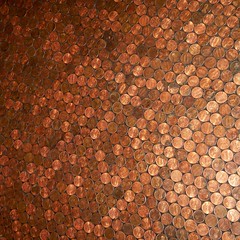
Penny Floor:  Hotel CongressIn today’s economy, with today’s prices, coins have become nearly worthless.  We all know that the penny costs more to manufacture than it is “worth”.  When was the last time you paid for anything with a few pennies?  Or with a few nickels?  Heck, even paying for anything with a few quarters is becoming a bit harder to do.

So, how do you know when coins are worthless? (besides their worth being less than metallic value)  People start using them regularly (and even commercially) for purposes other than as currency.  Like, I dunno, maybe using coins as an alternative to tile.  Someone has used Nickels to tile their bathroom floor.  There’s several instances of Pennies being used as tile.  A bathroom tiled with pennies. And an entire restaurant floor.

Kinda looks cool, actually.  I can’t find a figure on the pennies, but according to the post, the nickel floor has 195 nickels per square foot.  Or, about 9.75 a square foot for flooring.  Kind of expensive for flooring, really.  You can get cheap ceramic tile for less than $3 a square foot.  If I had to guess, I’d bet that the pennies are comparable to that price though.  Maybe you could even design a mosaic of some sort.  Lincoln’s bust in pennies surrounded by nickels for a background, perhaps.

What’s next?  Wallpapering with $1 bills?  That might look kinda cool.

Image credit: Penny Floor: Hotel Congress by cobalt123, on Flickr

Shane Ede

Shane Ede is a business teacher and personal finance blogger.  He holds dual Bachelors degrees in education and computer sciences, as well as a Masters Degree in educational technology.  Shane is passionate about personal finance, literacy and helping others master their money.  When he isn’t enjoying live music, Shane likes spending time with family, barbeque and meteorology.

www.beatingbroke.com

Filed Under: economy, Green, Home, ShareMe Tagged With: coin tile, nickel, nickel tile, nickels, pennies, penny, penny tile

  • « Previous Page
  • 1
  • …
  • 31
  • 32
  • 33
  • 34
  • 35
  • …
  • 37
  • Next Page »
  • Facebook
  • Pinterest
  • RSS
  • Twitter

Improve Your Credit Score

Money Blogs

  • Celebrating Financial Freedom
  • Christian PF
  • Dual Income No Kids
  • Financial Panther
  • Gajizmo.com
  • Lazy Man and Money
  • Make Money Your Way
  • Money Talks News
  • My Personal Finance Journey
  • Personal Profitability
  • PF Blogs
  • Reach Financial Independence
  • So Over Debt
  • The Savvy Scot
  • Yes, I am Cheap

Categories

Disclaimer

Please note that Beating Broke has financial relationships with some of the merchants mentioned here. Beating Broke may be compensated if consumers choose to utilize the links located throughout the content on this site and generate sales for the said merchant.

Visit Our Advertisers

Need to change careers? Consider an Accounting Certificate Program from WTI.