Beating Broke

Personal Finance from the Broke Perspective

  • Home
  • About
  • We Recommend
  • Contact
  • Our Editorial Commitment

Powered by Genesis

American Economy on the Brink of Collapse?

February 10, 2014 By Shane Ede 22 Comments

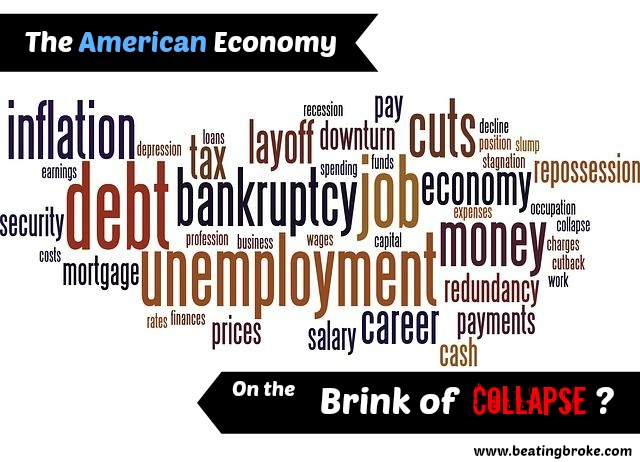
I think it’s normal, during hard times, to consider what might happen should the worst happen.  A recent post by Crystal, asking “Will You See the Collapse of America“, brought the question to the forefront for me.  Is the American Economy on the Brink of Collapse?  Will we see the collapse of America?

First, the optimist in me immediately says no.  There are too many good things going on in our country for it to collapse completely.  The stock market just came off of a really good year.  The job market is, if not rising, holding somewhat steady and certainly isn’t gushing jobs like it was in 2008-2009.  And, up here in North Dakota, we’re working on providing lots and lots of oil.  We just need a little bit more refining capacity to do even better.

But, those aren’t the only indicators.  Crystal points to the slow degradation of our rights, and our ever increasing consumerism as reasons that America might collapse in 100-200 years.  While the loss of rights is something that we have to do something about, our consumerism had shown signs of slowing down.  With the crash of the housing market, the average saving rate had been rising.  From a low in 2005 of 1.5%, to a rate of 5.4% in 2008.  Since then, it’s begun to slowly work it’s way lower, but is still close to 4%.  At the same time, the average consumer debt held has continued to decline.  Maybe, just maybe, we’re making a difference and a better educated population is starting to make the changes that are necessary to be more financially stable.  Now, if only we could convince the government to do the same.

An Economy, Broken.

And, really, when we start talking about the American economy, it’s going to be the government that makes it or breaks it.  After all, you and I can save 100% of our income, but it won’t do a bit of good against a $17 Trillion dollar (and growing) debt.  The truth is, with debt that increases by several Billion each day, the rate of personal savings won’t do a bit of good.  At some point, the countries of the world that use the Dollar as a basis for trade will cease to do so.  The continual weakening of the dollar against the other world currencies (even BitCoin), makes for a potentially disastrous recipe.  It’s very possible that, if spending (and that debt) don’t come down, that the American economy could find itself between a rock and a hard place very soon.  And that could spell a major recession or depression.  How the government reacts to such a thing could be the only indicator of whether the economy ever comes back out of it, and, ultimately, whether the America we know and love continues to exist.

Like Crystal, I think the eventual collapse of the economy is unavoidable.  The government hasn’t made any meaningful steps to reduce debt or spending.  And the majority of the population either don’t see it, or believe that the people that we are electing are going to save us.  Frankly, without a major overhaul of the government, and some changes to who we elect, it may be too late.  Really, it just comes down to how quickly the collapse will come.

Crystal thinks it’s 100-200 years from now.  She may be right as far as the collapse of America.  The country itself might last that long.  The Roman empire lasted for many years before finally collapsing completely, but the signs were there for a very long time.  If I’m being optimistic, I think we might have 4 or 5 years before we see any major collapse of the economy.  But, we’ll start seeing signs even sooner than that.
American Economy on the Brink of Collapse

Signs of the Collapse

What signs, you ask?  There are some broad indicators, like the overall housing market and the stock market.  The rate of inflation as well.  But, unless you’re heavily invested in the stock market, that indicator might not make much difference to you.  Watch for more simple indicators.  The price of gas.  The cost of a gallon of milk.  The cost of produce.  When you combine all the simple indicators that you notice every day with the overall indicators, you should be able to make a pretty good guess which direction the economy is heading.

What next?

Let’s say that I’m right.  In 4-5 years, the American economy collapses.  Maybe it’ll be gradual, or maybe it’ll be a crash for the ages.  Either way, what can you and I do about it?  On the grander scale, not much.  We’re not going to stop the collapse by ourselves.  But, we can push it further off, and we can prepare.

Delaying the Collapse

I’m already taking some steps to delay the collapse of the economy.  How?  By talking about it.  By making people aware of how to best handle their money.  You are too!  By being a good steward of your money, and telling your money how to work for you instead of your money telling you what to do, you’re making your own contribution to the betterment of the overall economy.  We can get involved in politics (I know that sounds like a lot of fun… or not.)  and push our representatives to work harder to reduce debt, reduce deficit spending, and to get it done without any partisan politics.  Just don’t hold your breath that it will happen.  We can also help by not only helping our own finances out, but by also helping our friends and family get their financial houses in order.  It’s a touchy subject, but, ask yourself this; how many of your friends and family do you want knocking on your door when the economy collapses?

Preparing for the Collapse

Even with all that work, the collapse might (probably will) still come. Surviving it will depend wholly on your preparation for it.  I’m not saying you have to go out today and become a prepper.  What I am saying, though, is that you need to start taking steps to be ready.  Start learning how to be more self-reliant.  Learn how to grow some of your own food.  Then learn how to can it and preserve it.  Yes, that might mean creating a little bit of a stockpile like a prepper, but I happen to think we could all do with a bit more sustainability in our lives.

Most of all, have a plan.  What happens in an emergency?  Even if it isn’t caused by the economic collapse of America?  If you were without power for days, how would you keep warm?  How would you eat?  What would you do for a bathroom?  These questions don’t require anything more than a little thought, and maybe some research on solutions!  Have a plan.

What do you think?  Is the American economy on the brink of collapse?

Shane Ede

Shane Ede is a business teacher and personal finance blogger.  He holds dual Bachelors degrees in education and computer sciences, as well as a Masters Degree in educational technology.  Shane is passionate about personal finance, literacy and helping others master their money.  When he isn’t enjoying live music, Shane likes spending time with family, barbeque and meteorology.
www.beatingbroke.com

Filed Under: economy, ShareMe Tagged With: american economy, economy

January Financial Reset

January 17, 2014 By Shane Ede 4 Comments

You’ve had your fun.  You spent the holidays with your loved ones, did some frugal gift giving (right?), and probably ate way more than you should have.  But, the new year is upon us, and it’s time to get back to business.  It’s time for a January financial reset.

With tax season right around the corner, there’s no better time to get all your financial books from the last year in order, take a good look at the balance sheet, and decide on the directions you’re going to take your finances in the coming year.  For some of you, that will mean finally getting a handle on your debt.  For others, it will mean finally paying off your debt.  And for more of you, it will mean finding the best ways to make your money work for you as you build your net worth and make strides towards financial independence.

For those in that last group of people, this post isn’t likely to help much, but you might want to take a peek at my Lending Club page for a great way to keep your money working for you.  The rest of you, stick around.

Reformulate your debt

January Financial ResetIf you’ve still got debt hanging around, a new year financial reset is a great time to investigate reformulating it. What the heck does that mean?  It means taking a good look at the debt that you’re carrying, and considering the options you may have to pay it off earlier.

  • Reduce the rates: The worst feature of credit card debt is the interest rate that they like to charge.  12%, 15%, 22%, or more.  The interest payments eat into any payment you make on the debt quickly, and make it that much harder to make any meaningful progress.  If’ you’ve got good credit, consider finding some good 0% balance transfer cards to transfer your existing balances to.  You should be able to find something with a 12 to 15 month 0% rate.  Be aware of the balance transfer fee when you do this, but otherwise it can be a good way to help you make some good progress on your credit card debt repayment.
  • Refinance: In some cases (mostly secured debt) you may want to look into a refinance of the loan.  If you can reduce the rate on a loan and extend the length of it, it can free up some of your debt repayment money to go towards loans with higher rates and speed up your debt snowball.

Recalculate your debt snowball

Now is also a really good time to update all the numbers on your debt snowball plan.  (or debt avalanche if you’re so inclined) Unless you’ve been keeping it updated throughout the year, the numbers are probably pretty out of date, and need to be freshened.  Take the time, while you’re doing this, to determine if you need to move one debt ahead of another, or if you can afford to increase the snowball payment to speed it up.

Seed your budget

Your budget can be the lifeline for your financial life.  It’s a blueprint for how you’re building your financial house.  Even a simple budget can help tremendously, and the beginning of the year is a great time to give your budget a full inspection (or just to start one) and make sure that it’s got all the categories you need, that it’s still balancing, and for planning out where you’re going to focus your efforts in the new year.

Examine your bills

We all get bills throughout the month.  In many cases, we throw them in a pile, then enter them into bill pay, (or, gasp, write checks) and then forget about them until they show up the next month.  While you’re going through your finances from the previous year, pay attention to the bills that you’re paying.  Are there bills that have increased?  How about ones that you meant to cancel the service but didn’t?  Or maybe there are some that you just haven’t called to try and get a better rate for?  Know what time it is?  You guessed it.  It’s time to cancel that service. It’s time to call and see why the rate increased, and if there’s a change you can make to get a better rate.  It’s time to compare your services with their competitors and see if there isn’t a better rate/service available out there.  You may think it’s a waste, but you could end up saving hundreds a month.  And that can quickly make your debt snowball grow!

Keep on your financial path

Here’s the most important thing you have to take away from this post.  You’ve got to keep on that path.  Once you’ve done the things above, you’ve taken some really solid steps on your path to being debt free, but they’ll only work if you keep working with them.  Keep that budget going, keep a close eye on your bills, keep your snowball updated, and know how much debt (and at what rate) you have left.  Whether your debt feels like a mountain, or just a molehill, knowing the what/when/where of it make the climb that much easier.

Will you take the time to do a January Financial Reset?

Shane Ede

Shane Ede is a business teacher and personal finance blogger.  He holds dual Bachelors degrees in education and computer sciences, as well as a Masters Degree in educational technology.  Shane is passionate about personal finance, literacy and helping others master their money.  When he isn’t enjoying live music, Shane likes spending time with family, barbeque and meteorology.

www.beatingbroke.com

Filed Under: budget, credit cards, Debt Reduction Tagged With: balance transfer, debt avalanche, debt snowball, financial reset, Saving

Lending Club Returns Update 4Q13

January 6, 2014 By Shane Ede 4 Comments

Another quarter has come and gone, so it’s time for an update on the Lending Club returns I’ve been getting on my account.  At the end of the third quarter, my account was sitting at a return rate of 14.69%.  It’s actually improved a bit since then, but Lending Club has also added the ability to adjust the displayed NAR, which does some funny stuff (see below) and reduces the rate a bit.  I think that’s a good thing (again, see below) and that’s the rate I’ll likely be using for future updates.

Lending Club Adjusted NAR

A few months back, Lending Club introduced what they’re calling an adjusted NAR.  Basically, it uses the historical charge off rates of loans at the different stages of delinquency.  Obviously, the current loans have a historical rate of charge off of 0%.  Once they go into the Grace Period, about 23%, 16-30 days late, about 49%, 31-120 days late, about 72%, and in full default, about 86%.Beating Broke Lending Club Update

As an example, my portfolio currently has two notes that are in the 31-120 days late category.  So, when Lending Club is adjusting my NAR, they use the 72% figure and assume that 72% of the principle will be lost.  Using that number, they then calculate the new, adjusted NAR.  With the two notes late, my adjusted NAR is currently showing as 13.16%.  Still a very healthy number, and likely a more realistic number.  I like the new adjustment, as it should give investors a more realistic number to look at.

Lending Club Defaults and Late Notes

As I mentioned above, my portfolio currently has two notes that are 31-120 days delinquent.  And, if you go by the historical numbers, those two notes have about a 72% chance of eventually going into collections.  I’ve been lucky enough to only have had one note actually go that far to date, and the collection agency was able to get a bit of that money back for me.  It wasn’t the entire amount owed, but a significant portion of the principle, which I was happy for.  I could try and sell off the two delinquent notes, but at this point, I wouldn’t get much out of them, so I think I’ll just ride them out and see what happens.  The total principle involved is only about $35, so it would mean about a month and a half of lost interest payments.  That’s a risk I’m willing to take.

The Future of My Portfolio

With the rates I’m getting, I don’t foresee stopping my investing through Lending Club.  I may even start putting some more money into the account sometime in the future.  At the moment, I’m content to just leave it and reinvest the payments each month.  I’ve seen a few other investors that have either significantly changed how they’re using Lending Club, or have begun backing out of it altogether.  I think it’s something that you need to be able to change how you do it, but I also believe that backing out altogether is a mistake at this point.  The technology is still relatively new, and many of the changes that we’re seeing Lending Club make have been for the better.

I’ve created a page that consolidates all of the posts I’ve done on Lending Club, as well as the quarterly updates since I began doing them.  If you’re interested in starting to invest in Lending Club, you can read more on my Lending Club page, or you can sign up for an account and give it a go.

Shane Ede

Shane Ede is a business teacher and personal finance blogger.  He holds dual Bachelors degrees in education and computer sciences, as well as a Masters Degree in educational technology.  Shane is passionate about personal finance, literacy and helping others master their money.  When he isn’t enjoying live music, Shane likes spending time with family, barbeque and meteorology.

www.beatingbroke.com

Filed Under: Investing, loans, Passive Income Tagged With: Investing, lending club, p2p investing, peer investing, peer to peer investing, social investing

  • « Previous Page
  • 1
  • …
  • 8
  • 9
  • 10
  • 11
  • 12
  • …
  • 119
  • Next Page »
  • Facebook
  • Pinterest
  • RSS
  • Twitter

Improve Your Credit Score

Money Blogs

  • Budget and the Bees
  • Celebrating Financial Freedom
  • Christian PF
  • Clever Dude
  • Dual Income No Kids
  • Everybody Loves Your Money
  • Financial Panther
  • Gajizmo.com
  • Grocery Coupon Guide
  • Lazy Man and Money
  • Make Money Your Way
  • Money Talks News
  • Personal Profitability
  • PF Blogs
  • Reach Financial Independence
  • Saving Advice
  • The Savvy Scot
  • Yes, I am Cheap

Categories

Disclaimer

Please note that Beating Broke has financial relationships with some of the merchants mentioned here. Beating Broke may be compensated if consumers choose to utilize the links located throughout the content on this site and generate sales for the said merchant.

Visit Our Advertisers

Need to change careers? Consider an Accounting Certificate Program from WTI.
  • Home
  • About
  • We Recommend
  • Contact
  • Our Editorial Commitment