Beating Broke

Personal Finance from the Broke Perspective

  • Home
  • About
  • We Recommend
  • Contact
  • Our Editorial Commitment

Powered by Genesis

Lending Club Update 3Q2012

October 3, 2012 By Shane Ede 18 Comments

Lending Club is a great tool for making some very nice passive income.  I’ve been using my account to invest some funds and see what I can do as far as a return, as well as to learn more about the service and what can be done with it.  As someone who lives in a state where the direct investing isn’t allowed (state laws that need changing), I use the FolioFN trading platform within Lending Club to make my investments.  This eats into my return a bit, as I pay a small premium to the original investor when I buy the investment.  However, I’m finding that even with that small premium, my return is still far above what I am making in any savings account.  If you’d like to start at the beginning of the year, you can read my 1Q2012 and 2Q2012 updates first then come back to this one.

Lending Club Returns Growing

After the last update, in July, I made the decision that I could increase the risk level a bit on the my portfolio and still safely be in a place where it wasn’t too high.  While I don’t have a direct history of working at a commercial lender, I did work in I.T. at a Credit Union.  (Also, I did not sleep at a Holiday Inn Express last night.)  In my position there, I learned a few things about the way the backend of an institution works.  And, what I can tell you is that the credit scores that are getting C and even D ratings on Lending Club would be the average borrowers at a commercial brick-and-mortar institution.  What that tells me is that even the C and D rating loans at Lending Club are still a pretty safe investment.  After all, if the banks and credit unions couldn’t make money on them, they wouldn’t loan to them.  So, I increased my lending in the C and D ranges and have now moved the middle of my portfolio into the C/C- range.  It’s weighted a bit riskier, but the reward is a bit higher as well.  At the end of 2Q2012, my rate was stated on my dashboard as 13.58%.  At the end of 3Q2012, that rate has increased to 14.08%.
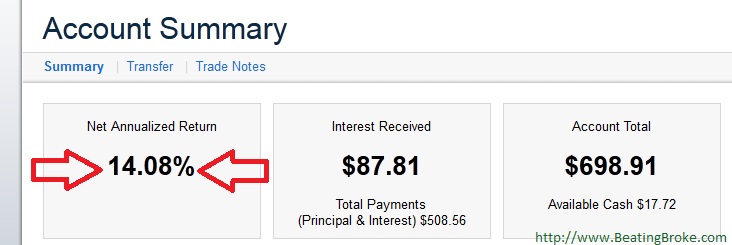
Lending Club 3Q2012 Returns update

A half a percent increase doesn’t sound like much, but it’s twice what my local savings account pays!  If I’d have dumped that money into my savings account instead, I’d be making half of just the increase I made last quarter.  Sad, no?

Delinquencies and Diversification on Lending Club

If you read the 2Q2012 update, you’ll know that I had two loans that have entered into the delinquency statuses.  One of which, I was able to immediately sell on FolioFN for the outstanding principle.  I lost the interest, but also lost the risk of it becoming a written off loan.  The other had a very low principle balance on it, so I decided to keep it to see what would happen, and to force myself through the collection process should it have gone that far.  It did not.  The loan went so far as to become 31-120 days past due and then a payment was made that brought it current.  It has remained current since then.

This is a good time to talk about diversification too.  As you can see from the above screenprint, I have just under $700 in my Lending Club account.  Nearly all of that (except the $17.72 in available cash) is invested into loans.  All told, I have investments in 37 loans currently.  That’s an average investment of about $18.50 per loan.  Obviously, some of them are nearing payoff, and others are nearer funding, so the actual amount per loan varies wildly between $0 and $25.  I do try and keep each investment to about $25-$30 to maintain that diversification.  If any one of the loans were to go into collections and then be written off, I’m only loosing a small fraction of my overall portfolio, and the hit would be minimal.

Much like any other investment, whether it be in stocks, real estate, etc, diversification can greatly improve your risk tolerance.  The risk of having one or two loans that go bad is far outweighed by the fact that you’d still have 10, 20, 30, or more loans that are in a current status.  I’ll continue to monitor for loans that go past due and then decide individually whether to keep them or to try and liquidate them through the FolioFN trading platform.

Other notes

Over the last quarter, my Lending Club account has reached a point that the principle payments combined with the interest payments exceed $25 a month.  What that means is that part of my experiment is complete.  I’ve been able to create a portfolio of self-sustaining investments.  I can stop putting any new funds into the account, and be able to reinvest the returns each month without having a whole lot of dead money sitting around waiting on me to invest it.  At most, any funds from payments should only sit around for a maximum of about 30 days.  It’s not ideal, but it’s far better than it could be.

I don’t intend to completely stop adding funds to the account either.  I want the portfolio to grow at a slightly faster clip than it would with just the returns and payments, so I’ll continue making deposits into it.  I like the way the portfolio is currently balanced, so will likely try and keep it that way.  What that likely means is that I shouldn’t expect to see any major movement on the rate of return.  I’m happy with the 14% I’m currently getting though, so that isn’t really a problem for me.

How many of you have not invested in a P2P lending account like the mine at Lending Club or at Prosper?  Why not?

Shane Ede

Shane Ede is a business teacher and personal finance blogger.  He holds dual Bachelors degrees in education and computer sciences, as well as a Masters Degree in educational technology.  Shane is passionate about personal finance, literacy and helping others master their money.  When he isn’t enjoying live music, Shane likes spending time with family, barbeque and meteorology.

www.beatingbroke.com

Filed Under: Investing, loans, Passive Income Tagged With: lending club, lending club returns, lending club update

Motif Investing

August 24, 2012 By Shane Ede 5 Comments

How much do you know about investing?  If you needed to build a balanced, diversified portfolio of investments, would you even know where to begin?  What if you wanted to take advantage of a certain trend by investing in the companies behind that trend?  Could you do the research necessary to find those companies and pick the ones that are best suited to taking advantage of the trend?  Yeah, me either.

Motif Investing; Investing in Patterns

That’s where Motif Investing (affiliate link) comes in.  They’ve done the research for us.  They know how to build a portfolio of investments that is poised to take advantage of a new trend.  And, they’re sharing that knowledge.  They’ve created motifs that you can invest in.  In their own words: “A motif is a carefully researched and balanced grouping of up to 30 stocks that combine to give investors diverse exposure to a single big idea.”  But, what does that mean?  Well, let’s say you think the economy is going to continue to stink for the next several years.  You know that as the economy goes down, places where you can buy stuff cheaply do well.  How about a motif called “Discount Nation” that is an array of discount retail stocks?  What if you also think that when the economy goes down, things like gambling, alcohol, and tobacco pick up, and the companies that produce those things do well too?  The “Seven Deadly Sins” motif might be for you.  Check out the description they’ve given it.

Even in tough times, consumers continue to partake in things that may not be considered particularly virtuous. From cigarettes to sex, burgers to Botox®—consumer indulgences require products and services from a wide range of publicly traded companies. Some luxuries see reduced demand during tough times. But smokers could keep smoking, drinkers keep drinking, and the lustful keep…lusting. Bad habits are hard to break. And when times are rough, who wants to even try? Nobody can predict the markets, but consumers are only human. And economic conditions may not be able to defeat their appetites for sinful stuff.

Funny! You’ve got to have an account, and be logged in to see the individual stocks for each motif.  I couldn’t resist, so I signed up just to see what was in the “Seven Deadly Sins” motif.  It’s got 25 stocks in it.  I recognize almost all of the names, like Anheuser-Busch under the Gluttony category, and Sturm Ruger & Co. under the Wrath category.

Investing with Motif Investing

Motif investing might be something to look into.  It looks like they’ve got a pretty low minimum investment of $250 per motif with a fee of only $9.95 for the entire motif.  If you tried to replicate the above motif, you’d have to buy 25 individual stocks, and even at the $4.95 I’ve seen at a few discount investing houses, you’re going to spend a ton more to achieve the same diversification.  In a way, it’s a bit like an ETF or mutual fund, but without the added expenses of either.  Plus, unlike an ETF or mutual fund, you own the shares of the individual stocks, not the shares of the ETF or mutual fund.

The motifs are also customizable.  You can adjust the weighting of the motif to lean a little more heavily on one stock or another, and can even add or remove stocks to the motif to fully customize it to your liking.  Each gives you a simple way to buy a little diversification as is, or you can customize it to fit your liking.  I like that.

I don’t necessarily like that there is a minimum investment, but I’m sure it’s in place to keep their costs as low as they can. They also don’t reinvest dividends, which would be nice to see since they’re already doing fractional shares, but, I do like the fee structure.  $9.95 might seem a bit much, but when you consider that you’re buying up to 30 stocks at a time, it’s really a pretty good deal.  Plus, once you own a motif, you can sell/buy individual stocks within the motif for $4.95 a trade.  They’ve got IRA accounts available which is nice.

If investing seems like a big confusing mess to you, you might want to check out Motif Investing.  I like the idea, and having some knowledge behind the stock picking is always a good thing.  I’m not sure that too many seasoned investors will be picking up the idea, simply because most of them know how to do their research, and usually have a set way they go about investing.  Maybe I’m wrong, but that’s the way I see it.  It’s a cool tool for beginners.


Shane Ede

Shane Ede is a business teacher and personal finance blogger.  He holds dual Bachelors degrees in education and computer sciences, as well as a Masters Degree in educational technology.  Shane is passionate about personal finance, literacy and helping others master their money.  When he isn’t enjoying live music, Shane likes spending time with family, barbeque and meteorology.

www.beatingbroke.com

Filed Under: Investing Tagged With: Investing, motif investing

Can You Fund Your Own Lending Club Loan?

July 25, 2012 By Shane Ede 16 Comments

In order to be both a borrower and a lender at Lending Club, you have to open two accounts.  With two accounts, can your lender account fund your borrower account’s loan?

One of the things that I occasionally do to find new ideas to write about is to go through the referral logs and look at the search queries that have clicked through to the site.  One such query was “Lending Club can you fund your own loan”.

I want to be upfront with you.  I haven’t asked Lending Club for an official policy on this.  If I had to guess (which I’m doing now) I’d say that they don’t allow it.  At first, I couldn’t figure out why someone would even want to fund their own loan.  The only thing that I can come up with is to perform some sort of arbitration.  Saving some money on interest rates while paying yourself a bit of interest as well.

While that might sound like a good idea, it probably isn’t.  First, if you’re using the loan to pay off higher interest rate debts, you’d be better off just using the cash you’re planning on using to fund your loan to pay down the debt you already have.  Instant savings equal to the interest rate of the debt.  No need to worry about breaking rules, just instant savings.

The more compelling reason you probably don’t want to fund your own loan on a P2P lending site like Lending Club is all the fees and taxes you’ll end up having to pay.  First, you’ll pay an origination fee on the loan.  This could be anywhere from 1% – 5.5% of the loan depending on the credit “grade” of your loan.  Next, you’ll pay fees on every payment that you pay yourself, further eating into any advantage.  Finally, when tax time comes around, you’ll pay taxes on the interest income on the lending account.

The combination of the fees you’ll incur through Lending Club, and your effective tax rate will, in most cases, completely erase any benefit you might see from paying the interest to yourself.  It just doesn’t make sense.

So, can you fund your own Lending Club loan?  I can’t think of a good reason why you’d want to.

Want to know how I suggest you use Lending Club investing?  Check out my 2Q12 Lending Club results.


Shane Ede

Shane Ede is a business teacher and personal finance blogger.  He holds dual Bachelors degrees in education and computer sciences, as well as a Masters Degree in educational technology.  Shane is passionate about personal finance, literacy and helping others master their money.  When he isn’t enjoying live music, Shane likes spending time with family, barbeque and meteorology.

www.beatingbroke.com

Filed Under: Investing, loans, ShareMe Tagged With: lending club, p2p investing, p2p lending, p2p lending club

  • « Previous Page
  • 1
  • …
  • 8
  • 9
  • 10
  • 11
  • 12
  • …
  • 20
  • Next Page »
  • Facebook
  • Pinterest
  • RSS
  • Twitter

Improve Your Credit Score

Money Blogs

  • Budget and the Bees
  • Celebrating Financial Freedom
  • Christian PF
  • Clever Dude
  • Dual Income No Kids
  • Everybody Loves Your Money
  • Financial Panther
  • Gajizmo.com
  • Grocery Coupon Guide
  • Lazy Man and Money
  • Make Money Your Way
  • Money Talks News
  • Personal Profitability
  • PF Blogs
  • Reach Financial Independence
  • Saving Advice
  • The Savvy Scot
  • Yes, I am Cheap

Categories

Disclaimer

Please note that Beating Broke has financial relationships with some of the merchants mentioned here. Beating Broke may be compensated if consumers choose to utilize the links located throughout the content on this site and generate sales for the said merchant.

Visit Our Advertisers

Need to change careers? Consider an Accounting Certificate Program from WTI.
  • Home
  • About
  • We Recommend
  • Contact
  • Our Editorial Commitment