Beating Broke

Personal Finance from the Broke Perspective

  • Home
  • About
  • We Recommend
  • Contact
  • Our Editorial Commitment

Powered by Genesis

Lending Club Update 4Q2012

January 16, 2013 By Shane Ede 6 Comments

Now that the year has ended, and the new one has begun, it’s time for another Lending Club Update.  (Here’s the link to the 3Q2012 update if you care to read it.)

A couple of significant things happened in the final quarter of 2012.  My account maintained sustainability and I stopped contributing to the account (temporarily). I’ll go over each in turn, but the first is a milestone that I have been waiting for, while the second was something that just needed to happen because of my personal financial situation.

Lending Club Account Sustainability.

What defines sustainability?  For me, I’ve defined it as receiving in excess of $25 a month in principle and interest payments.  My account first reached that goal in June of 2012, and has maintained it since.  In August of 2012, it came close to dropping below that threshold, but managed to stay above.  It seems to have settled in at about $30 towards the end of the quarter, so hopefully as that money is reinvested, that number will continue to increase.
Beating Broke Lending Club Update

The entire quarter saw the interest payments that I received rise to a little over $9 a month.  I won’t likely get rich off of that, but it’s also not an insignificant amount on an account that has a total just under $800.  The Net Annualized Return (NAR) that’s being displayed on the account homepage is up .4% to 14.48%, a number I’m happy with.  There’s some argument over whether you should really use the NAR as a gauge of the account performance or not.  I won’t pretend to understand most of it. 🙂  What I do understand though is that having exact figures is less important to me for this experiment than it is to have a standard metric to measure my results by.  So long as the method of calculation remains the same, it should give me a general idea of how the account is doing.  (I’m open to learning more about how some of this is calculated.  Drop links in the comments!)

Contributions Stopped.

I stopped my contributions to the account in November.  If you’ve been reading along with the site, you’ll know that we ended up having some financial difficulties at the end of October.  As a result, much of the money that I was using to fund the account ended up getting transferred to my personal account to help dig ourselves out of that rut.  It isn’t any reflection on Lending Club, but a reflection on my finances and the need to help keep the ship afloat.  We’ve mostly righted the ship, now, so I’ll likely start putting some money back into this account sometime in the first or second quarter of 2013.

My Lending Club Portfolio

My portfolio remains strong.  I still haven’t had any defaults.  *knock on wood* While this experiment of sorts (it’s gone beyond that, I think) started in July of 2011, I’ve had my account at Lending Club since January of 2010.  That’s a pretty long stretch to go without a default of any sort.  You might recall that I sold a loan that had gone delinquent in the 2Q/3Q 2012 area.  I also had a second loan that had gone late, but it eventually was made current.  Currently, my portfolio has 42 loans in it.  All of them are current.  It also has 13 loans that have been paid in full.  Of those, perhaps about half have been paid off in advance.  That’s both good and bad.  I like that they’ve paid them off in advance because it seems to show that the borrowers are perhaps getting their finances together.  It’s bad, because I lose out on some income from interest when they pay them off early.  One of the risks of this income stream.

I’m still not able to directly invest in loans, and still have to invest through the FolioFN platform.  It’s still not ideal.  But, until my state (North Dakota) pulls their head out, and starts allowing it, that’s what I’m stuck with.  I’m not holding my breath.  I’m not going to complain too much, as I do seem to have found a pretty good method for selecting my Lending Club notes, and it seems to be working.

How are your investments starting off the new year?  How’s your Lending Club (or Prosper) account doing?

Shane Ede

Shane Ede is a business teacher and personal finance blogger.  He holds dual Bachelors degrees in education and computer sciences, as well as a Masters Degree in educational technology.  Shane is passionate about personal finance, literacy and helping others master their money.  When he isn’t enjoying live music, Shane likes spending time with family, barbeque and meteorology.

www.beatingbroke.com

Filed Under: Investing, Passive Income Tagged With: lending club, lending club investing, lending club update, p2p investing, p2p lending, peer to peer investing, peer to peer lending

Lending Club Update 3Q2012

October 3, 2012 By Shane Ede 18 Comments

Lending Club is a great tool for making some very nice passive income.  I’ve been using my account to invest some funds and see what I can do as far as a return, as well as to learn more about the service and what can be done with it.  As someone who lives in a state where the direct investing isn’t allowed (state laws that need changing), I use the FolioFN trading platform within Lending Club to make my investments.  This eats into my return a bit, as I pay a small premium to the original investor when I buy the investment.  However, I’m finding that even with that small premium, my return is still far above what I am making in any savings account.  If you’d like to start at the beginning of the year, you can read my 1Q2012 and 2Q2012 updates first then come back to this one.

Lending Club Returns Growing

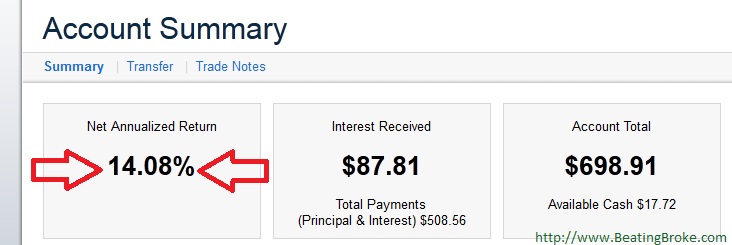
After the last update, in July, I made the decision that I could increase the risk level a bit on the my portfolio and still safely be in a place where it wasn’t too high.  While I don’t have a direct history of working at a commercial lender, I did work in I.T. at a Credit Union.  (Also, I did not sleep at a Holiday Inn Express last night.)  In my position there, I learned a few things about the way the backend of an institution works.  And, what I can tell you is that the credit scores that are getting C and even D ratings on Lending Club would be the average borrowers at a commercial brick-and-mortar institution.  What that tells me is that even the C and D rating loans at Lending Club are still a pretty safe investment.  After all, if the banks and credit unions couldn’t make money on them, they wouldn’t loan to them.  So, I increased my lending in the C and D ranges and have now moved the middle of my portfolio into the C/C- range.  It’s weighted a bit riskier, but the reward is a bit higher as well.  At the end of 2Q2012, my rate was stated on my dashboard as 13.58%.  At the end of 3Q2012, that rate has increased to 14.08%.

Lending Club 3Q2012 Returns update

A half a percent increase doesn’t sound like much, but it’s twice what my local savings account pays!  If I’d have dumped that money into my savings account instead, I’d be making half of just the increase I made last quarter.  Sad, no?

Delinquencies and Diversification on Lending Club

If you read the 2Q2012 update, you’ll know that I had two loans that have entered into the delinquency statuses.  One of which, I was able to immediately sell on FolioFN for the outstanding principle.  I lost the interest, but also lost the risk of it becoming a written off loan.  The other had a very low principle balance on it, so I decided to keep it to see what would happen, and to force myself through the collection process should it have gone that far.  It did not.  The loan went so far as to become 31-120 days past due and then a payment was made that brought it current.  It has remained current since then.

This is a good time to talk about diversification too.  As you can see from the above screenprint, I have just under $700 in my Lending Club account.  Nearly all of that (except the $17.72 in available cash) is invested into loans.  All told, I have investments in 37 loans currently.  That’s an average investment of about $18.50 per loan.  Obviously, some of them are nearing payoff, and others are nearer funding, so the actual amount per loan varies wildly between $0 and $25.  I do try and keep each investment to about $25-$30 to maintain that diversification.  If any one of the loans were to go into collections and then be written off, I’m only loosing a small fraction of my overall portfolio, and the hit would be minimal.

Much like any other investment, whether it be in stocks, real estate, etc, diversification can greatly improve your risk tolerance.  The risk of having one or two loans that go bad is far outweighed by the fact that you’d still have 10, 20, 30, or more loans that are in a current status.  I’ll continue to monitor for loans that go past due and then decide individually whether to keep them or to try and liquidate them through the FolioFN trading platform.

Other notes

Over the last quarter, my Lending Club account has reached a point that the principle payments combined with the interest payments exceed $25 a month.  What that means is that part of my experiment is complete.  I’ve been able to create a portfolio of self-sustaining investments.  I can stop putting any new funds into the account, and be able to reinvest the returns each month without having a whole lot of dead money sitting around waiting on me to invest it.  At most, any funds from payments should only sit around for a maximum of about 30 days.  It’s not ideal, but it’s far better than it could be.

I don’t intend to completely stop adding funds to the account either.  I want the portfolio to grow at a slightly faster clip than it would with just the returns and payments, so I’ll continue making deposits into it.  I like the way the portfolio is currently balanced, so will likely try and keep it that way.  What that likely means is that I shouldn’t expect to see any major movement on the rate of return.  I’m happy with the 14% I’m currently getting though, so that isn’t really a problem for me.

How many of you have not invested in a P2P lending account like the mine at Lending Club or at Prosper?  Why not?

Shane Ede

Shane Ede is a business teacher and personal finance blogger.  He holds dual Bachelors degrees in education and computer sciences, as well as a Masters Degree in educational technology.  Shane is passionate about personal finance, literacy and helping others master their money.  When he isn’t enjoying live music, Shane likes spending time with family, barbeque and meteorology.

www.beatingbroke.com

Filed Under: Investing, loans, Passive Income Tagged With: lending club, lending club returns, lending club update

Why I Like Passive Income

July 11, 2012 By Shane Ede

When you’re in debt, and trying to escape from the cycle of debt, the one thing that seems to dominate your every thought is paying off that debt.  Far too often, those of us who talk about debt and finances regularly tend to focus on debt as well.  We focus on paying off debt, eliminating debt, and ways to spend less money so you free up more money in your budget to pay off that debt.  What we don’t talk about often enough, in my opinon, is making more money.  In many ways, increasing your income is just as important to your fight against debt as staying disciplined in paying your debt off.

I don’t know about you, but I often feel like my income is capped.  In any job, you are either paid a yearly salary, or paid an hourly wage.  In that way, you’re income is capped.  If you’re paid on a salary, it doesn’t matter how much you work, you only get paid a certain amount every pay period.  If you work hourly, there are only so many hours that you can work in any pay period.  There are always ways to advance yourself through the workforce, and up the ladder at work, but your income is still capped.

Uncapped income.

Passive Income Cash Machine
img credit: <a href="http://www.flickr.com/photos/whatleydude/3461788369/" rel="nofollow">Whatleydude on Flickr</a>

One way to increase your income, that doesn’t require that you work all hours, and that doesn’t cap your income is through passive income.  I’ve talked about it before here, and here, and here.  The ideal definition of passive income is income you earn without putting in any work.  And, maybe in an ideal world, that type of income would actually exist.  In our less than ideal world, truly passive income is very hard to find.

How I define passive income

I like to define passive income in somewhat more liberal terms.  To me, any income that I can earn with a minimal amount of work is passive income.  If I can make income off of something that only takes me 30 minutes a month, I consider it passive income.  Anything that continues to make me money long after I’ve put the work in counts too.  It’s like Ronco income.  “Just set it and forget it!”

For me, my blogs and websites are passive income.  A majority of the income I make off of them is income from posts I’ve already written.  The work has already been put in, and it would continue to pay me even if I quit writing.  My traditional stock portfolio is a passive income.  I did the work early on, earning the cash to buy the stocks, as well as doing the research to pick the stocks, and many of them pay me dividends on a regular basis.  That dividend payment is a passive stream of income.  Yet another stream that I take advantage of is my Lending Club portfolio of peer-to-peer loans.  (See my latest report on LC)

Other forms of passive income can include things like royalties, patents, and rental properties.  I’m sure if you think hard enough about it, you’ll find several other streams of potential income that would fit my definition of passivity.  (Share them in the comments!)

Why do I like passive income?

Naturally, I like passive income because I’m lazy.  😉  After all, what could be lazier than earning money while you sit on your behind and watch soap operas on T.V.?

“Naturally, I like passive income because I’m lazy.” — @beatingbroke (Click to Tweet)

As much as I like that reason, the real reason is a bit more explanatory.  I like paying off my debt.  I like the ability to do that while still enjoying life.  And, as many of you can attest, doing both of those things can sometimes be somewhat difficult.  Balancing the expenditures that can come enjoying life (even a frugal one) with paying off your debt is troublesome.  The best way that I’ve found to try and do both is to work hard at paying off debt, while working hard at increasing income at the same time.  Without passive income, the only way to increase income is to work more hours at your hourly job or to negotiate regular raises at your salary job.  Recently, it’s become even more difficult to do either of those.  Passive income becomes the last, best way to increase your income with little to no continuing work output.

Why do you like passive income?  What do you consider to be passive income?  What are some of your passive income streams?  What are some that you’d like to take advantage of?

Shane Ede

Shane Ede is a business teacher and personal finance blogger.  He holds dual Bachelors degrees in education and computer sciences, as well as a Masters Degree in educational technology.  Shane is passionate about personal finance, literacy and helping others master their money.  When he isn’t enjoying live music, Shane likes spending time with family, barbeque and meteorology.

www.beatingbroke.com

Filed Under: budget, Debt Reduction, Frugality, Investing, Passive Income, Saving, ShareMe Tagged With: debt, Debt Reduction, income streams, passive income, passive income streams

  • « Previous Page
  • 1
  • 2
  • 3
  • 4
  • 5
  • 6
  • 7
  • Next Page »
  • Facebook
  • Pinterest
  • RSS
  • Twitter

Improve Your Credit Score

Money Blogs

  • Budget and the Bees
  • Celebrating Financial Freedom
  • Christian PF
  • Clever Dude
  • Dual Income No Kids
  • Everybody Loves Your Money
  • Financial Panther
  • Gajizmo.com
  • Grocery Coupon Guide
  • Lazy Man and Money
  • Make Money Your Way
  • Money Talks News
  • Personal Profitability
  • PF Blogs
  • Reach Financial Independence
  • Saving Advice
  • The Savvy Scot
  • Yes, I am Cheap

Categories

Disclaimer

Please note that Beating Broke has financial relationships with some of the merchants mentioned here. Beating Broke may be compensated if consumers choose to utilize the links located throughout the content on this site and generate sales for the said merchant.

Visit Our Advertisers

Need to change careers? Consider an Accounting Certificate Program from WTI.