Beating Broke

Personal Finance from the Broke Perspective

  • Home
  • About
  • We Recommend
  • Contact
  • Our Editorial Commitment

Powered by Genesis

The Lending Club IRA : Peer-to-Peer Enters the Retirement Realm

February 3, 2012 By Shane Ede 8 Comments

You already know that I like Lending Club as an investment vehicle.  The returns are good (or great, depending on your default rate), and I like the idea that my money isn’t going to line the pockets of some corporation, but is being used to help someone who needs a loan get a better rate than they might get at a financial institution or through credit card usage.

Recently, Lending Club started offering IRA accounts to the lenders.  My first thought, was something along the lines of “that sounds kinda cool”.  But, then I got to thinking about it.  Many of us struggle to put money away for our retirements.  Do we really want what little money we have put away in an investment that carries as much risk as Lending Club notes carry?  I like risky investments, but even I don’t think I’d want all of my retirement money in these notes.

One use that could redeem it is using it as a supplemental IRA.  If you’ve already got a 401(k) and an IRA that you use to invest in more traditional, lower risk, investments, you could use a Lending Club IRA as a way to diversify further and add a little more risk to your portfolio.  That would also allow for keeping a higher percentage of your 401(k) and standard IRA in investments that are a little less risky.  Of course, that would also mean balancing your investment portfolio over several accounts.

I tried to figure out some of the finer details of the Lending Club IRA through their site, but either it isn’t all that clear, or I’m just a bit dense.  😉  So, I emailed them to get a few questions answered.  Here’s what I found out.  The accounts are administered through a company called Self Directed IRAs.  I’m not all that familiar with what a self directed IRA is, but it basically looks like an IRA account that you can use to invest in just about anything.  They offer several different IRA “types”, so it will depend on which the LC IRA falls under to determine what other investments you can add to your account besides the LC notes.  It doesn’t seem out of the question to assume that you would be able to invest in stocks and such as well.  (I’ve replied to the email I got to try and determine this for sure)  Based on what I was seeing on the administrators website, it was looking like the account might be pretty heavy in fees.  The email from Lending Club managed to answer that question as well.

There are no fees associated with a Lending Club IRA with a balance of at least $5,000 in the first year (you have all year to reach this), or $10,000 in the second year and beyond.

If you don’t meet those requirements, the account carries a $100 annual fee.  Pretty hefty if you don’t meet the requirements.  There’s two ways to look at that, however.  If you’re IRA is large enough, it shouldn’t be a problem to keep $10,000 in Lending Club notes and still keep your risk diversification.  If you’re IRA is smaller though, you’d be automatically raising the risk of the account my meeting the requirements.

Anyway you look at it, I don’t think it will be the most popular IRA account around.  But, it’s nice that they offer it for those of their customers who want a tax sheltered way to take advantage of peer-to-peer investing.  You can read more over on their site: Lending Club IRA.

What are your thoughts on the Lending Club IRA?  Too risky for retirement funds?  Good as a part of the retirement portfolio?

Shane Ede

Shane Ede is a business teacher and personal finance blogger.  He holds dual Bachelors degrees in education and computer sciences, as well as a Masters Degree in educational technology.  Shane is passionate about personal finance, literacy and helping others master their money.  When he isn’t enjoying live music, Shane likes spending time with family, barbeque and meteorology.
www.beatingbroke.com

Filed Under: Investing, Retirement Tagged With: ira, lending club, lending club ira, p2p investing, p2p lending, peer lending, peer to peer lending, Retirement

Are You Suffering from Optimistic Financial Denial?

September 14, 2011 By MelissaB 9 Comments

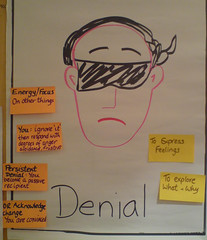
Some people suffer from a certain form of optimistic financial denial.  They look at part of someone else’s circumstances and use that to justify their own way of life, without considering the entire picture.  Take, for example, a relative I have that I will call Stacey (not her real name).  Stacey is nearing retirement, and she doesn’t have quite as much socked away for retirement as she would like because finances were very tight when she was young and she and her husband just didn’t have the extra to put away.  Her husband died young, and she entered the full-time work force in her early 40s, which is when she began putting away for retirement in earnest.

denialStacey isn’t one to worry.  She tells herself that she should be able to get by just fine with the money she will have in retirement and uses the rationale first, that you never know how long you will live, and second, that her parents did just fine on a limited retirement.  She is firm about retiring at 62 and cannot be persuaded otherwise; she is not interested in working part-time early in her retirement.

Regarding Stacey’s first point, it is true that you never know how long you will live.  I have, unfortunately, known plenty of people who retired and died within a year or two.  Others died before they were even able to retire.  However, Stacey’s parents lived to be 88 and 90, respectively, so if she takes care of herself, there is a good chance she will live well into old age.

Second, her parents did retire on a relatively small retirement savings, but they made some serious adjustments to their lifestyle.  Here are some of the smart financial moves they made to make sure their retirement nest egg stretched:

  • they immediately sold their paid for house, freeing themselves from the expense of upkeep, property taxes, and heating and cooling a large home
  • they took some of the money from the house to buy a fifth wheel trailer, and they lived there during the summer months on their children’s property
  • they took some of the money and bought a trailer in a retirement trailer park in Florida.  They were then only responsible for monthly trailer park fees and heating and cooling
  • they took the rest of the money and invested it
  • they only went out to eat occasionally, usually when their children were visiting them in Florida
  • they sent each of their 38 grandchild a crisp dollar bill for their birthday and at Christmas

On the other hand, here is where Stacey is:

  • she still owes $70,000 on her 1,600 square foot home
  • she has no immediate plans to sell, which means she is paying thousands of dollars a year on property tax, maintenance, and heating and cooling costs
  • she goes out to eat several times a week and plans to continue doing so when she retires as that is her main way to socialize
  • she only has 3 grand-kids, but she spends $100 to $125 per child per year for Christmas and birthday presents
  • she would like to travel, including traveling internationally, when she retires

While Stacey is right that her parents did not have a large, comfortable retirement, she is only looking at part of their financial picture.  Her parents were willing to make significant changes to downsize their expenses so they could live comfortably on the retirement they did have.  In fact, when her last parent died at 90, there was still enough left over to give a small inheritance to each of their 9 children.  To have a comfortable retirement of her own, Stacey should also downsize her lifestyle.  It is the only way to make the money stretch as her parents did.

When it comes to your own retirement, or financial planning in general, it does little good to compare your finances to others.  Ultimately, it can lead to a form of optimistic denial that can lead to considerable financial stress in the future.

Do you know anyone who suffers from financial optimistic denial? 

photo credit: robynejay

MelissaB
MelissaB

Melissa is a writer and virtual assistant. She earned her Master’s from Southern Illinois University, and her Bachelor’s in English from the University of Michigan. When she’s not working, you can find her homeschooling her kids, reading a good book, or cooking. She resides in New York, where she loves the natural beauty of the area.

www.momsplans.com/

Filed Under: Retirement, ShareMe Tagged With: Retirement, savings

The Scales of Finance

May 11, 2011 By Shane Ede 1 Comment

IMG_2394Not to be confused with the scales that our friend Lady Justice carries around with her everywhere, the scales of finance are a bit different in function.  To truly weigh something, using a scale, you load up one side of the scale with that which you want to weigh and then put weights of a known mass on the other side.  When the scale is balanced, you count up the known mass weights and you’ve got the weight of the item(s) on the other side.  Lady Justice, as the story goes, does this by weighing a persons crimes and adding the appropriate amount of punishment to the other side so that the Scales of Justice balance.

When we think about personal finance, there are those that are die-hard frugalers.  There is no other way to save money, retire comfortably, or live, than by being frugal.  The more frugal you are, the more you save, and the less you spend.  Coupons are their best friends, as are black friday deals and places like farmers markets and flea markets.

There are also those that are the die-hard incomers.  Skipping a latte isn’t for them.  The only way to get ahead is to make more money while not spending any more.  They’ll work three jobs to achieve levels of income that were previously unheard of and use that added income to pay off debt and save for retirement.

But, much like justice, the scale can pretty easily be tipped into unbalance.  Frugaling, while a good idea, can only take you so far.  Income increasing can only take you so far.  Eventually, you’ll need to make a bit more money, or work less.  The right way to do it is to strike a balance between the two.  Cut your costs as much as you can, without going to extremes.  Increase your income as much as you can, without going to extremes.  Find a place where you can balance your financial life while still getting to live life and not be classified as a cheapskate work-a-holic.


Balancing the Scales of Finance

  • Create a budget. Know where your money is going (even if it’s going down the drain), and plan where you want it to go.
  • Cut costs. A little bit of frugal living isn’t going to hurt you.  Drop cable T.V.  You can replace it with Netflix, or books.  Find other things that you can do without completely or cut usage of.
  • Analyze your finances. Use your budget to determine the inflow/outflow of your finances.  How long to payoff your debts?  Could it be accelerated greatly by taking on a second job?  Maybe you only need a second job for 6 months to pay off a credit card.
  • Increase your income. There are other ways, besides taking on extra jobs, to increase your income.  Prepare for, and then ask for a raise.  Sell off stuff you no longer use.  Find a way to get paid for hobbies you already do.
  • Don’t over-do it. Maintain focus on your end goal, but keep your sacrifices to a bearable level.  All that extra income won’t do you any good if you burn out in 3 months because you’ve been working 80 hour weeks.  And all the frugal in the world won’t do you any good if you burn out in 3 months because you’ve been manually separating the plys on your TP.

Don’t think that just because you do all of this once, that you’ll remain in balance forever either.  At first, you will probably benefit from regular weekly or bi-weekly check-ups.  As you get more comfortable with it all, you might be able to do it once a month.  Much more infrequent than that and you’ll lose your focus and begin letting things slip.  If that happens, pick up where you left off and continue on.

As you continue on, the Scales of Finance will become easier to balance.  You’ll become better at it, and the scales will gain a little extra margin for error.  It may seem hard now, but it does get easier.  And, believe it or not, it can be fun.

Photo credit: Thatedeguy on Flickr

Shane Ede

Shane Ede is a business teacher and personal finance blogger.  He holds dual Bachelors degrees in education and computer sciences, as well as a Masters Degree in educational technology.  Shane is passionate about personal finance, literacy and helping others master their money.  When he isn’t enjoying live music, Shane likes spending time with family, barbeque and meteorology.

www.beatingbroke.com

Filed Under: budget, Debt Reduction, Frugality, General Finance, Personal Finance Education, Retirement, Saving, ShareMe Tagged With: balance, budget, income, justice, scales of finance

  • « Previous Page
  • 1
  • …
  • 7
  • 8
  • 9
  • 10
  • 11
  • Next Page »
  • Facebook
  • Pinterest
  • RSS
  • Twitter

Improve Your Credit Score

Money Blogs

  • Budget and the Bees
  • Celebrating Financial Freedom
  • Christian PF
  • Clever Dude
  • Dual Income No Kids
  • Everybody Loves Your Money
  • Financial Panther
  • Gajizmo.com
  • Grocery Coupon Guide
  • Lazy Man and Money
  • Make Money Your Way
  • Money Talks News
  • Personal Profitability
  • PF Blogs
  • Reach Financial Independence
  • Saving Advice
  • The Savvy Scot
  • Yes, I am Cheap

Categories

Disclaimer

Please note that Beating Broke has financial relationships with some of the merchants mentioned here. Beating Broke may be compensated if consumers choose to utilize the links located throughout the content on this site and generate sales for the said merchant.

Visit Our Advertisers

Need to change careers? Consider an Accounting Certificate Program from WTI.