Beating Broke

Personal Finance from the Broke Perspective

  • Home
  • About
  • We Recommend
  • Contact
  • Our Editorial Commitment

Powered by Genesis

5 Quick Ways to Start Prepping. You’re Already Doing at Least Two of These.

February 14, 2014 By Shane Ede 11 Comments

In my recent post about the state of the American economy, I told you that you didn’t need to immediately go out and become a prepper.  And you don’t.  But, much like anything else, it helps to be prepared.  You don’t have to have a bunker under your backyard, a whole armory in the bedroom closet, or enough food to feed your whole neighborhood for years.  You can, however, start making sure that you and your family have a good start in preparing for any disaster.  Here’s 5 quick ways to start prepping.  And you’re already doing at least two of these!

Stockpiling

You don’t have to have enough stockpiled to keep your family fed for months or years.  But, if there’s anything that this winter has taught much of the U.S., it’s that it’s very possible that you could find yourself stuck in one place for several days.

What should you stockpile?  Well, food is a good start.  Canned and dry goods mostly.  Beans, rice, canned vegetables (straight from the garden if you DIY), flours, grains, vacuum packed foods, and canned meats all are good staples that can go straight into your pantry and provide backup food sources should you be unable to reach a grocery store.  (also, if grocery stores cease to exist… but let’s not go all extreme just yet.)

Stockpile other goods too.  Toilet paper, pet food, matches, fire starters, medical supplies, and even ammunition if you have that armory in your closet.  Any essential that you use regularly that won’t spoil is fair game for stockpiling in case of emergency.
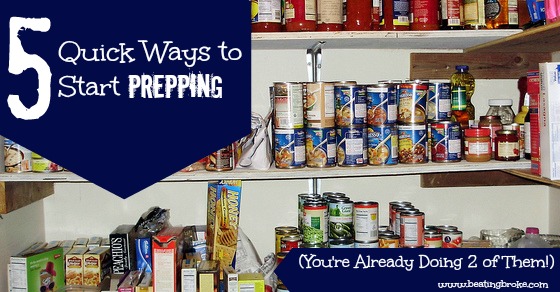
5 Quick ways to start prepping

Reducing Debt

If the economy crashes, do you know what the worst thing to still have is going to be?  Well, if you haven’t guessed it, that thing is debt.  If you think your hands are tied by debt now, just wait until the economy is in the dumps, you lose your job, and inflation kills your buying power.  Debt is your enemy, no matter the state of the economy.  Start with a detailed spending log where you list what you spend every day.  Knowing what you spend, and when you usually spend it, create a simple budget.  Stick to the budget, and pay down debt by whatever means necessary.  Get rid of it.  Even if the economy booms, you’ll still be better off.

Become More Sustainable

Sustainability isn’t just for hippies.  Being eco-friendly maybe attributed to the earth loving, free love, woodstock-ing people of previous generations, but today, it’s an excellent way to be healthier, and save money on costs.  There are lots of things you can do to become more sustainable.

The easiest way to start making a difference in your bottom line is to replace high energy consuming items with low energy consuming items.  LED or Incandescent light bulbs are a relatively cheap start, and last for years.  High efficiency appliances like on-demand hot water heaters are more expensive, but can save a lot on energy over the long run.  Try air drying your clothes too.  It takes a little longer, but make it a habit, and your energy savings will grow a lot.

Growing your own vegetables, installing rain barrels, and composting are also great ways to decrease your footprint, while saving yourself money.  You can replace that produce at the grocery store with home-grown veggies, use the water in your rain-barrel instead of the electrically pumped water from a well, or the municipal water, and you can save on what you put into the dump while providing nutrient rich compost for your garden.

Learn New DIY Skills

If the economy completely fails, there’s a good chance that your access to many of the services and products that you have access to now will be severely limited, or severely cost prohibitive.  Not only will learning new DIY skills (like growing vegetables, canning food, repairing items, building items (like a deck), and the list goes on) save you money by allowing you to not pay for someone else to do it, but you’ll also gain a barter-able service that you can trade for services you can’t do.

There are plenty of ways to learn new skills too.  You can just try it and see what happens, although, in my experience, doing so increases the chances that the project you’re working on will take longer or fail entirely.  If you look, you can probably find a local class that can teach you some of the skills.  Videos on YouTube and instructions on the internet (easily found through a search) are also great ways to learn something new.

Make Your Plans

We all know that we should have a plan so that everyone knows what to do should they wake up in the middle of the night to a house that’s on fire.  We give our children a plan should they get separated from us in a crowded place.  We create budgets to plan how we will spend our money, and pay down our debt.  Having a plan for an economic collapse and the conditions that could arise should it crash doesn’t cost us anything.  A little time, and some thought.  That’s it.  Do you have family that you’d “bug out” to?  Are there people in town that you’d want to help?  Are there people in town that would help you?  How will you get wherever you’re going?  Even if that’s just home?

Having a plan, and executing it if you have to is very likely to be the difference between uninterrupted life, and something far more unpleasant.

How many of these things are you already doing?  Which are you going to try out?

Original image credit:Robert Benner Sr., on Flickr.

Shane Ede

Shane Ede is a business teacher and personal finance blogger.  He holds dual Bachelors degrees in education and computer sciences, as well as a Masters Degree in educational technology.  Shane is passionate about personal finance, literacy and helping others master their money.  When he isn’t enjoying live music, Shane likes spending time with family, barbeque and meteorology.

www.beatingbroke.com

Filed Under: economy, General Finance, Green, ShareMe Tagged With: budget, canning, prepping, sustainable

All Is Not Lost

November 7, 2013 By Shane Ede 13 Comments

I can’t tell you the number of times that, in our seemingly never-ending struggle with debt, that I’ve seriously contemplated just giving up.  Just throwing in the towel and saying f-it.  You know it’s bad when you catch yourself fantasizing about it.  About how much easier your life would be without the struggle.  Just declaring bankruptcy, taking the hit on your credit score, and moving on with your life.

Even now, after having written about personal finance for over five years, I still find myself in that place occasionally.  We let our budgeting lapse, and inevitably our spending gets out of whack again.  Something happens, and the emergency fund just doesn’t seem to cover it all.  Or, worse, doesn’t seem to replenish itself as quickly as it should.

someecards.com - I can't believe I work this hard to be this poor.I can try and lay the blame somewhere.  That always helps, right?  If it isn’t my fault, then I can’t be blamed for it.  I can’t be the one that everyone points to as the failure.  I can deflect that attention to someone or something else.  That helps.  Until it doesn’t.

Every single time, it’s really me that deserves the blame.  It wasn’t the boss that refused to give me a raise.  It wasn’t the heater in the car that needed to be fixed.  And it certainly wasn’t the kids that needed to eat.  It was me.  Every.  Single. Time.

I failed to negotiate the raise.  I failed to have enough saved up to make that repair.  I failed to budget properly to make sure that we wouldn’t have to cut corners at the grocery store.  Me.  I did that.

I could just give up.  I could miss having to work harder to be paid appropriately.  I could miss having to pay attention to my budget to save money for car repairs, or to pay for groceries.  I could do that.  Giving up would be so easy.

Until it isn’t.

Shane Ede

Shane Ede is a business teacher and personal finance blogger.  He holds dual Bachelors degrees in education and computer sciences, as well as a Masters Degree in educational technology.  Shane is passionate about personal finance, literacy and helping others master their money.  When he isn’t enjoying live music, Shane likes spending time with family, barbeque and meteorology.

www.beatingbroke.com

Filed Under: budget, Financial Mistakes, Financial Truths, ShareMe Tagged With: bankruptcy, budget, emergency fund

We’re All Financial Optimists, and It’s Hurting Our Bottom Line

July 15, 2013 By MelissaB 12 Comments

Are you an optimist or a pessimist?

Do you see the glass half full or half empty?

No matter your answer, I have a secret for you.  We’re all financial optimists, and it’s hurting our bottom line.

Don’t believe me?

I didn’t expect you to.

You might say, my finances are a mess.  I have debt; I’ve pulled money out of my 401(k).  I’m definitely not a financial optimist.

But, I’d argue that you are.  When you look into the future, you don’t see bankruptcy and years of the same financial mess.  You likely think that eventually things will get better, and you make decisions based on that.

If your financial situation isn’t that bad, you’re probably even more of a financial optimist.  Say you’re getting ready to buy a house, and you know that your limit is a house that costs $250,000.

You find the perfect house.  The problem?  It costs $270,000.  Still, you decide to buy it, even though you know you can’t afford it.

What do you tell yourself?

  • It’s in a good neighborhood, and the house will appreciate.
  • In just a few years, inflation will make your now nearly unmanageable payment much smaller, and paying it won’t be such a hardship.
  • You’re just starting your career, and in a few years you’ll be making a lot more money, so the house payment will be easier to afford.

Sound familiar?

Just a few years ago, millions of people thought their houses would appreciate, and then they were caught up in the housing crisis.

Houses don’t always appreciate, but we optimistically think ours will.

[Tweet “Houses don’t always appreciate, but we optimistically think ours will.”]

Sure inflation will make your house payment more manageable, but you’ll have other expenses in a few years that you’re not thinking of because you’re thinking optimistically.  In a few years, maybe you’ll have a few kids to fill that house, and they’ll cost a lot of money.  You’ll be spending more on food, health care, transportation and day care, just to name a few things.  Suddenly, having a manageable house payment doesn’t really make a financial difference because you’ll have so many other expenses competing for your money.

If you’re lucky, your career will soar, and you’ll make more money, but that doesn’t always happen.  You might get laid off and have to find a job that pays less.  You or your spouse may decide to quit so one person can stay home with the kids.  Or, maybe you do get raises, but at the same time your health care premiums go up every year so your pay essentially stays stagnant.

Of course, thinking optimistically is beneficial to our mental health, but for our financial health, recognize that thinking optimistically hurts your bottom line.  When you get ready to make a large purchase like a house or a car, don’t forecast into the future.  Determine if you can afford the item now, in your current situation.  If you can, you’ll tie up less of your future money and benefit from this.  If you can’t, it’s best to pass it up.

MelissaB
MelissaB

Melissa is a writer and virtual assistant. She earned her Master’s from Southern Illinois University, and her Bachelor’s in English from the University of Michigan. When she’s not working, you can find her homeschooling her kids, reading a good book, or cooking. She resides in New York, where she loves the natural beauty of the area.

www.momsplans.com/

Filed Under: budget, Financial Truths, ShareMe Tagged With: bottom line, budget, financial optimist, homeowner, loans, optimism

  • « Previous Page
  • 1
  • …
  • 10
  • 11
  • 12
  • 13
  • 14
  • …
  • 22
  • Next Page »
  • Facebook
  • Pinterest
  • RSS
  • Twitter

Improve Your Credit Score

Money Blogs

  • Budget and the Bees
  • Celebrating Financial Freedom
  • Christian PF
  • Clever Dude
  • Dual Income No Kids
  • Everybody Loves Your Money
  • Financial Panther
  • Gajizmo.com
  • Grocery Coupon Guide
  • Lazy Man and Money
  • Make Money Your Way
  • Money Talks News
  • Personal Profitability
  • PF Blogs
  • Reach Financial Independence
  • Saving Advice
  • The Savvy Scot
  • Yes, I am Cheap

Categories

Disclaimer

Please note that Beating Broke has financial relationships with some of the merchants mentioned here. Beating Broke may be compensated if consumers choose to utilize the links located throughout the content on this site and generate sales for the said merchant.

Visit Our Advertisers

Need to change careers? Consider an Accounting Certificate Program from WTI.
  • Home
  • About
  • We Recommend
  • Contact
  • Our Editorial Commitment