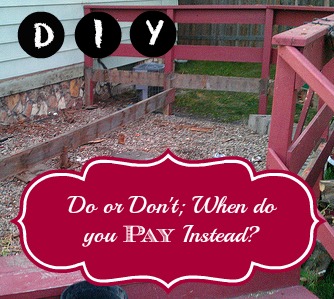
Sites around the web, including this one, are always pushing free or DIY alternatives to lots of things. And, in most cases, I think that they (and I) am right. There are so many things that we pay other people to do that we can just as easily do ourselves. Just about a year and a half ago, I built my own deck. It wasn’t necessarily easy, and it certainly wasn’t quicker than hiring someone to do it for me, but boy did it save me some money.
I truly believe that there is little that you and I cannot do ourselves. With a quick search on Youtube for the DIY project, and a few quick web searches, we can have some pretty detailed instructions on how to do anything. Well, OK. Probably not something like brain surgery. There’s probably a bit more of a skill/knowledge gap there. But, certainly, most everything else.
Occasionally, I find a service that I decide I’d rather outsource to someone else. Oil Changes are an excellent example. Can I change my own oil? Absolutely. But, for $30, I get someone else to do it for me. I don’t have to mess around with getting the filter loose, disposing of the waste oil, and I certainly don’t have to crawl around under the car doing it. For me, it’s well worth the $20 or so difference to have someone else do it. That’s more of a choice of convenience. Meaning, for me, that it is just more convenient to have someone else do it and save me the time and effort.
There are, however, some services that have less to do with convenience, and more to do with some other factors.
Saving Time
In the case of my DIY deck, I could have saved a whole lot of time by having someone else do it for me. For a professional with a crew of a couple of guys, it probably would have only taken 3-4 days. Maybe less. It took me several weeks. Obviously, it saved me a lot of money to do it myself, but if I had been crunched for time, it would have made a lot of sense to factor the time it would save into my choice. I had the time, so it wasn’t that big of a deal. (note: I say that now. At the end of the project, I was seriously wondering why I did it myself) The choice to have someone else change my oil isn’t weighted so heavily on saving time, but that is a factor. I can have someone else do the work, and all I have to do is drop the car off.
Motivational
I think this is one that many people discount too often. In many of those cases, people choose to do something themselves strictly to save themselves some money and then fail at it. In my case, I’ve tried, for many years, to control my weight. I used to be an athlete, so I’ve always thought that I had the tools to lose the weight myself. I’d start by finding some calorie counter that was free and start tracking calories. But, what inevitably happens is that I forget to count for a day or two and then it stretches to a couple of weeks. If I had lost any weight, it goes right back on. Sometimes, paying for a service that has free or DIY alternatives can be motivational. You’re paying for it, so you better get the most out of it. I recently joined Weight Watchers Online and that factor has helped a lot. There are other factors, but you better believe that the fact that I’m paying for the service is playing into it as well and keeping me working at it.
Hate/Fear
How could I write this post without adding this factor. There are just some things that you hate to do. For one reason or another, you just hate doing them. To you, not doing that task is worth the money to have someone else do. Maybe it’s mowing the lawn. Maybe it’s changing the oil in your car. Maybe it’s losing weight. Wait, maybe not that one. But, how cool would that be! For me, I tend to avoid major electrical work. There’s just something about the possibility of electrocuting myself that I don’t like… Another would be doing anything very high off the ground. Can’t do it.
Impossible
As much as I (and you), would like to think that there isn’t anything outside of our realm of possibility, we always seem to find something that we just aren’t capable of doing. While I truly believe that you can learn to do many of the things that you think are impossible, I recognize that sometimes there are things that are physically impossible. It doesn’t happen very often, but it does happen.
Saving money by doing things ourselves is a good trait to have. It helps us keep our budgets from overrunning. It keeps us learning new things. It gives us a sense of self worth by developing new skills and knowledge. But, sometimes, there are other factors at work and we make the choice to have someone else do the work for us. Maybe the cost difference isn’t worth the time you’d put into it. Maybe the extra time you’d spend on it isn’t worth the savings. Or, maybe you need some monetary motivation. Whatever it is, we develop our own factors that go into the decision, and make a choice over whether to do something ourselves, or to hire someone to do it for us.
What are your factors in deciding whether you DIY or not?
Shane Ede is a business teacher and personal finance blogger. He holds dual Bachelors degrees in education and computer sciences, as well as a Masters Degree in educational technology. Shane is passionate about personal finance, literacy and helping others master their money. When he isn’t enjoying live music, Shane likes spending time with family, barbeque and meteorology.
For the last three years, my husband and I have had a very low income, well under the median income level of the average American family. This was a result of my decision to launch a freelance writing career and my husband finishing his Ph.D.
We live in the suburbs of Chicago, so living expenses aren’t low. Simply put, we couldn’t live on what we earned the last three years, which is why we incurred credit card and student loan debt and went through our $12,000 emergency fund.
Things Should Be Looking Up, But. . .
Now, however, the tide is changing, and our income is increasing. My husband has a post-doc position, and my freelance business is growing.
We now are almost at the median income level of the American family in 2009, which was $60,088 according to the U.S. Census Bureau. While this should afford us some comfort financially, it doesn’t because we are still cleaning up the financial mess from the past.
Preet Banerjee, author of the website, Where Does All My Money Go, in a recent speaking engagement, classified the ability to incur debt as the bank allowing you to borrow money from your future self. As he says, “One day you will be your future self, and you won’t be happy.”
This is where we are at. Three years ago when we took on student loan debt and credit card debt, we were borrowing from our future selves. The selves we are now, and as Banerjee says, we aren’t happy.
Avoiding Mistakes of the Past
My husband and I both feel that we are in an important phase of our financial life. If we can get through this period of paying down debt and growing our income without incurring any more debt, we should be in a comfortable financial position a few years from now, ideally debt free and with an even greater income.
However, that means a few more years of struggling now.
For instance, we are facing $2,000 in car repairs, and we just don’t have the money now. A few years ago we would have put the expense on our credit card, but we refuse to go that route anymore. Instead, we are scrimping and saving for the repairs, and meanwhile, I’m trying to walk rather than drive to buy us more time until we need to make the repairs.
I find it a bit humorous that credit card use allows people to fool themselves into thinking they have more money than they do.
Using credit cards now would help us float through for another year or so until our income increases greatly, but we won’t do that again. We are living on what we earn and paying down debt even though it isn’t a comfortable process. We are done borrowing from our future selves.
Banerjee puts it succinctly when he says, ” Think of borrowing money today as negotiating a pay cut with your future self.” He also asks, “How much money do you want to pay to spend your earnings earlier?” i.e. pay interest on borrowed money?
Our answer is clear. We aren’t going to negotiate any pay cuts with our future selves. We are struggling now, so our future selves can have a more comfortable life.
Melissa is a writer and virtual assistant. She earned her Master’s from Southern Illinois University, and her Bachelor’s in English from the University of Michigan. When she’s not working, you can find her homeschooling her kids, reading a good book, or cooking. She resides in New York, where she loves the natural beauty of the area.
What are your children’s expectations for Christmas presents? Do they expect many Christmas presents under the tree and their every wish to be met? Do they expect a modest Christmas?
Believe it or not, the answer to this question doesn’t really depend on your kids; it depends on you. From the time your children are small, you set their expectations, and what you set by example is what they come to know as “normal” (until they get married and find that their partner has a different “normal” than they do, but that is another post).
If you have small children, think carefully about what expectations you want to give your children. Yes, retailers would prefer that you shop ’til you drop and give your credit card a work out, but it doesn’t have to be that way. Here are what some people do who have chosen to have a different Christmas celebration than retailers would prefer you have:
1. Give some new gifts, some used, and some homemade.
Amy Dacyczyn, the original Frugal Zealot and author of The Tightwad Gazette had six children to buy for. Each child got one new gift. Then, they got a few gifts that were used items that she had purchased at garage sales and thrift stores. She also made her children a few gifts. If I remember correctly, she spent $50 or under for each child. (Of course, this was 20 years ago, so accounting for inflation, she spent no more than $82 for each child in 2012 dollars.
While you might balk at the idea of giving garage sale gifts for presents, I can tell you that I followed Dacyczyn’s practices when I had my own kids, and some of our kids’ presents are nice finds that we got at garage sales. My oldest is 8, and he has yet to complain about it because it is what he expects. He still does get new presents, but there are used ones in the mix. (I like the term recycled better, though.)
2. Give a charitable donation instead of gifts.
Ann Voskamp, the blogger behind A Holy Experience, recounts that one Christmas Eve 10 years ago, her son asked her, “Why don’t we give up things so we can give to Jesus for his birthday?” The question radically changed Voskamp’s way of thinking, and from that year on, her family has foregone giving Christmas gifts to one another. Instead, each day during Advent they make a charitable donation using the money they would have spent on gifts.
This is a radical idea, to be sure, but it is the norm now for her family.
3. Only give 3 gifts.
Another idea based in Christian roots is to only give your children three gifts. Some do this because the Wise Men brought Jesus 3 gifts. Others take a spin on this and give their children three gifts–something they want, something they need, and something they can experience.
4. Meet needs as gifts.
Gifts don’t have to be all luxuries and things you want. When I was growing up, my parents’ money was extremely tight. I got some new clothes during the back to school season, but my winter clothes and sometimes even my uniform clothing or new backpack were all given as Christmas presents. I was always excited to get these things and never felt deprived. My mom told me a few years ago that she had to give gifts this way because money was so tight, but I never knew. This practice was normal for me.
Christmas gift giving was not always the extravaganza it is now. As an adult, I reread the Little House in the Prairie books, and I was struck by how happy Laura was to get her very own handmade tin cup and an orange for Christmas one year.
If you are a parent of small children, you can start your Christmas gift giving traditions now, and they don’t have to involve credit card debt you can’t pay off until March or April.
What is your favorite way to give gifts at Christmas?
Melissa is a writer and virtual assistant. She earned her Master’s from Southern Illinois University, and her Bachelor’s in English from the University of Michigan. When she’s not working, you can find her homeschooling her kids, reading a good book, or cooking. She resides in New York, where she loves the natural beauty of the area.