Beating Broke

Personal Finance from the Broke Perspective

  • Home
  • About
  • We Recommend
  • Contact
  • Our Editorial Commitment

Powered by Genesis

Do Politics Have Any Place in Personal Finances?

February 24, 2012 By Shane Ede 11 Comments

First, this is a personal finance blog.  As such, I try very hard to not comment too much on politics and keep them out of my articles.  But, should I?  Do politics have a place in personal finance?  Do our financial beliefs have any bearing on who and how we vote?  Should they?

I think the short answer is yes.

Whether we like it or not, politics and politicians play a significant part in how our finances play out.  The laws and regulations that they enact have the ability to cause widespread change in how we earn, spend, and save money.  Some examples:
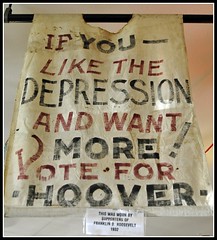
Hoovervilles: 1932 Do-Nothing EconomicsPolitics Changes How We Earn

Recent legislation has raised the minimum wage so that many of the workers who were making minimum wage are now earning more per hour than they were before.  The legislation, in effect, gave many of those workers a pretty big raise.  Of course, the opposite can be true where many companies, feeling the pinch of having to pay that much more per hour, were forced to reduce hours or the number of workers causing some to make less than before. Temporary reductions in payroll taxes have added dollars to our paychecks.  Proposed changes to Social Security could change that again, and could change the way retirees earn their SS funds back.

Politics Changes How We Spend

The most obvious example of how politics can change how we spend money is taxes.  The tax rates that we pay, both federally and locally, can cause us to spend less on some items.  They can also cause us to spend a bit more when we receive a refund each year.  Another good example is the recent legislation that changed the way interchange fees work and caused many banks to raise fees to compensate.  Instead of compensating, many of us moved our accounts to Credit Unions that weren’t charging the new fees.  State sales taxes can drive sales across borders, especially when a bordering state has no sales tax.  Tax credits and deductions have caused millions to be spent on home improvements, energy efficient appliances, electric and hybrid cars, and even the birth of children.

Politics Changes How We Save

Regulations and laws determine the methods of investment for most every investment vehicle publicly available today.  With each new legislative session, new regulations and laws are passed that affect how investments and savings vehicles are able to operate and function.  Any new scandal, like the recent Madoff Ponzi scandal, or the less recent Enron failing, causes a flurry of new regulations and laws that are meant to prevent similar situations from happening, but also result in increased administrative costs that get passed down to the investor.  Tax incentives for certain retirement savings accounts cause added funds to be added to retirement accounts as a tax shelter.

I don’t think that there’s any doubt that politics and the politicians that play them play a huge part in our personal finances.  The laws and regulations that they enact each session make changes to the entire financial field.  Especially in the last few election cycles, there’s been a lot of focus put on the economy as a whole, and how the recent slump has been caused by this politician, or that politician.  There’s lots of blame going around, but in the end, I think it took a concerted effort by a bunch of folks.

As this election cycle heats up with local primary elections this spring and the presidential elections in November, I urge you to take a good look at who your choices are, and inform yourself on their stances on ALL the important areas of your life.  Too often, we look at a politician and judge them based on just one of their platform stances.  “That one is Pro-Choice! I can’t vote for him”.  I think that’s a mistake.  You’re unlikely to find any politician that agrees 100% with all of your views.  Find one that agrees with the most of your viewpoints, and vote for that one.  If you don’t know where they stand, find their campaign website and find out.  Contact them if you have to.  But, educate yourself before you blindly go into the voting booth.  The worst thing you can do is vote based on a gut feeling, or vote blindly without knowing who you are voting for.  Your finances may depend on it!

photo credit: Tony the Misfit

Shane Ede

Shane Ede is a business teacher and personal finance blogger.  He holds dual Bachelors degrees in education and computer sciences, as well as a Masters Degree in educational technology.  Shane is passionate about personal finance, literacy and helping others master their money.  When he isn’t enjoying live music, Shane likes spending time with family, barbeque and meteorology.


www.beatingbroke.com

Filed Under: economy, Financial Miscellaneous, ShareMe Tagged With: Personal Finance, politics, voting

Opportunity Cost is Bull

June 8, 2011 By Shane Ede 10 Comments

That’s right.  Bull.  All these experts go on and on about calculating the opportunity cost of something and adding that in to your cost analysis when deciding whether you should do something yourself, or hire it out.  Heck, even I have used it before.  But, we’ve all taken it way too far.

Let me ask you this; What is your opportunity cost of reading this post?  Of eating your breakfast this morning?  Not relevant?  Bull, again.  We use it to determine if we should keep cable T.V.  We use it to determine the added cost of our daily commute.  Personally, I’ve used it to validate paying people to do all sorts of things.  Mechanics?  The cost of doing it myself is too great, let them replace those brakes!  Plumbers? I hate doing plumbing.  Let them fix that leak!  We’ve become so obsessed with being frugal and pinching our pennies that we figure out the cost of everything that we do.  If the cost is too high, we should avoid doing it, or do it ourselves, our mantra goes.  But, that isn’t always true! Sometimes, it’s just straight up bull.

We all want to improve our finances.  That’s why we do those calculations.  It’s simple mathematics.  The problem with opportunity cost, however, is that most people assume a 100% efficiency.  I hate to be the one to break it to you, but there is nothing that is 100% efficient.  Not you, me, or anything ever created.  There’s gonna be some loss.  So, yes, I can figure the opportunity cost of my time.  But, it depends on my using that time to be efficiently working on something that will make me money.  The opportunity cost of my time at work is about $25/hour.  But, that doesn’t mean that every hour I sit at home watching T.V. has an opportunity cost of $25/hour.  I can’t stop watching T.V. and replace that time with paid time for work.  They don’t like paying overtime.  Plus, I’m paid on salary, so every extra hour I work at work, reduces the effective hourly pay.  Did you catch that?  Every hour over 40 hours a week that I work reduces my efficiency to earn money.  If I were paid hourly, that might be slightly different.  But, I’d be willing to bet, my employer would still have an aversion to paying overtime and would not allow me to work many more hours over 40.

If you’ve got side projects, like I do, there is a opportunity cost for every hour that I’m not working on them.  Some side projects are extremely easy to figure the cost of.  If I contract out my work on an hourly basis, my cost (for every hour I’m not working that project) is that hourly rate.  But, just like my job, I can’t be 100% efficient at my side project either.  I’ve got to sleep sometime.  (Egads!!!  The opportunity cost of sleep!!!)

The point is this; If you’re going to try and figure the opportunity cost in order to validate a decision, don’t do it blindly.  Realize that you won’t be 100% efficient.  Just because you disconnect the cable T.V. doesn’t mean you’re going to replace all that T.V. watching time with efficient money making time.  Some of it might be spent reading a book.  Or playing with kids.  Or napping. 😉  Each of those may have some benefit to you, but they really don’t have much place in a financial cost analysis.  Sorry, you can’t bill your kids for playtime!

The personal finance world is full of stuff like this.  Mantras and rules-of-thumb that we use like crutches to validate and justify why we do what we do.  It’s like an addiction.  If you truly want to take control of your finances and live a better life, you’ve got to discard those addictions like you would a pack of smokes and begin to analyze what you do with a critical view.  Nothing is worth using in your finances until you’ve tested and proven that it is.

photo credit: zogh

Shane Ede

Shane Ede is a business teacher and personal finance blogger.  He holds dual Bachelors degrees in education and computer sciences, as well as a Masters Degree in educational technology.  Shane is passionate about personal finance, literacy and helping others master their money.  When he isn’t enjoying live music, Shane likes spending time with family, barbeque and meteorology.

www.beatingbroke.com

Filed Under: Financial Truths, Frugality, General Finance, Personal Finance Education, Saving, ShareMe Tagged With: frugaler, Frugality, opportunity cost, passive income, Personal Finance, Saving

Isolationism and Stagnation

October 27, 2010 By Shane Ede 2 Comments

Isolationism isn’t a new idea.  At it’s root, it is the idea of being alone.  Isolated.  There have been a few countries that have used Isolationism to cut their country almost completely off from other countries.  China, Japan and North Korea all are examples.  China and Japan have opened up, but North Korea is still cut off from most of the world.  (OT: Did you know that North Korea is technically still at war with us?  An Armistice was signed, but no declarations of the end of the war.)

Given a long enough time as an isolationist country, a stagnation can be reached.  I don’t believe any of the above mentioned countries ever reached that stage.  But, at some point, a country that has no exports and no imports will find an equilibrium of sorts.  The capacity of the manufacturing industry will be reached as will the consumption limits of the people.  When that happens, the economy of those countries will stagnate as well.  The law of supply and demand notes that the supply (and price) of an item can be an important factor in the demand for an item.  The opposite is true as well.  But, if demand is level, there is no need for increased demand and prices are likely to drop.  As the stagnation continues, the country will be forced to open it’s borders to outside trade in order to stimulate the countries economy.

How does all of this relate to personal finance and Beating Broke?

Mo Money Mo ProblemsPeople can be isolationist as well.  We each have a personal economy.  And each of our economies is a bit different.  When we treat our economy with an isolationist view, we too can stagnate.  But, how do we do that?  The most extreme example is to take all of your money and put it in a coffee can and then bury it in the back yard.  Or to take all of your money and stuff it in between the mattress and the boxspring.  That money is isolated from the economies of other people.  And while it isn’t necessarily shrinking (as long as you aren’t buying things), it also isn’t growing at all.

A less extreme example would be that of the person who keeps all of their money in a savings account that pays little interest.  With no growth (interest), your personal economy will eventually reach an equilibrium.  That equilibrium will be signified by the 0 cash flow situation that will occur when you begin spending as much as you make and are unable to add any more to your little lumpy mattress stockpile.  Given enough time, it will actually swing the other way as you find yourself pulling a bill or two out to buy stuff.

But, all of this is fixable.  All you have to do is be open to ways to grow your personal economy.  You can be open to increased imports (interest + wages).  Growing your exports (value of your work) can help grow your imports.  Finding a good savings account to put your savings in will grow your imports (interest).

Don’t let your economy stagnate!  Take the little extra time that it will take to find a better rate for your savings.  Find a way to increase your work output without increasing your hours, or take on overtime or a second job to increase your income . Maybe you can increase your financial knowledge and education with a finance degree.  The basic idea here is that you have to be open to new ideas, new products, and to the value that your economy has to you.

The effect that isolationism can cause to a region/country. Without outside import/export, optimization occurs and stagnation ensues.

Image Credit: Mo Money Mo Problems by greggoconnell, on Flickr

Shane Ede

Shane Ede is a business teacher and personal finance blogger.  He holds dual Bachelors degrees in education and computer sciences, as well as a Masters Degree in educational technology.  Shane is passionate about personal finance, literacy and helping others master their money.  When he isn’t enjoying live music, Shane likes spending time with family, barbeque and meteorology.

www.beatingbroke.com

Filed Under: economy, ShareMe Tagged With: economy, economy of you, isolation, isolationism, isolationist, money, Personal Finance

  • « Previous Page
  • 1
  • …
  • 15
  • 16
  • 17
  • 18
  • 19
  • Next Page »
  • Facebook
  • Pinterest
  • RSS
  • Twitter

Improve Your Credit Score

Money Blogs

  • Budget and the Bees
  • Celebrating Financial Freedom
  • Christian PF
  • Clever Dude
  • Dual Income No Kids
  • Everybody Loves Your Money
  • Financial Panther
  • Gajizmo.com
  • Grocery Coupon Guide
  • Lazy Man and Money
  • Make Money Your Way
  • Money Talks News
  • Personal Profitability
  • PF Blogs
  • Reach Financial Independence
  • Saving Advice
  • The Savvy Scot
  • Yes, I am Cheap

Categories

Disclaimer

Please note that Beating Broke has financial relationships with some of the merchants mentioned here. Beating Broke may be compensated if consumers choose to utilize the links located throughout the content on this site and generate sales for the said merchant.

Visit Our Advertisers

Need to change careers? Consider an Accounting Certificate Program from WTI.
  • Home
  • About
  • We Recommend
  • Contact
  • Our Editorial Commitment