Beating Broke

Personal Finance from the Broke Perspective

  • Home
  • About
  • We Recommend
  • Contact
  • Privacy Policy

Powered by Genesis

Are You Rationalizing Your Way Into Debt?

May 16, 2012 By Shane Ede 18 Comments

Staying out of debt is difficult.  Terribly difficult.  It isn’t made any easier if you rationalize yourself into debt, either.  Many of us spend a good deal of our time and energy trying to get out of debt, and stay out of debt.  We do that through so many devices, and each have our own system that helps us along the way.  Budgeting is obviously a big tool that many of us use to make sure that we have enough money to pay the bills, and ourselves at the end of the month.  We figure out how many months it will take to pay off this debt, or that debt, and then budget out that amount over that many months.

Sale © by markhillary

Many years ago, I spent a few years working as a salesperson at a retail store where bigger ticket items were popular.  Computers, televisions, and cell phones were big sellers, and good for commissions.  As part of our training for our jobs, we were trained on the many ways to sell a customer on the item they were looking at, and even how to convince the customer that they needed the upgraded item.  One of those sales tactics was to help them rationalize the purchase.  And, chief among the ways to do that was to take the price of the item, break it up over a set amount of months (24, 36, 48, 60) and tell them how much they’d be spending “a month” for the item.  Suddenly, that $2000 computer (it was that long ago) becomes a $25 a month purchase.  Psychologically, people are more likely to purchase something if it’s under $100.  Even if that “under $100” is in the form of a monthly payment for several years.

Salespeople are the only ones we have to watch out for when it comes to this tactic in particular.  Pay special attention the next time you’re looking at purchasing something.  See how many times over the next month, you attempt to rationalize a purchase based on what it will cost per month on credit over what the total price will be.  I think you’ll be surprised just how often you use that same sales tactic on yourself.

Don’t rationalize your way into debt.  Fight back, and stick to your guns.  That purchase has a total price.  And if you’re buying it on credit, that price will be far larger than if you had purchased it with cash.  More importantly, don’t saddle yourself with more debt just because the “monthly” price is more palatable.

Shane Ede

Shane Ede is a business teacher and personal finance blogger.  He holds dual Bachelors degrees in education and computer sciences, as well as a Masters Degree in educational technology.  Shane is passionate about personal finance, literacy and helping others master their money.  When he isn’t enjoying live music, Shane likes spending time with family, barbeque and meteorology.

www.beatingbroke.com

Filed Under: budget, Consumerism, credit cards, General Finance, Saving, ShareMe Tagged With: debt, Debt Reduction, sales, sales tactics, Saving

Take a Challenge To Start the New Year Off Right

January 30, 2012 By MelissaB 14 Comments

If you would like to start 2012 on the right financial footing and want to do something that is attainable, consider taking a challenge.  Two of my favorite challenges are spending challenges and pantry challenges.  Take either or both of these challenges, and you will find extra money to do with what you please—to save for a new vehicle or home, to bulk up your emergency fund or to snowflake on your debt to get it paid off faster.

I have already spoken about the spending challenge, otherwise referred to as the No Spend Month as an excellent way to raise money for Christmas gifts, but it is also good to
do another time of the year.  Choose one month when you limit your spending for disposable items such as groceries, entertainment and gas by as much as 50% of what you typically spend.  You will find yourself being mindful of what you spend money on because there is very little money to spend.  If you normally spend $800 a month on groceries, entertainment and gas and you vow to slash that amount by half for one month, you now have an extra $400 available to meet your financial goals.  (I often have a no spend month in February.  The psychological boost of knowing it is the shortest month of the year makes it easier to stay the course.)

Save MoneyAnother challenge I try to take at least one month a year, but ideally two months a year, is a pantry challenge.  All of us have some extra items lurking in the cabinet.  I often buy ingredients for a certain recipe, but then if I don’t get a chance to make that recipe, I often still have the non-perishable items on the shelf a few months later.  With a pantry challenge, you try to use up what you have.  A common misconception is that you are not allowed to grocery shop at all.  That is not true.  Just like a spending challenge, you set a designated amount you want to spend.  Say you spend $600 a month to feed your family of five.  During a pantry challenge, you decide you will only spend $200 for the month.  That means you must try to make meals from ingredients you already have on hand.  This is a great way to not only save money but also to use up food that may be nearing its expiration date so it doesn’t go to waste.

If you would like a little extra money for your financial goals this year but you don’t have the time or inclination to work more hours, having a spending or pantry challenge may be the perfect solution to generating more money in a limited time frame.

Have you taken part in a challenge before?  Were you successful?

photo credit: 401K

MelissaB
MelissaB

Melissa is a writer and virtual assistant. She earned her Master’s from Southern Illinois University, and her Bachelor’s in English from the University of Michigan. When she’s not working, you can find her homeschooling her kids, reading a good book, or cooking. She resides in New York, where she loves the natural beauty of the area.

www.momsplans.com/

Filed Under: Frugality, Saving Tagged With: goals, new year, no spend, resolutions, Saving

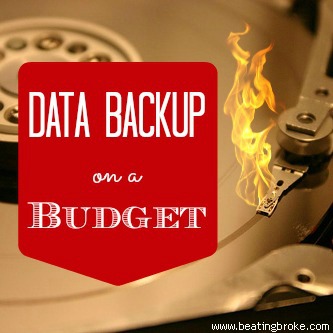
Data Backup on a Budget

December 14, 2011 By Shane Ede 24 Comments

One of the most common things we hear in the computer repair shop that I work part-time in is that the computer has crashed, and could we please make sure to get the data off of the hard drive before we re-install windows.  And, the first question we always ask is, “do you have your data backed up?”  I probably don’t have to tell you what the common answer is to that question.

Many computer users assume that backing up their data is expensive.  We see advertisements for services that cost $40-$50 a month, and for external hard drive solutions that are several hundred dollars.  But, keeping your data safe, doesn’t have to be expensive.  In fact, I’ve got all my important data backed up, and I spend less than $50 a year.  It’s not because I have some inside information, or get favors from tech companies.  You can do it too.  And, if you value your data at all, you should.

This is the set-up I currently use.

Data Backup BudgetPicture Backup

Pictures are one of the top two things that people are concerned about losing when they bring their computers in.  Unfortunately, pictures are also the largest files that you’ll likely have to backup and store.  If you take a lot, you can have Gigabytes of pictures that will need to be backed up. In my set-up, I pay for a full membership to photo sharing site, Flickr.  It’s about $26 a year, and allows for unlimited uploading to the site.  The pictures are then stored on Flickr’s server, and I can get to them whenever I want.  I should note that this isn’t the most elegant solution, as I would have to download the images one-by-one if I wanted to restore them to my local PC.  I’ll go over some more efficient services at the end, but you’ll likely have to spend more money to use them. (See note below: 4/15/13)

Data Backup

For any files that are important, besides pictures, I use a service called Dropbox.  Their basic plan is free, but limits you to 2GB of data storage.  Because I backup my photos elsewhere, I’m able to store everything else that is important with them, and keep the free account.  After several years of using it, I am getting close to the 2GB max, so I may have to upgrade to the next plan up soon.  The first paid plan allows for 50GB, and is only $9.99 a month, so I don’t think I’d ever have to go above that plan.  I should also note, here, that if you have a very large music collection on your computer that you’d like to backup, you’ll likely have to look at a paid plan. (See note below: 4/15/13)

Other options for data backup

There are several other options that you could use for data backup.  The aforementioned external hard drives can be super easy to use.  One drawback to using one, however, is that the data is still physically located in the same place as the PC you’re backing up.  That’s fine if you only need to restore because of PC failure, but can be a disaster if you have to restore due to something like a fire or flood.  Ideally, external hard drives that are used for PC backup should be placed in an off-site location, but since that’s a bit cumbersome and likely to keep you from actually backing up your data, they should be at least placed in a fire-proof safe when not in use.

Another, more ideal way to back your data up, is through a service like Dropbox.  There are a few others that are specifically designed and marketed as data backup services.  Carbonite is probably the most well-known of them, but there is also CrashPlan, and Mozy that do the same job.  Carbonite and CrashPlan come in at $59 a year (about $4 a month), while Mozy comes in at $5.99 a month. Crashplan has a free plan, but it requires you to have your own server to back up to.  This can work out if you have a second computer at another location or have a friend that you trust with your data.  They’ve also got a plan that’s $33 a year, but it limits you to 10GB total storage.

Not backing up your data can be an expensive mistake to make.  Not only can it cost you a lot of money ($100 or more) to get your computer fixed, but you could lose all of your valuable data.  Save yourself the money of having it recovered, and save yourself from losing years of photos and information; get a data backup plan.

Update 4/15/13:

One of the nice things about a disaster recovery backup plan is that you usually don’t have to use it.  More often than not, our computers run on and on until we replace them and we transfer the data to the next machine.  Earlier this week, I had to put my set up to the test.  My main storage hard drive crashed.  While I tried to recover the data from it, it was lost.  With a newly formatted hard drive, I was able to reinstall Dropbox and as soon as it was done syncing, I had all the data that was in Dropbox back on my PC.  The Flickr photo backup was a little bit more cumbersome.  There are several apps out there that you can run that will allow you to download all of your pictures one after the other.  I ended up using one called Flump.  It worked, but the pictures are in one heck of a mess.  None of them have any names, and the structure I had before is lost.  So, I’ve got 7000+ pictures to sort through.  Moving forward, I’ll be adding one of the above back up services (Crashplan or Carbonite) to my PC to back up my file structure and other assorted things.  For the $59 a year it costs, it’s worth the added convenience of not having to deal with the sorting of files and individual applications.

Do you backup your data?  What do you use for your data backup plan?

Original Image Credit:Hard Disc Crash by barnoid, on Flickr

Shane Ede

Shane Ede is a business teacher and personal finance blogger.  He holds dual Bachelors degrees in education and computer sciences, as well as a Masters Degree in educational technology.  Shane is passionate about personal finance, literacy and helping others master their money.  When he isn’t enjoying live music, Shane likes spending time with family, barbeque and meteorology.
www.beatingbroke.com

Filed Under: Frugality, General Finance, Home, Saving, ShareMe Tagged With: data backup, data recovery, frugal data backup, Frugality, Saving

  • « Previous Page
  • 1
  • …
  • 10
  • 11
  • 12
  • 13
  • 14
  • …
  • 24
  • Next Page »
  • Facebook
  • Pinterest
  • RSS
  • Twitter

Improve Your Credit Score

Money Blogs

  • Celebrating Financial Freedom
  • Christian PF
  • Dual Income No Kids
  • Financial Panther
  • Gajizmo.com
  • Lazy Man and Money
  • Make Money Your Way
  • Money Talks News
  • My Personal Finance Journey
  • Personal Profitability
  • PF Blogs
  • Reach Financial Independence
  • So Over Debt
  • The Savvy Scot
  • Yes, I am Cheap

Categories

Disclaimer

Please note that Beating Broke has financial relationships with some of the merchants mentioned here. Beating Broke may be compensated if consumers choose to utilize the links located throughout the content on this site and generate sales for the said merchant.

Visit Our Advertisers

Need to change careers? Consider an Accounting Certificate Program from WTI.