Beating Broke

Personal Finance from the Broke Perspective

  • Home
  • About
  • We Recommend
  • Contact
  • Privacy Policy

Powered by Genesis

The Benefits of Weekly Menu Planning

May 27, 2011 By MelissaB 3 Comments

Does this sound familiar?  It is 5 p.m., and you stop by the grocery store after work.  You don’t have much time to make dinner before you have to go to a parent/teacher conference at 7 p.m., so you buy some carrot sticks, a pound of meat, whole wheat buns and sloppy joe mix from a package.  Oh, don’t forget a bag of chips.  That covers dinner for tonight.

The next night, it is the same story, but this time you have had a really stressful day at work and all you want to do is go home and relax, so you go through the drive through and spend $25 to feed your family of four.

If this sounds familiar and you want to save yourself some time and money, try menu planning.

Life is busy whether you are a stay at home parent or employed full time, whether you have kids or not.  A menu plan is the best way to help control the chaos that surrounds dinner time.

The Time Investment
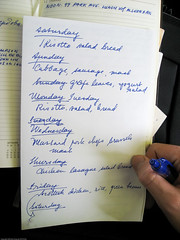
SML <3 Foodies! / 20090916.SD850IS.2859 / SMLTrue, it does take some time to create a menu plan, but you will reap the rewards all week long.  In the beginning, you can expect to spend about 30 to 60 minutes once a week picking your recipes and making a grocery list.  (The time you spend doing this will lessen as you become more comfortable with the routine and create a repertoire of recipes that you and your family like.)

The Time Payoff

If you go to the grocery store with a list of all the necessary ingredients needed to make your meals for the week, you will be focused.  You should be out of the grocery store in 60 minutes or less.

If you operate without a menu plan, it is not unusual to stop by the grocery store (or to go through the drive thru) four to five times a week.  If your average stop is about 20 to 30 minutes, you are spending 80 to 150 minutes a week.  Having a grocery list and shopping only once a week will save you 20 to 90 minutes a week!

The Financial Payoff

Unless you are extremely disciplined, you make impulse buys when grocery shopping.  Let’s say you make three impulse buys each time you shop.  If you only enter the grocery store once a week, you are only making 3 impulse buys.  If you grocery shop 5 times a week, you will likely make 15 impulse buys.  Depending on the price of the unplanned items, you could be spending as much as $15 to $30 and upwards a month by shopping so frequently.

If you make a menu plan and a grocery list, you give yourself time to look through the ads and choose recipes that take advantage of sale items, lowering your grocery bill overall.  By contrast, if you stop by the store every night and buy what you “feel” like eating that night or what is convenient to make, you will be spending much more weekly.

Even though it may not be something you do now, hopefully realizing the time and financial payoffs will have you thinking about menu planning.  Next time we will explore the mechanics of menu planning.

(B.B. Note: Make sure you come back on Tuesday to read about how to implement a Menu Plan!)

photo credit: See-ming Lee 李思明 SML

MelissaB
MelissaB

Melissa is a writer and virtual assistant. She earned her Master’s from Southern Illinois University, and her Bachelor’s in English from the University of Michigan. When she’s not working, you can find her homeschooling her kids, reading a good book, or cooking. She resides in New York, where she loves the natural beauty of the area.

www.momsplans.com/

Filed Under: budget, Frugality, Home, Saving, ShareMe Tagged With: frugal, frugaler, Frugality, grocery, menu plan, menu planning, Saving

Saving Money with PaperBackSwap

April 11, 2011 By Shane Ede 6 Comments

I like to read.  A lot.  Not as much as some people, but I still manage to read somewhere between 30 and 40 books a year.  As you can imagine, that gets a little bit expensive if you’re paying full price for all of them.  Swapping and borrowing books only gets you so far if you limit it to the people you know directly.  But, that’s where a fun site called PaperBackSwap comes into play.

Here’s how it works.  You post the books that you want to trade away.  Other users request those books and you ship them off.  You can either print the postage directly through the site, or buy it anyway you like.  Personally, I use paypal shipping because it’s slightly cheaper, and, I already have the account at paypal to do that.  Once you’ve shipped the book, or books, off, you merely wait for them to be received.  Once received, the person you sent them to marks them as received and you get a credit.

Save Money with Paper Back SwapWith your credits, you can then request books from other members.  (note: the first person from your household to sign up for PaperBackSwap gets two free credits when they list 10 books) Then, it’s just the same process, but with you being the receiver rather than the sender.

I’ve been a member since 2009.  I’ve sent 71 books out, and I’ve received 59 books.  I’ve only had one of the books that I sent disappear in postage, and one other that was damaged in postage.  Every other book I’ve sent has safely gotten where it was going and was accepted by the receiver.  The same is true of receiving books.  I’ve never had one get lost, and only had one that was damaged.  It’s a great community of readers, and a great source of books.

The selection of books is usually pretty good.  As you would expect, most of the newer books are a bit hard to get, but you can throw them on your wish list and the system will email you when one becomes available.  If one on your wish list becomes available, you’ve got two options.  The default is that PBS will put it on a 48 hour hold while it waits for you to either request it or decline it, or you can put it on auto-request which will automatically request it from the other member as soon as they list it.

If you’re an avid reader (or, really, even a more casual reader) you really should check out PaperBackSwap.  It’s  great, frugal, way to get books to read, and a great way to share great books with others too!

Shane Ede

Shane Ede is a business teacher and personal finance blogger.  He holds dual Bachelors degrees in education and computer sciences, as well as a Masters Degree in educational technology.  Shane is passionate about personal finance, literacy and helping others master their money.  When he isn’t enjoying live music, Shane likes spending time with family, barbeque and meteorology.

www.beatingbroke.com

Filed Under: Books, Frugality, Saving, ShareMe Tagged With: book swap, Books, frugal, frugaler, Frugality, paperbackswap, reading, Saving

Supply and Demand Goes Both Ways

March 4, 2011 By Shane Ede 13 Comments

Supply and Demand.  We all learn about this tenet of the capitalist market at a rather early age.  It’s a pretty simple concept really.  When one increases the other decreases.  As supply grows, demand diminishes.  As does the price for that product.  As demand grows, supply diminishes.  And price goes up. It’s a function of our market.  And, I think parts of it are broken.

As a frugal blogger, I’m constantly wracking my brain trying to find new ways to be more frugal, and new ways to present that information to you. Part of that includes keeping an eye on the market.  And as such, I’ve come to the conclusion that the law of supply and demand has become more of a guideline than a law.

How so?

Take airfare for instance.  According to this CNN Money article, airfare prices have been raised twice as many times this year as they were all of last year.  And we’re only in March.  What allows them to do that and get away with it?  You keep paying for the tickets.  Gas goes up, and we still fill up our SUVs.  As long as you continue to pay the prices they are asking, the prices will continue to go up.  And, recently, they’ve gone up anyways.

We all know that some of the things that we are buying are too expensive.  I read several articles a day about how expensive somethings have gotten and ways to save money by making your own, or frugally using what you do buy.  And, to some extent, that does work.  For a select few.  But, there are others who are willingly paying that price and then complain about it afterwards.  Why?  They’ve been conditioned to do that.  When was the last time you heard of a boycott based on the price of a good, rather than something the company did to offend you?  Do you think that if even half of the consumers boycotted flying for a month, that prices wouldn’t drop?  They’d have to or they’d have to go out of business.

Why can I buy a ticket from Fargo, ND to Las Vegas, NV for less than $150, but it costs me 3x that much to fly to San Antonio?  It’s not 3x as far.  Why can I buy a bag of malt-o-meal cereal for $2 that tastes exactly the same as a name brand cereal but I can’t buy that name brand cereal for less than $3.50?  The examples of this are plentiful.

We aren’t just consumers.  We have brains and are capable (in most cases) of thinking with them.  It’s time we used them to demand fair prices for products.  We’ve forgotten that supply and demand goes both ways.  We do have some small modicum of control here, but we’ve grown complacent and forgotten that we have it at all.  Many of you are frugalers.  But, we always say that we’re doing it to save money.  And, that’s true, but maybe it’s time we also say that we’re doing it to protest the high prices that we’re being charged.  Oddly, saving money isn’t always a good enough excuse for some people.  Sometimes they need a moral soapbox to stand on.  And, maybe that’s the way to take back supply and demand, and turn it into a working machine again rather than a pleasant theory in economics textbooks.

What say you? (So Say we All.  If you’d watched BSG, you’d get that.)

Shane Ede

Shane Ede is a business teacher and personal finance blogger.  He holds dual Bachelors degrees in education and computer sciences, as well as a Masters Degree in educational technology.  Shane is passionate about personal finance, literacy and helping others master their money.  When he isn’t enjoying live music, Shane likes spending time with family, barbeque and meteorology.

www.beatingbroke.com

Filed Under: Consumerism, ShareMe Tagged With: Consumerism, economics, frugal, frugaler, Saving, supply and demand

  • « Previous Page
  • 1
  • …
  • 15
  • 16
  • 17
  • 18
  • 19
  • …
  • 24
  • Next Page »
  • Facebook
  • Pinterest
  • RSS
  • Twitter

Improve Your Credit Score

Money Blogs

  • Celebrating Financial Freedom
  • Christian PF
  • Dual Income No Kids
  • Financial Panther
  • Gajizmo.com
  • Lazy Man and Money
  • Make Money Your Way
  • Money Talks News
  • My Personal Finance Journey
  • Personal Profitability
  • PF Blogs
  • Reach Financial Independence
  • So Over Debt
  • The Savvy Scot
  • Yes, I am Cheap

Categories

Disclaimer

Please note that Beating Broke has financial relationships with some of the merchants mentioned here. Beating Broke may be compensated if consumers choose to utilize the links located throughout the content on this site and generate sales for the said merchant.

Visit Our Advertisers

Need to change careers? Consider an Accounting Certificate Program from WTI.