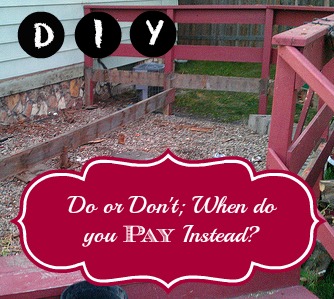
Sites around the web, including this one, are always pushing free or DIY alternatives to lots of things. And, in most cases, I think that they (and I) am right. There are so many things that we pay other people to do that we can just as easily do ourselves. Just about a year and a half ago, I built my own deck. It wasn’t necessarily easy, and it certainly wasn’t quicker than hiring someone to do it for me, but boy did it save me some money.
I truly believe that there is little that you and I cannot do ourselves. With a quick search on Youtube for the DIY project, and a few quick web searches, we can have some pretty detailed instructions on how to do anything. Well, OK. Probably not something like brain surgery. There’s probably a bit more of a skill/knowledge gap there. But, certainly, most everything else.
Occasionally, I find a service that I decide I’d rather outsource to someone else. Oil Changes are an excellent example. Can I change my own oil? Absolutely. But, for $30, I get someone else to do it for me. I don’t have to mess around with getting the filter loose, disposing of the waste oil, and I certainly don’t have to crawl around under the car doing it. For me, it’s well worth the $20 or so difference to have someone else do it. That’s more of a choice of convenience. Meaning, for me, that it is just more convenient to have someone else do it and save me the time and effort.
There are, however, some services that have less to do with convenience, and more to do with some other factors.
Saving Time
In the case of my DIY deck, I could have saved a whole lot of time by having someone else do it for me. For a professional with a crew of a couple of guys, it probably would have only taken 3-4 days. Maybe less. It took me several weeks. Obviously, it saved me a lot of money to do it myself, but if I had been crunched for time, it would have made a lot of sense to factor the time it would save into my choice. I had the time, so it wasn’t that big of a deal. (note: I say that now. At the end of the project, I was seriously wondering why I did it myself) The choice to have someone else change my oil isn’t weighted so heavily on saving time, but that is a factor. I can have someone else do the work, and all I have to do is drop the car off.
Motivational
I think this is one that many people discount too often. In many of those cases, people choose to do something themselves strictly to save themselves some money and then fail at it. In my case, I’ve tried, for many years, to control my weight. I used to be an athlete, so I’ve always thought that I had the tools to lose the weight myself. I’d start by finding some calorie counter that was free and start tracking calories. But, what inevitably happens is that I forget to count for a day or two and then it stretches to a couple of weeks. If I had lost any weight, it goes right back on. Sometimes, paying for a service that has free or DIY alternatives can be motivational. You’re paying for it, so you better get the most out of it. I recently joined Weight Watchers Online and that factor has helped a lot. There are other factors, but you better believe that the fact that I’m paying for the service is playing into it as well and keeping me working at it.
Hate/Fear
How could I write this post without adding this factor. There are just some things that you hate to do. For one reason or another, you just hate doing them. To you, not doing that task is worth the money to have someone else do. Maybe it’s mowing the lawn. Maybe it’s changing the oil in your car. Maybe it’s losing weight. Wait, maybe not that one. But, how cool would that be! For me, I tend to avoid major electrical work. There’s just something about the possibility of electrocuting myself that I don’t like… Another would be doing anything very high off the ground. Can’t do it.
Impossible
As much as I (and you), would like to think that there isn’t anything outside of our realm of possibility, we always seem to find something that we just aren’t capable of doing. While I truly believe that you can learn to do many of the things that you think are impossible, I recognize that sometimes there are things that are physically impossible. It doesn’t happen very often, but it does happen.
Saving money by doing things ourselves is a good trait to have. It helps us keep our budgets from overrunning. It keeps us learning new things. It gives us a sense of self worth by developing new skills and knowledge. But, sometimes, there are other factors at work and we make the choice to have someone else do the work for us. Maybe the cost difference isn’t worth the time you’d put into it. Maybe the extra time you’d spend on it isn’t worth the savings. Or, maybe you need some monetary motivation. Whatever it is, we develop our own factors that go into the decision, and make a choice over whether to do something ourselves, or to hire someone to do it for us.
What are your factors in deciding whether you DIY or not?
Shane Ede is a business teacher and personal finance blogger. He holds dual Bachelors degrees in education and computer sciences, as well as a Masters Degree in educational technology. Shane is passionate about personal finance, literacy and helping others master their money. When he isn’t enjoying live music, Shane likes spending time with family, barbeque and meteorology.
We all work, in some way, shape, or form. Many of you, when asked the question, “what are you working for”, will likely give the easiest answer. Money. That’s what we all work for, right? We need it to pay our bills, buy our food, and do many of the things that we choose to do. But, one of the things that I’ve contemplated for some time, and that helped me make the decision to quit my job last year, was the furtherance of that question. Sure, we all work for money. But, is that all we work for? And, if so, should it be?
The conclusion that I came too, as you can probably guess, is that money isn’t everything. We do need some, but if that’s all we’re working for, it quickly becomes less of the tool that it should be, and, instead, becomes something that makes us feel trapped where we are.
Primal Money
One of the popular diets, recently, is the Primal Diet. It’s a diet of foods that our primal ancestors (the hunter-gatherers) would have eaten. Mostly meat, and readily available nuts and fruits. The idea is that the human race has been around for thousands of years, but only been farming, and eating what we farm, for a fraction of that time. Proponents think that we haven’t evolved sufficiently enough to properly handle the abundance of grains and other “farmed” foods in our diets. (sidenote: the increase in Celiac disease over the last few decades might point to them being correct) Because of that perceived evolutionary gap, they’ve taken up eating what our kind would have eaten before the rise of farming. The movement made me think, though. What of money?
For centuries, we’ve used money as a means of trade. I give you a coin, you give me goods and services. If I run out of coins, I have to find a way to make more. I trade my surplus goods and services to someone, and they give me coins. We repeat that cycle, and we have an economy. Slowly, coins become the only way to attain goods and services, and we all depend on them. And the more we depend on them, the more of them we need. And the more we need, the more we have to sell our goods or services to get more. Eventually, we end up where we are now. We all work in order to gain more coins. Our economies have evolved. But, if that’s the case, what were they like in the Primal era?
Before we all became obsessed with coins, and money, our ancestors hunted for their food. They didn’t need to buy it, they just went out and trapped or shot it. Or they scavenged it off of the tree it grew on. Or dug it out of the ground where it grew wild. The work they did wasn’t for a new tv, or a new car, it was for survival. If they didn’t do the work, they would starve.
If you don’t do the work, you get fired (if you work for someone), or you just don’t make any money. And, yes, you still might starve. Eventually. But, food wasn’t the only thing that many of them worked for. They worked to help their family survive. They worked so that their children would grow up healthy and strong. Their children were their legacy; what they would leave the world when they passed on.
Legacy.
Now, we’ve found the real purpose of work, I think. That’s why I work, now. It isn’t about the money, although money can have a place in legacy, but about what I leave the world when I leave the world. The example that I set for my children, the good works I do, the changes I make in my world that make it better, and the life I lead, are my legacy. Money is merely a tool, like the bow and arrow for our primal ancestors, to help me do those things. And, here’s the funny part. Looking at that list of things, it’s a tool that I don’t need that much of. I set a better example for my children by being conscious of the things that I do, and by what I teach them. Donating money to charity is a good work, but there are just as many good works to be done through volunteering your time and skills. And, I can certainly make changes for the better in this world without money. My legacy doesn’t need money. I’ll use what money I have to give it a boost now and again, but it doesn’t need it.
I’m working for my legacy, not for a new tv or a new car, or even a new house. The realization of that is what helped me make the decision to leave my job. There will always be other jobs that I can get that will help me pay the bills and put food on the table, but I don’t need one to help me do my work.
Shane Ede is a business teacher and personal finance blogger. He holds dual Bachelors degrees in education and computer sciences, as well as a Masters Degree in educational technology. Shane is passionate about personal finance, literacy and helping others master their money. When he isn’t enjoying live music, Shane likes spending time with family, barbeque and meteorology.
You’ll hear me talk about it all the time. Well, you won’t likely hear me at all, but read me write about it just doesn’t sound right. 😉 If you want to succeed at your personal finance goals and your personal life goals, you need to continually work towards them. (Make some if you haven’t already)
And working towards your goals sometimes doesn’t get the required dedication that it deserves. If you’ve set goals for your personal finance, but have never met one on time, you probably suffer from a low level of PF dedication. If, however, you always meet your goals on time or early, you not only likely have a high level of PF dedication, you also need to set higher goals! 😉
In the course of my day to day life (and yours, I’d bet) I’m constantly tempted with things that I would like to have or places I would like to go. And to get those things or go to those places costs money. Money that might not be in the budget. The temptation can sometimes be strong to put aside a budget item for this month so that you can have that “want” now. Time for a self check.
It’s at times like that, that I try to remind myself of the goals that I have set. That $50 gadget could be a $50 payment towards the next debt item in the debt snowball/avalanche/snowflake. It could go towards retirement, or towards college savings, or towards down payment savings, or… You get the idea. Often, that little reminder is enough to keep me on track.
But it’s only because I’ve decided to have a very high level of dedication to my personal finance goals that it works. If I had a much lower PF dedication level, it might not be so easy to turn down that gadget. And I’d be that many more months behind schedule on paying off my debt.
What is your PF dedication level? Do an inventory of the goals that you have set and decide now how much dedication you want to have towards those goals. I’ll let you in on a little secret. If you set a goal, you want it to be a 100% dedication item. Maybe you don’t realize that, but (consciously, or sub-consciously) you created that goal with the intention of giving it 100% dedication. And if you aren’t giving it the dedication that you intended for it, you’re letting yourself down. And maybe it’s time to rethink your goals and set new ones.
Whatever the case may be, your dedication level to your goals is the deciding factor in meeting those goals.
Shane Ede is a business teacher and personal finance blogger. He holds dual Bachelors degrees in education and computer sciences, as well as a Masters Degree in educational technology. Shane is passionate about personal finance, literacy and helping others master their money. When he isn’t enjoying live music, Shane likes spending time with family, barbeque and meteorology.