Beating Broke

Personal Finance from the Broke Perspective

  • Home
  • About
  • We Recommend
  • Contact
  • Privacy Policy

Powered by Genesis

Flossing with Chest Hair

October 10, 2011 By Shane Ede 12 Comments

Being a frugaler means making some sacrifices.  We sacrifice in order to save a few bucks.  Sometimes, it becomes a bit of an addiction.  We get a small high off of the act of saving.  While you can certainly have worse addictions, even an addiction to saving can be a bad thing at times.

Taking Frugal to Extremes.

Before you get any funny ideas, I really should let you off the hook.  This post isn’t really about flossing with chest hair.  (It’s a catchy title though, isn’t it?)  I don’t actually know of anyone ever having flossed with chest hair, nor would I suggest it.  But, it serves as a good example of a way that people could take saving to an extreme.  There’s a growing movement to do things in a sustainable manner, and using things that are renewable (like chest hair) is a big part of that.  But, there are extremes.  For instance, I’ve read about people who use a special kind of stick that is very fibrous, and they chew on it instead of brushing or flossing.  Some things, I’d just rather pay for.  Being frugal is good.  Being so frugal that you chew on sticks?  I’m not going to judge, but it seems a bit too extreme for me.

Finding a Happy Frugal Medium.

There is seldom a cure to any addiction.  Overcoming one usually entails years of counseling, and hard work on the part of the addicted.  Part of the treatment is usually to completely forgo whatever it is that you’re addicted to.  If you’re an alcoholic, drinking any alcohol at all is forbidden.  But, I can’t, and won’t, condone abstaining from frugality.  Overcoming an addiction to being frugal is just a matter of finding a happy medium where you can still save money, while still living in a way that doesn’t have to include extreme cutbacks.

Thinking..

The Cure to Extreme Frugality.

Without thinking about it too hard, come up with something that you spend money on that you can’t do without.  Again, I’m not going to judge.  For some, it will be their car.  For others, it will be their morning coffee.  Now, come up with something that you currently spend money on that you can do without.  For some reason, for most people, it’s harder to come up with something we can do without than it is something we can’t do without.  Why is that?  The answer is that it’s psychological.  As frugal people, we’ve thought long and hard on ways to save money and to pay off our debt.  In our minds, we’ve analyzed everything that we spend money on.  We then justified everything that we spend.  In some of those cases, we’ve created justification for ourselves so that we don’t have to get rid of something that we would rather not.  So, it’s harder to find something that we know we can do without because, in our minds, we’ve created a justification that makes it something we need.  The cure to finding a happy medium and avoiding the extreme frugal addiction is to take a close look at the things we’ve justified and find those things that we’ve created justifications for that really aren’t all that justified.  In short, stop lying to yourself.  Once you do, you’ll have found several things that you can cut back on, or remove entirely, that will save you money without going to extremes.

It’s just as hard to overcome the addiction of lying to yourself as any other addiction.  There should (and maybe is) be a 12-step program for it.  Until then, try and be truly honest wit yourself.  Understand that you’ll probably slip up once or twice.  That’s forgivable.  Just recognize that you’ve slipped, and get back on track.

photo credit: Just Add Light

Shane Ede

Shane Ede is a business teacher and personal finance blogger.  He holds dual Bachelors degrees in education and computer sciences, as well as a Masters Degree in educational technology.  Shane is passionate about personal finance, literacy and helping others master their money.  When he isn’t enjoying live music, Shane likes spending time with family, barbeque and meteorology.

www.beatingbroke.com

Filed Under: Financial Truths, Frugality, Saving, ShareMe Tagged With: addiction, frugal, frugaler, Saving

Have a No Spend Month This Fall to Save for Holiday Gifts

October 3, 2011 By MelissaB 10 Comments

Have you ever watched your family open up Christmas gifts while mentally calculating how much each gift cost and comparing that against the amount you have in your checking?  Have you dreaded opening the bills in January because you know the credit card statement from holiday shopping will be coming soon and you do not have the money to pay the balance in full?
When my husband and I were newly married and dirt poor, we carefully planned our Christmas purchases to fit within our meager budget.  We didn’t buy many gifts, but the ones we bought were well thought out.  When we went to visit my mom over the holidays, she kept telling us about all of the presents she had bought for us.  There were so many under the tree!  Because we are the only people to buy gifts for my mom because my dad has passed, we started feeling guilty about the few presents we bought her.  Noticing that her bathroom towels were worn, we went out Christmas Eve night and bought her an entire set of 6 new bath towels including hand towels and washcloths with money we did not have.  Then we bought her some jewelry.  We charged everything knowing we didn’t have the money to pay.

50mm HBWOn Christmas morning, she delighted in her presents.  When we opened ours, we were in for a surprise.  She too had bought a few well thought out gifts for us.  But all those extra gifts we found under the tree?  They were leftover t-shirts from a conference some of the professors had hosted at the university where she works.  She bought them for a $1 each.  Each time I or my husband opened another one of those presents that contained a t-shirt, I felt sick.  We had put ourselves in debt to try to make sure our presents were equal to hers, but she had stuck to her financial budget by giving us “filler” presents.  There had been no need to buy those extra gifts on Christmas Eve. . .

We worked like crazy selling off things in our apartment such as textbooks we no longer used so that we could pay off those credit cards used to buy the extra gifts.  On our meager salary, it took us until March.  Thankfully, we have learned our lesson.

If you don’t want to spend the months after Christmas worrying how you will pay off the new debt you just acquired, consider having a no spend month now.  We still have nearly three months until Christmas.  Pick a month such as October or November to drastically reduce your spending.

If you normally spend $1000 a month on groceries, gas, entertainment, eating out, toiletries, etc., decide how much you want to cut that amount.  Maybe you will decide that in October you will only spend $500 a month.  To make up the difference, perhaps you won’t eat out or you will eat from the pantry to use up those groceries that have been on the shelf for awhile.  Maybe you will do something for free as a family rather than catching the latest movie.

By reducing your spending for just 4 weeks, you will be able to come up with a good amount for your holiday gift giving.  If you normally spend $1000, but only spend $500 of that in October, you now have $500 saved for holiday gift buying.  Yes, you sacrifice now, but it will be well worth it when you know that every present under the tree has been paid for.  Best of all, there is no reason to dread the bills in January.  Isn’t that a great way to start the new year?

photo credit: kevin dooley

MelissaB
MelissaB

Melissa is a writer and virtual assistant. She earned her Master’s from Southern Illinois University, and her Bachelor’s in English from the University of Michigan. When she’s not working, you can find her homeschooling her kids, reading a good book, or cooking. She resides in New York, where she loves the natural beauty of the area.

www.momsplans.com/

Filed Under: budget, Financial Mistakes, Frugality, Saving, ShareMe Tagged With: frugal, frugaler, Holiday, no spend, Saving, spending

Evaluate the True Price of Dining Out to Save Money

August 31, 2011 By MelissaB 14 Comments

Our culture seems to be one that is centered around dining out.  When you are younger, you meet friends at a restaurant for a night out and to chat.  As you get older and have a family, you may go out to eat because time is short between working, raising a family, helping with homework, and doing housework, among other things.  Some people are extreme and eat out for every meal because they do not like to cook or have not learned to cook.  This is so commonplace in the American culture, that we don’t often question these expenses.  Instead of just assuming that going out to eat or grabbing take out is a necessity, evaluate the cost of your restaurant purchase.

It has been a stressful day, and you would like nothing more than a night off from the kitchen.  You decide to buy take out for your family of 4 and spend $25.  True, you did buy yourself a night out of the kitchen by avoiding cooking and washing the dishes that you would use.  Yet, ask yourself, would you have paid $25 to hire someone to come to your kitchen for an hour that night, make a meal and do the few dishes that you used?  No?  Well, that is essentially what you did by picking up take out.

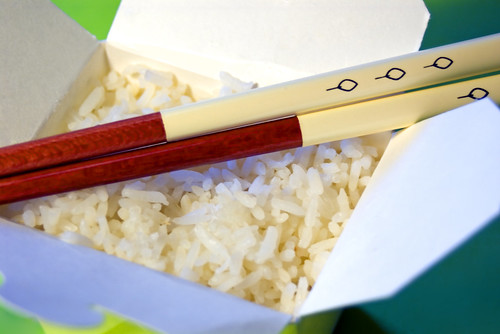
Riced out.

I use this way of thinking frequently now to save myself from spending money eating out.  My family ate out by habit until I started evaluating the true cost.  I recently quit my job and have been doing freelance work from home.  Several of my smaller jobs each pay $20 a month.  Recently, I wanted to go out for sushi, which is a weakness not only of mine, but of my husband and kids.  When our family of 5 goes out for sushi, it typically runs us $55 to $60.  I asked myself if one meal of sushi was worth doing 3 additional small jobs to recoup the $60?  Although the jobs do not take much time weekly, I would have to do the three jobs for a month to recoup the money spent on sushi.  Was it worth it?  No.  We did not go out that night.

The idea of evaluating life energy for consumption is not new.  It was the subject of the book, Your Money or Your Life by Joe Dominguez and Vicki Robins.  The overall principal is to look at the amount of time and money it would take to recoup an expense.  I try to use this in my life normally, but I find it especially effective when considering the often inflated price of dining out.  Take the sushi dinner for $60—my family’s weekly grocery budget is $100.  Is that one meal worth half a week’s groceries?  Definitely not.

I am not saying we shouldn’t go out.  My family still enjoys going out, but I am suggesting we should stop thinking of dining out as something routine and to be done daily or several times a week.  Instead, think of dining out as a treat and something to be planned and enjoyed.

photo credit: dslrninja

MelissaB
MelissaB

Melissa is a writer and virtual assistant. She earned her Master’s from Southern Illinois University, and her Bachelor’s in English from the University of Michigan. When she’s not working, you can find her homeschooling her kids, reading a good book, or cooking. She resides in New York, where she loves the natural beauty of the area.

www.momsplans.com/

Filed Under: Consumerism, Saving, ShareMe Tagged With: cooking, dining out, eating out, family, food, frugal, frugaler, Saving

  • « Previous Page
  • 1
  • …
  • 12
  • 13
  • 14
  • 15
  • 16
  • …
  • 20
  • Next Page »
  • Facebook
  • Pinterest
  • RSS
  • Twitter

Improve Your Credit Score

Money Blogs

  • Celebrating Financial Freedom
  • Christian PF
  • Dual Income No Kids
  • Financial Panther
  • Gajizmo.com
  • Lazy Man and Money
  • Make Money Your Way
  • Money Talks News
  • My Personal Finance Journey
  • Personal Profitability
  • PF Blogs
  • Reach Financial Independence
  • So Over Debt
  • The Savvy Scot
  • Yes, I am Cheap

Categories

Disclaimer

Please note that Beating Broke has financial relationships with some of the merchants mentioned here. Beating Broke may be compensated if consumers choose to utilize the links located throughout the content on this site and generate sales for the said merchant.

Visit Our Advertisers

Need to change careers? Consider an Accounting Certificate Program from WTI.