Beating Broke

Personal Finance from the Broke Perspective

  • Home
  • About
  • We Recommend
  • Contact
  • Privacy Policy

Powered by Genesis

Are You a Patient Purchaser?

January 18, 2013 By Shane Ede 12 Comments

Conventional wisdom, at least in frugal personal finance circles says you should wait several days (or even weeks) before making most purchases.  Especially large purchases.

Personally, I’m usually a pretty patient purchaser.  I hate paying retail for most things. When I decide I need something (or even want it), I usually start my search on eBay.  Only when the price on eBay is pretty close to retail, or when I just can’t get something at a discount will I purchase it through a retail outlet.  And even then, I generally wait for a sale.

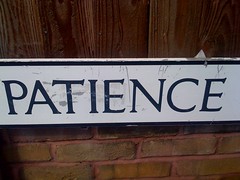
Patience is a Virtue

The main reason that experts suggest that you wait on a purchase is that, after thinking about it for a few days, most people will decide that they don’t need the item, or that they don’t want to spend the money on it right then. It also prevents spontaneous purchases.  I seldom find that to be true.  Well, not entirely, anyways. There have been a few cases where I’ve decided that I really didn’t want the item.  I’m also frugal to a fault, and rarely make a spur-of-the-moment purchase.  If I see something that I want, I’m off to research it and find the best price for it.
Limited Time Offers

LTOs are my downfall.  Because of their limited timeline, I don’t have the luxury of waiting until I can do the same amount of research that I normally do.  I still have a hard time purchasing the item, but have been known to buckle under the pressure and pull out my card.  (That’s a debit card, thank you.)  And, that’s the reason that retailers will have LTOs.  Put under the pressure of a deadline, people will often put off doing the research they should and purchase on the spot to take advantage of a great deal.

How I Practice Patient Purchasing

Patient purchasing has probably saved me thousands of dollars over the years.  Here’s the method that I generally use.

  • Decide on the brand and model that you want.  This can be the super heavy duty research part of the purchase.  I’ll spend time shopping for the item, and then looking online at retailers to find a brand and model that I like as well as get an idea of the average price of the item.  e.g. when I last bought a pair of shoes, I first decided on the brand that I wanted to buy (New Balance) and then on the model.  Deciding on the model took the most time as they have many models that are built for different strides, pronations, etc.  I also found that the full retail for a pair was about $125, but that there were discount retail outlets that regularly sold them for about $100.
  • Set up a search on eBay.  I like eBay.  It gives me the ability to fine tune a search and then save it.  I also very rarely find that the price that I can get something for on eBay is more than what I can get it for at a retailer.  Most of the time it’s quite a bit less.  I usually start with a pretty generic search for the brand and model of the item I’m looking for and then fine tune it based on the other qualifications I’m looking for.  e.g. in the case of the shoes, I started with a search for “New Balance 757” and then refined the search with the shoe size, width, and maximum price I was willing to pay.
  • Exhibit Patience.  This is the part that some people find to be really hard, but that I find comes pretty easily.  I wait.  I check the saved search every two or three days (auctions can be run in 1,3,7, or 10 day lengths, but I’m willing to miss a few of the 1 day auctions) and add items that look like good possibilities to my watch list.  I then sort my watch list by the auctions that are ending soonest, and will place a bid on the first one for the maximum that I am willing to pay.  That usually involves figuring out how much shipping will be, subtracting it from the max I’m willing to pay and then bidding the remainder.

Using that method, I can usually get an item that I want at a price that I want.  Being patient is key though.  Sometimes it can take me weeks to finally win an auction.  In the example I used above (shoes), I think it took me about 3 weeks to get a pair of shoes that I wanted at the price I wanted.  In the end, I paid just under $60 (including shipping) for a pair of shoes that I would have paid about $125 for at a retail shoe store.

Is the savings I got worth the time I put into it?  If you break down the savings and figure out an hourly savings based on the amount of hours I put into getting the shoes, it would probably not be a very good rate.  Below minimum wage for sure.  But, for the most part, the time I spent on it is time that I likely would have wasted on watching TV or something anyways.  In other words, it was non-productive time and therefore had little monetary value associated to it in the first place.  I got a new pair of shoes, and saved money doing.

Are you a patient purchaser?  What are your methods for buying bigger ticket items?

img credit:gemb1 on Flickr

Shane Ede

Shane Ede is a business teacher and personal finance blogger.  He holds dual Bachelors degrees in education and computer sciences, as well as a Masters Degree in educational technology.  Shane is passionate about personal finance, literacy and helping others master their money.  When he isn’t enjoying live music, Shane likes spending time with family, barbeque and meteorology.
www.beatingbroke.com

Filed Under: Consumerism, Frugality, Saving, ShareMe Tagged With: Consumerism, frugal, Frugality, patient purchasing, Saving

Need Money Quick? Have a Flash Savings Challenge

November 19, 2012 By MelissaB 3 Comments

The last few months have not been kind to my family.  As Dave Ramsey says, “Murphy came to visit.”  Within the last few months, I have had several medical tests run, my computer broke so I had to buy a new one, my husband’s pay was docked $750 for two months in a row because his employer didn’t take out enough taxes, and my husband had to pay $1,700 out of pocket for a conference for work and we are waiting for reimbursement.

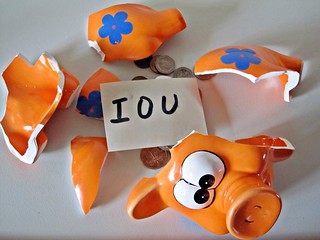
IOU Piggy BankBecause we were trying to pay off as much as possible as quickly as possible on our debt, we had very little in emergency savings (only about $1,000).  All of our unexpected expenses cost much more than that, so we not only used most of our emergency fund, we also added to our credit card debt.

Because we had paid down our credit card debt for 10 straight months, having to add to it for the last two months was difficult.  Even though we didn’t come close to erasing all of our progress from the last year of gazelle intensity, we definitely knew we were moving in the wrong direction.

Righting Our Situation:  A Flash Savings Challenge

My natural urge, now that everything has settled down, was to once again try to throw as much on debt as possible.  While it might have made me feel better in the short term, I realize that the next time Murphy comes to visit (and I know he’ll be back some time), we would end up in the same situation.

Instead, my husband and I decided to focus on growing our emergency fund, and quickly, before hitting the debt hard again.

Paying the minimum on our debt for the next few months so we can grow our emergency fund is almost as difficult as watching our credit card balance increase the last two months, but we both know a healthy emergency fund is necessary.  Since I am self-employed and bring in 1/3 to 1/2 of our income and work can sometimes be sporadic, we decided not to follow Dave Ramsey’s advice of a $1,000 emergency fund (because clearly that was not enough last time); instead we are aiming for $5,000.

To get started, we challenged ourselves to have $3,000 in our emergency fund by December 9th.  We started with $611 in the emergency fund, so that meant we had to come up with $2,389 in 4 weeks.

How We Are Earning $2,389 Extra in 4 Weeks

We are only one week into the challenge, but here is what we have earned so far:

  • Sold my 8 year old breast pump: $60 (Yes, it has been sitting in the basement for 7 years.  Why didn’t I sell sooner?!)
  • Sold 2 window guards to protect kids from falling:  $40
  • Listed my kids outgrown clothes on eBay:  $124 so far, but the auctions won’t end for 2 more days, so I imagine it will be more
  • 3 unexpected jobs I got as a freelancer:  $64.67
  • Turned in our change in a jar:  $62.67
  • Returned unopened vitamins I didn’t need:  $32
  • Redeemed 10,000 Swagbucks for PayPal cash:  $100

Our total so far, one week in is $483.34

Over the next few weeks, we intend to do more things to raise the additional money:

  • Put my husband’s reimbursement check in savings
  • Cash out reward points from our credit card and use them as a credit card payment.  Put the same amount in our savings since we won’t have to pay that money on the credit card
  • Put more stuff on Craigslist and eBay (We have kids’ clothes, toys, and equipment to list as well as some of my husband’s tools he hasn’t used for years.)

Why  a Flash Savings Challenge Is Working for Us

I have known that I have a lot of stuff to sell around the house, but I just never got to it.  Now, because we have set a short goal of just 4 weeks and also an ambitious goal of over $2,300 to raise, I am motivated.  Yes, listing all of this stuff is time consuming, but it is nice to get some money in the emergency fund to make us feel more secure, and I also like getting rid of our “stuff”.

If you have extra stuff around the house, especially toys and holiday clothes, now is the perfect time to sell it and make some cash.

Have you had a flash savings challenge like this?  What were your results?

img credit:Images_of_Money, on Flickr

MelissaB
MelissaB

Melissa is a writer and virtual assistant. She earned her Master’s from Southern Illinois University, and her Bachelor’s in English from the University of Michigan. When she’s not working, you can find her homeschooling her kids, reading a good book, or cooking. She resides in New York, where she loves the natural beauty of the area.

www.momsplans.com/

Filed Under: Debt Reduction, Emergency Fund, Financial Mistakes, Saving, ShareMe Tagged With: Debt Reduction, emergency fund, flash savings, frugal, Frugality, Saving

Are Certificates of Deposit (CDs) Still a Valuable Tool?

November 15, 2012 By Shane Ede 7 Comments

Read just about any personal finance article on saving and you’re likely to also read something about certificates of deposit.  Heck, I’ve covered what a certificate of deposit is, how to create a CD ladder, and mentioned CDs several other times.  But, as much of a mainstay as they are in the typical savings mantras, are they still a valuable tool for savings?

Recent economic changes have certainly not been kind to many of us, and our methods of savings haven’t been treated well either.  The interest rates on savings accounts is terrible.  My local credit union doesn’t pay enough to even make it worth my while.  And online savings banks that used to be the poster children of high-yield accounts are paying less than 1%.  It wasn’t that long ago that a 5 year CD would have been paying 6-7%.  Now?  Closer to 1%, even at the online banks.  My local credit union is paying 0.25% on a 12-month.  (they apparently either don’t offer  5 year, or they don’t post the rates for them)

There are still some good rates out there though, if you take the time to look.  Well, better rates than what some are offering.  In the current economic situation, you can’t ask for much.  Click here to read more information on one such certificate of deposit.  But, even with rates that are closer to 2%, are they worth your time?  If we assume that the rate of inflation is somewhere around 3%, (I think it’s higher) aren’t you losing money by only earning 2% on the CD?  Yes and no.  If the money would just be sitting around in a savings account and making little to no interest, the CD at near 2% would be better than nothing.  Literally.

So, back to the question at hand.  Are CDs still a valuable tool for savers?  The answer, again, is yes and no.  No, because they aren’t the best tool.  There are other ways for you to make your money work for you.  They all make better returns than you would with a CD.  However, they all carry some caveat that you have to know about if you’re going to use them.  In many cases, the risk is higher.  Investing the money in stocks, or in something like Lending Club can get you much higher returns, but the risk is also much higher.  Investing the money into real estate, while a good passive income idea, is also a higher risk investment, plus the money is locked away in a non-fluid investment.  Treasury bonds can have higher returns, but often only at the cost of tying the money up for a long time.

If there are so many higher yielding investments to make, why are CDs still sometimes a valuable tool for savers?  There’s two really good reasons.  The first is that the money is not tied up for very long.  Even if you purchase a 5 year CD, you can still cash the CD out and only pay a small fee.  That fee is usually something like 3 months of interest.  As long as you’ve held the CD 3 or more months before cashing it out, you don’t lose any money.  So, the money remains pretty fluid.  The second reason is that a CD is an ultra secure investment.  That’s also why the rates are lower.  A CD is what is called a secured investment.  You deposit (hence it’s name, certificate of deposit) an amount of money into the account, and agree to leave it there for a certain period of time (the term of the CD) in exchange for a guaranteed return rate.  There’s very little risk at all.  Even if the bank you open the CD at goes bankrupt, you’ll be covered by the FDIC or NCUA insurance.

While I wouldn’t suggest putting a huge chunk of your retirement into CDs, (unless you’re nearing retirement) I would suggest putting something like your emergency savings into them.  They’re also a good tool for squeezing a bit more interest out of a new car savings, or a similar savings that has a mid-range use date. Just pick a CD with a term shorter than the length of time you’ll be saving up to avoid any extra penalties.

CDs don’t offer the greatest rates, that is for sure.  But, their lack of risk, and higher fluidity make them great for short and mid range savings.  And that makes them a mostly valuable tool for savers.  You just have to know where and when to use them.  Just like any other tool.

Do you agree?  What savings would you use a CD for?

Shane Ede

Shane Ede is a business teacher and personal finance blogger.  He holds dual Bachelors degrees in education and computer sciences, as well as a Masters Degree in educational technology.  Shane is passionate about personal finance, literacy and helping others master their money.  When he isn’t enjoying live music, Shane likes spending time with family, barbeque and meteorology.

www.beatingbroke.com

Filed Under: economy, Emergency Fund, Investing, Saving, ShareMe Tagged With: CD, cd rates, certificate of deposit, economy, Investing, Saving, savings rates

  • « Previous Page
  • 1
  • …
  • 7
  • 8
  • 9
  • 10
  • 11
  • …
  • 24
  • Next Page »
  • Facebook
  • Pinterest
  • RSS
  • Twitter

Improve Your Credit Score

Money Blogs

  • Celebrating Financial Freedom
  • Christian PF
  • Dual Income No Kids
  • Financial Panther
  • Gajizmo.com
  • Lazy Man and Money
  • Make Money Your Way
  • Money Talks News
  • My Personal Finance Journey
  • Personal Profitability
  • PF Blogs
  • Reach Financial Independence
  • So Over Debt
  • The Savvy Scot
  • Yes, I am Cheap

Categories

Disclaimer

Please note that Beating Broke has financial relationships with some of the merchants mentioned here. Beating Broke may be compensated if consumers choose to utilize the links located throughout the content on this site and generate sales for the said merchant.

Visit Our Advertisers

Need to change careers? Consider an Accounting Certificate Program from WTI.