Beating Broke

Personal Finance from the Broke Perspective

  • Home
  • About
  • We Recommend
  • Contact
  • Our Editorial Commitment

Powered by Genesis

Saving Money (and Possibly Your Life) With Vaping

November 8, 2015 By Shane Ede 7 Comments

I’ve written about cigarettes and smoking in an offhanded way a few times here.  It doesn’t take an accountant to tell you how expensive of a habit it can be.  I was smoking about a half pack a day.  Sometimes more, sometimes less.  Now, I save money with vaping, and I might just be saving my life too.

Why I Switched to Vaping

I was a smoker for almost 15 years.  Over those years, I’ve attempted to quit a number of times.  I tried the nicotine patches, Wellbutrin, and Chantix on several occasions.  All with varying levels of success, and then failure.  Of the bunch, Chantix was probably the most successful.  I think I managed 6 weeks without a cigarette that time.  But, you only take Chantix for about 6 weeks, and then the urge returned, my will power left, and it was back to it.

Saving with VapingAbout a year or so, I started seeing, and reading, articles on Facebook and elsewhere about vaping.  For the uninitiated, vaping is the act of vaporizing a liquid called e-juice.  Technically, those e-cigarettes you see at the gas stations are vaporizers.  Whomever decided that naming them e-cigarettes should be ashamed of themselves though.  The e-juice that you vaporize is a mixture of Propylene Glycol and/or Vegetable Glycol, liquid nicotine, and various flavorings.  The mix is added to a tank that wicks the e-juice to a coil.  You press a button on your Mod (the device that holds the batteries and powers the coil) and the coil heats the e-juice to vaporization.  You inhale the vapor, exhale the vapor, and get your nicotine fix without a lot of the chemicals you’ve been getting in your cigarette smoke.

As I read more and more of those articles, a recurring theme started to show itself.  There were a lot of people who had started vaping and completely replaced their cigarette habit.  And most of the reports I had read seemed to indicate that vaping was a lot safer than smoking cigarettes.  I decided to give it a try.

Luckily, for me, I had a friend who I knew used a vaporizer, and I was able to ping him to get suggestions on equipment.  If I hadn’t, I would have been completely lost, and probably struggled with the process a lot more.  I might have even failed again and written off vaping entirely.  I’m glad I had that help.

I ordered my equipment, and some e-juice to get me started, and on May 25th, 2015 I made the switch to vaping.  I’ve had a total of two cigarettes since then.  And they both tasted terrible.  It’s been almost 6 months.  The urge to have a cigarette is almost entirely gone.  There are still a few triggers that spark the urge, but I can easily overcome those with a few quick vapes.  I’m no longer a smoker.

Saving Money with Vaping

In a way, I’m lucky that I live where I do.  A pack of cigarettes is only about $5 here.  In neighboring Minnesota, a pack will easily cost you $7.50.  There are places where it’s more expensive. For comparison sake, I can buy a 15mL bottle of e-juice for somewhere between $7 and $25 (the premium juices are the top end of that range.  Average is closer to $10-12).  On an average day, I vape my way through about 3-5 mL.  So, that 15mL bottle lasts about 3 days.  I used to smoke a half pack of cigarettes a day.  The cost for e-juice is slightly less overall.  Equipment adds a bit more, averaged over time.  As the cost of cigarettes continues to go up, over time I’ll save more.  That’s assuming that taxes and such aren’t applied to vaping products of course.  They might be.  If so, it might be a wash.

While some of this is unclear, what I’ve read so far indicates that vaping is a whole heck of a lot safer for you than cigarettes.  I fully expect, based on that, so see a lot of the savings from making the switch through my health and health care costs.  There’s really no way to calculate those savings, but I believe they are pretty huge.  Those savings aren’t just in financial terms either.  There’s a very real possibility that my health will improve, my quality of life will improve, and I’ll possibly have saved my life from some nasty cigarette related disease.  That’s my kind of savings!

Over the last few months, I’ve found a few ways to apply some standard saving techniques to my vaping as well.  I’ve used coupons and sales to buy e-juice at bargain prices.  I’ve done the same for some of the equipment.  I’ve started making my own coils which reduces the cost of the coils by a great deal.  And I’ve found some nice subscription offers to get some good e-juice for a far cheaper price.

Ready to Save Money with Vaping too?

If you’re looking for equipment, I fully recommend an open tank vaporizer set up.  All that means is that the tank is refillable unlike those disposable ones you find at the gas station.  Reusable and refillable is excellent.  I use the eleaf iStick 30w Mod.  I wish I had the eleaf iStick 100W TC.  It just adds some additional wattage and other options that I would have liked to have had.  Cost made it a bit of a stretch though.

As for the tank itself, my favorite right now is the Kanger Subtank Mini.  It will take premade coil units in a pinch, but also has the ability for you to build your own coils.  It’s the best of both worlds.

e-Juices come in hundreds of different flavors.  What you need to know is that you can adjust your level of nicotine.  I started off with 18mg/mL and it was too much.  Someone who was a heavier smoker might want it that strong.  I’ve been using 12mg since, but recently started buying 6mg.  One of the coolest things I’ve found is Zamplebox.  It’s a subscription box where you get sent a variety of 15mL bottles each month.  I’m subscribed to the 6 bottle package.  It’s highly customizable, and allows for you to try some flavors that you might not have without. They offer a 3 bottle, 6 bottle, and 11 bottle subscription.  They’re $19.99, $24.99, and $44.99 respectively.  At $24.99, my 6 bottles are just a hair over $4 each.  That’s a pretty good deal.  If you’re just beginning, I highly recommend you give them a try for a few months.


Shane Ede

Shane Ede is a business teacher and personal finance blogger.  He holds dual Bachelors degrees in education and computer sciences, as well as a Masters Degree in educational technology.  Shane is passionate about personal finance, literacy and helping others master their money.  When he isn’t enjoying live music, Shane likes spending time with family, barbeque and meteorology.
www.beatingbroke.com

Filed Under: General Finance, Saving, ShareMe Tagged With: Saving, saving money, smoking, vaping

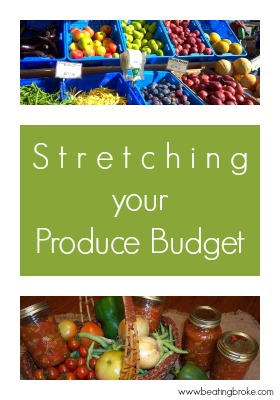
Stretching Your Produce Budget Further

June 12, 2015 By Shane Ede 14 Comments

Anyone who has made a simple budget has struggled with making their food budget fit with the rest of the budget.  If you attempt to eat healthy, one of the biggest components to a food budget is the produce.  Stretching your produce budget can be somewhat difficult.  Growing seasons are short, and the cost of produce keeps going up.  But, there are a few things we can do to stretch that produce budget, and make it a bit easier on your overall budget.

  1. Stretching your produce budgetStock Up on Sale: buying your produce on sale allows for you to stock up when the item is cheaper, then store it until you need it.   Canned produce is really easy to store.  Frozen only requires a freezer.  And if it’s the fresh stuff, there’s a few things you can do to store a surplus when you do pick it up in season and on sale.
  2. Canning for stockpiling: When you’ve got a surplus of produce, one of the best things you can do is can it to preserve it for another day’s use.  Canning only requires a few pieces of equipment, and a little time learning the process, then you can be off to the races filling your pantry shelves with preserved fresh produce to use later in the year when produce is much more expensive.
  3. Freeze it: Every year, around the end of summer, corn pops up in the backs of pickup trucks and in the farmers markets.  Compared to the rest of the year, it’s really cheap, and it tastes so good!  Unless we want to eat nothing but fresh corn, though, the season is fleeting, and we’re left with no other corn but the commercially canned or frozen corn you can get at the supermarket.  It’s just not the same.  Last year, we bought a whole bunch of corn (4-5 dozen), shucked them all, then cut the kernels off and combined them in a huge stockpot with some butter, a little bit of salt, and a little bit of water, and then cooked it for a little while.  Once it was done, we let it cool off, and then filled quart size freezer bags with the corn and froze it.  Now, if we want a little taste of that sweet summer corn, we just grab a bag, heat it backup and eat.  We did similar things with pumpkin, squash, zucchini, and a whole bunch of other summer fruits and veggies.  All it takes is a little bit of prep time and the freezer room to enjoy the flavor of fresh produce all year round.
  4. Grow it: If you already grow a garden every year, this might seem like a no-brainer of a tip.  But, growing your own garden can be an excellent way to stretch your produce budget out.  Last year, we enjoyed an abundance of tomatoes, potatoes, carrots, onions, jalepenos, cucumbers, and even an eggplant or two from our tiny container garden.  This year, we’re planning on consolidating down to a smaller selection in hopes that we’ll have some extras that we can can as well.
  5. Find a Farmer’s Market: Buying your produce from a local farmer can often be just as cheap as buying at the supermarket.  In some cases, if you order ahead, you can get a deal on bulk orders of produce which is great if you are planning on canning any of it.  It’s also fresher since it only had to make the trip from the farm down the road instead of the farm across the country.  It’s not always a great way to stretch the produce budget, but if you want high-quality produce that will last longer before spoiling, it’s a good place to check out.
  6. Pick it Yourself: A reader on twitter commented that I’d forgotten to add the u-pick farms.  I hadn’t really forgotten them, as they just don’t exist in my neck of the woods and the cost to drive to the nearest one would negate the savings.  But, if you have a u-pick farm nearby, it’s an excellent way to get out of the house, pick a ton of fresh produce (fruits usually) and save a pretty big chunk of change.  Many of the farms only charge about 1/3 of the cost at the grocery store!

Extending your produce budget is important, not just when there are droughts, but as a way to provide healthy options for you and your family to eat year round.

What do you do to stretch your produce budget?

Shane Ede

Shane Ede is a business teacher and personal finance blogger.  He holds dual Bachelors degrees in education and computer sciences, as well as a Masters Degree in educational technology.  Shane is passionate about personal finance, literacy and helping others master their money.  When he isn’t enjoying live music, Shane likes spending time with family, barbeque and meteorology.

www.beatingbroke.com

Filed Under: budget, Frugality, General Finance, ShareMe Tagged With: budget, canning, garden, grocery, produce

Would You Consider Moving to Improve Your Standard of Living?

March 30, 2015 By MelissaB 5 Comments

Last July, our family moved from the near suburbs of Chicago to the suburbs of Tucson, Arizona.  We knew that there would be some significant changes to get used to, like the change in weather, but honestly, we weren’t sure how our lives would change.

Had my husband not been offered a job in Tucson, we never would have considered moving so far away from family and friends.  However, making this move turned out to be a wonderful decision.

Even though my husband is only making $2,000 more than he was making in Chicago, our quality of life has improved tremendously.

Benefits of Moving to Tucson

Moving improve Standard of Living
Original img credit: <a href="https://flic.kr/p/5NWSvX">pbarry</a> on Flickr

We can own a house.  In the near suburbs of Chicago where we lived, a house, even a fixer-upper, cost at least $300,000.  Then, there were the property taxes to consider, which ran $10,000 to $25,000 a YEAR depending on the neighborhood you live in.  In Tucson, we got a very nice house for less than $200,000, and our taxes are only $2,000 a year.

Our kids have room to play.  Even though we lived in the suburbs of Chicago, the population is so dense that the houses all have very small yards.  Plus, the house that we rented backed up to an alley, so I never dared leave the kids outside alone.  Now, we have a large backyard with a cement fence around it.  I can see the kids outside playing while I’m in the kitchen preparing food.  We love this feature of our new home.

Money stretches so much further in Tucson.  Although it’s a challenge, in Tucson, I have a grocery limit of $125 a week.  There is absolutely no way I could have such a low grocery bill in Chicago.  It simply was not possible.  Gas here is much cheaper, too.

The environment is so much quieter and friendlier.  In Chicago, many people were just, well, grouchy.  (Not all of them, but certainly enough of them.)  We lived in a middle class suburb, and we had some sketchy characters in our neighborhood like a woman who lived down the alley and routinely dug through everyone’s trash.  (I’m not making that up!)  There was also so much noise from the nearby fire station, trains, and constant traffic.  In Tucson, our neighbors are very friendly, there is no one sketchy (that we’ve met so far), and it’s much, much quieter here.

Drawbacks to Our Move

We’re far away from family and friends.  Most of them live in the Midwest, so we are far, far from family and friends.  That is a challenge.  If we move back to the Midwest, it will be because we want to be closer to family and friends.

Everything is so far away.  In Chicago, I was very spoiled.  I had three grocery stores within a two mile drive.  Our dentist and doctor were each less than 4 miles away.  In Tucson, everything is 10 or more miles away.  We have to drive a half an hour to get to our dentist.  Driving so much can take up a large part of our time.

I never would have considered moving to improve our standard of living, but now that we’ve done so, I can see what a great move it was for our family.  Our quality of life has improved dramatically, and this move is giving us a chance to improve our financial situation.

Would you, or have you, moved far away to improve your standard of living and financial situation?  Or is this something you would not consider?

MelissaB
MelissaB

Melissa is a writer and virtual assistant. She earned her Master’s from Southern Illinois University, and her Bachelor’s in English from the University of Michigan. When she’s not working, you can find her homeschooling her kids, reading a good book, or cooking. She resides in New York, where she loves the natural beauty of the area.

www.momsplans.com/

Filed Under: Frugality, General Finance, Saving, ShareMe Tagged With: cost of living, moving, standard of living

  • « Previous Page
  • 1
  • …
  • 42
  • 43
  • 44
  • 45
  • 46
  • …
  • 66
  • Next Page »
  • Facebook
  • Pinterest
  • RSS
  • Twitter

Improve Your Credit Score

Money Blogs

  • Budget and the Bees
  • Celebrating Financial Freedom
  • Christian PF
  • Clever Dude
  • Dual Income No Kids
  • Everybody Loves Your Money
  • Financial Panther
  • Gajizmo.com
  • Grocery Coupon Guide
  • Lazy Man and Money
  • Make Money Your Way
  • Money Talks News
  • Personal Profitability
  • PF Blogs
  • Reach Financial Independence
  • Saving Advice
  • The Savvy Scot
  • Yes, I am Cheap

Categories

Disclaimer

Please note that Beating Broke has financial relationships with some of the merchants mentioned here. Beating Broke may be compensated if consumers choose to utilize the links located throughout the content on this site and generate sales for the said merchant.

Visit Our Advertisers

Need to change careers? Consider an Accounting Certificate Program from WTI.
  • Home
  • About
  • We Recommend
  • Contact
  • Our Editorial Commitment