Beating Broke

Personal Finance from the Broke Perspective

  • Home
  • About
  • We Recommend
  • Contact
  • Our Editorial Commitment

Powered by Genesis

You’re Doing it Wrong! Rethinking Your Processes

October 7, 2010 By Shane Ede Leave a Comment

Habit.  It’s a dirty little 5 letter word.  I read somewhere that it only takes 6 times of doing something before it becomes a habit.  Habit is a close relative to addiction, although somewhat easier to change.

If you’re like me, you’re a creature of habit.  You like doing things the way you’ve been doing them and don’t feel very compelled to change them.  That’s the way I was before I began taking control of my finances.  I was a habitual spender of my paycheck.  There was no saving involved.  When I started this personal finance journey, I had to break that habit and begin a new one.  One that involved paying off my debt and saving money.  Like any other habit, it took time to really make it into a habit.

Within that greater habit, there are other habits.  The habit of checking balances regularly.  The habit of balancing the bank accounts.  The habit of keeping the budget.

That last one, the habit of keeping the budget, is the one I’d like to focus on here.  In the beginning (anyone else hear that choir?), I used only a copy of Microsoft Money (now defunct).  As I matured in my budgeting, I adapted a spreadsheet based on the budget spreadsheet that Dave Ramsey created for his Financial Peace University.  And that’s where it’s been since.  I have spreadsheets going back several years, in fact.
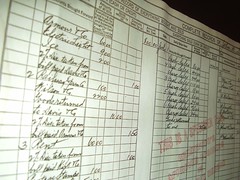
LedgerRecently, my computer became ill.  I ended up having to back all of my data off the hard drive and rebuild it.  Not a lot of fun, but it’s sometimes nice to start with a fresh drive and get rid of some of the flotsam that it’s accumulated.  Long story short, it took over a month to get it all sorted out and rebuilt.  When I had gotten everything installed and ready, it had been nearly 6 weeks since I had last checked in on my budget.  The process, if you’ll indulge me, is somewhat cumbersome.  First, I would manually enter in transactions from the internet banking application at my credit union.  With the version of Money that I had, I was never able to get it to properly import a file, so manual entry was my only option.  I would then manually enter in any outstanding checks and bill payment items.  Once the info was entered into Money, I would then manually, line by line, transfer the amounts from Money into the appropriate budget categories in my spreadsheet, using a calculator as I went to calculate the totals for each category.  (This was necessary because I didn’t have the individual line items in the spreadsheet, so I merely took the existing total and added whatever the line item was in Money to it.)

So, you can see, 6 weeks of undone budget work was quite a pile of work.  And like any good person with lazy tendencies, I put it off.  Before I knew it, there was almost 3 months worth of budget to do.  That was about the time that I decided that maybe my habit needed a bit of rethinking.  I began looking into new personal finance software that might integrate a little bit better.

What I decided on was You Need A Budget.  I’ll have a review of that coming up in the next week or so.

Telling all of you that was just getting us to this point.  The meat of the idea.  You’re doing it wrong!  Somewhere, something your doing is being done wrong.  Maybe not wrong in the sense that it’s incorrect (none of us make financial mistakes right?), but wrong in the sense that the processes that you are using are costing you;  Time or money, or both.

If there’s one thing I’ve learned through all of this, it is that you must be vigilant.  You’ve got to rethink your processes periodically.  It doesn’t have to be all that often; Some will go overboard and spend so much time rethinking their processes, that they’ll suffer from analysis paralysis.  Instead, set up a schedule where by you set aside an hour or two to go through your processes and try and discover new ways of performing those processes that might save you money or time.

In our case, moving to a newer software that made it easy to import our transactions and had the budget part of it all built in has resulted in saving us a lot of time.  What about you?  What processes do you perform that you’ve never changed?  Take a look at them and see if you can’t find a way to save yourself some time or money!

Image Credit: Ledger by er1danus

Shane Ede

Shane Ede is a business teacher and personal finance blogger.  He holds dual Bachelors degrees in education and computer sciences, as well as a Masters Degree in educational technology.  Shane is passionate about personal finance, literacy and helping others master their money.  When he isn’t enjoying live music, Shane likes spending time with family, barbeque and meteorology.

www.beatingbroke.com

Filed Under: budget, General Finance, Saving, ShareMe Tagged With: budget, budgeting, microsoft money, ms money, Personal Finance, personal finance software, ynab, you need a budget

The Financial Toll of Special Diets

September 29, 2010 By Shane Ede 6 Comments

wheatSpecial diets (unlike regular old diets like Nutrisystem, Weight Watchers, or even simpler ones like the Slow Carb Diet) are almost always a result of some sort of food intolerance or disease.  Lactose intolerance requires that the afflicted person refrain from milk and dairy product that contain lactose.  Of course, there are milk and dairy replacements.  You can buy soy milk or almond milk, for instance, to replace the commonly used cows milk.  The difference is cost.

Another special diet is the gluten free diet.  Gluten is one of the building block proteins in grass grains like wheat, rye, and barley (and others).  Stop for a second and think about that.  Do a mental assessment of your pantry.  How much of that stuff has one of those grains in it?  Now, add about 20% or so, because much of it that you wouldn’t think has those grains (or their by-products) in it, does.  Soy sauce?  Wheat.  Soup?  Wheat flour for thickening.  Seasoning mixes?  Wheat flour.  There are replacements for almost all of those things.  And, again, the main difference is cost.  (well, some flavor too, but that’s another topic for another day.)

It’s how much?!?

How much of a price difference are we talking?  Around here, a gallon of 1% fat cows milk costs about $3.50.  On Amazon, right now, you can buy an 18 pack of 8.25 ounce Silk Soy Milks for $20.  Let’s compare ounce for ounce.  The cows milk costs about $0.028 per ounce.  ($3.50/128 ounces)  The soy milk?  $0.135 per ounce.  ($20/148.5 ounces)  That’s a difference of over $0.10 an ounce.  There’s 128 ounces in a gallon.  How many gallons of milk do you and your family use in a given week or month?  If you want to talk about gluten replacements, the average price for a loaf of gluten free bread is about $6.  I bought wheat bread at the store the other day for $1.29! Pasta is just as bad.  A package of gluten free spaghetti is usually about $3-5.  The wheat stuff can be found, on sale, for about $0.25-$1.00 for an equivalent size package.

Budget Breaker

It doesn’t take an accountant to add that up and figure out how much of a difference in your finances a special diet can make.  Or, how much of a skewing factor it plays in a budget.  Suddenly, your budget for food has to be quite a bit higher than it used to be.  And, of course, the financial toll is that it sucks up funds that could easily be used for something else should the diet not be necessary.

Planning for the Extra Cost

If you have to eat a special diet, you probably know the added cost that it adds to your budget.  But, what about someone just venturing into a special diet?  How do you budget for the extra cost?  You can either do your research and get a really good idea of what it will cost, or you can just leave yourself a very nice cushion until you know for sure.  Researching is probably the more likely choice, I would think.  Take a look on Amazon and see what some of the replacement items will cost.  Compare to what you normally buy.  That should give you a rough guess as to how much your costs will increase for certain items.  Using your normal expenditure as a starting point, you can then make an educated guess as to how much you should budget for in the coming months as you begin your special diet.

Eat Fresh

Another way to offset some of the cost is to eat more fresh food.  Adding more fruit and vegetables into your diet won’t increase your cost any more than the new special diet food and will likely make you healthier for it.

Photo Credit: wheat by sky_mitch

Shane Ede

Shane Ede is a business teacher and personal finance blogger.  He holds dual Bachelors degrees in education and computer sciences, as well as a Masters Degree in educational technology.  Shane is passionate about personal finance, literacy and helping others master their money.  When he isn’t enjoying live music, Shane likes spending time with family, barbeque and meteorology.

www.beatingbroke.com

Filed Under: General Finance, Home, Saving, ShareMe Tagged With: celiac, gluten, gluten free, lactose, special diets

Sometimes Saving is Wrong

August 20, 2010 By Shane Ede 11 Comments

Invariably, every few months, we get a wave of posts talking about “what would you do if you won $x,xxx,xxx?”  Or, what you would do with a smaller windfall.  And invariably, a majority of the people talk about how they would save the money.  And in some cases they are right.  But, most of the time, they are wrong.

Why are they wrong?  Because they’re looking at saving from the wrong direction.  I wouldn’t save a dime of it.  I would use every last cent of it to pay off debt.  And until I have no more debt, that’s what I would do every time.  Sure, maybe I’d by a few things that I needed, but the rest goes to debt.  Saving in a savings account doesn’t do you damn bit of good if you have debt.

If you have any debt at all, you really should think twice about having any savings at all except for an emergency fund.  Why?  Because, there is no savings account in the world that will guarantee you more interest than what you are paying on your debt.   If you pay off $100 of your credit card debt, you’ve just earned the 19% interest that you would have paid.  You “saved” more with that $100 than you would have in years if you had put it into a savings account.

Don’t fool yourself into thinking you need to have anything more than an emergency fund in the bank.  All the rest is just money that could be making you 19% interest instead of the paltry 1.30% that you’ll get at that high-yield online savings.  When you get rid of your debt, then is the time to start building your savings!

Some of you will likely ask “what about retirement savings?”  That’s a gray area.  There are some that would argue that if you don’t get that debt paid off, you’ll end up taking that money out early anyways.  Others would argue that due to the tax benefits of retirements accounts, and the magic of compound interest, you really should be putting money into your retirement too.  My current opinion is stuck somewhere in between.  I think that you should be putting a little into retirement, just so you have something going.  But, I also think that you should keep in minimal until your debt is gone and then ramp it up like gangbusters.

So, what would you do if you won $x,xxx?

Shane Ede

Shane Ede is a business teacher and personal finance blogger.  He holds dual Bachelors degrees in education and computer sciences, as well as a Masters Degree in educational technology.  Shane is passionate about personal finance, literacy and helping others master their money.  When he isn’t enjoying live music, Shane likes spending time with family, barbeque and meteorology.

www.beatingbroke.com

Filed Under: budget, Debt Reduction, Emergency Fund, Investing, Retirement, Saving, ShareMe Tagged With: credit cards, debt, Debt Reduction, emergency savings, Retirement, Saving, savings, savings accounts

  • « Previous Page
  • 1
  • …
  • 78
  • 79
  • 80
  • 81
  • 82
  • …
  • 92
  • Next Page »
  • Facebook
  • Pinterest
  • RSS
  • Twitter

Improve Your Credit Score

Money Blogs

  • Celebrating Financial Freedom
  • Christian PF
  • Dual Income No Kids
  • Financial Panther
  • Gajizmo.com
  • Lazy Man and Money
  • Make Money Your Way
  • Money Talks News
  • My Personal Finance Journey
  • Personal Profitability
  • PF Blogs
  • Reach Financial Independence
  • So Over Debt
  • The Savvy Scot
  • Yes, I am Cheap

Categories

Disclaimer

Please note that Beating Broke has financial relationships with some of the merchants mentioned here. Beating Broke may be compensated if consumers choose to utilize the links located throughout the content on this site and generate sales for the said merchant.

Visit Our Advertisers

Need to change careers? Consider an Accounting Certificate Program from WTI.