Beating Broke

Personal Finance from the Broke Perspective

  • Home
  • About
  • We Recommend
  • Contact
  • Our Editorial Commitment

Powered by Genesis

1 Simple Trick to Find More Money in Your Budget

July 18, 2016 By MelissaB Leave a Comment

Do you have a budget that already feels tight?  Have you cut and cut but still have more month than money? Are you struggling to find more money in your budget?

I know how that goes.  Over the last few months, my husband and I have been working hard to cut our budget as much as possible.  We thought we’d cut all that we could, but I discovered one more secret, which, depending on your budget could help you “find” another $20 to over $100 a month.

So what’s the magic secret?

Make your payments on a semi-annual or annual basis rather than on a monthly basis.

Paying Annual Can Provide Big Discounts

1 Simple Trick to Find More Money in Your Budget
Find more money in your budget.

We have Ooma for our home phone line.  I pay $17.99 a month.  Recently I had to call Ooma because I was having an issue with the service.  After the customer service rep had finished helping me, she asked if I wanted to pay annually instead of monthly.  An annual payment would be $105, the equivalent of $8.75 a month.  In other words, I was paying an additional $110.88 a year for the convenience of monthly payments.

Our life insurance is the same.  When I checked into it, I realized that we would save $22 a month if we paid annually instead of monthly.

We already pay our car insurance semi-annually, but if we opted to pay monthly, we’d be charged a $2 per month fee.  Other car insurance companies charge as much as 5 to 10% more for a monthly payment.

Convenience is expensive.

Take a look through your monthly bills.  Are there any that you can choose to pay annually or semi-annually?  If so, how much will you save per month if you pay annually instead of monthly?  In our case, we “found” an extra $32 a month.  Sure, that doesn’t sound like a lot, but over a year, it adds up to an additional $384 we now have that we didn’t have before.

Two Caveats

Before you change your payment method, it’s important to consider two factors.  First, if your budget is already tight, you may need to wait to switch to an annual payment until you have a windfall like a bonus at work or an income tax return.  If you’re used to paying $80 a month for car insurance, even with a discount for paying annually, you may still be looking at paying $800 or $900 in one swoop, which can be difficult on a tight budget.

Second, only use this method if you know you’ll be disciplined enough to set aside money every month for the annual payment.  If your annual car insurance is $800, then set aside approximately $65 a month so you’ll have enough to pay the annual payment when it comes due.

Making payments annually or semi-annually can be a great way to find extra money in your budget, but before you change to this method, make sure that you have the discipline to set aside (and not spend) the money each month for the annual payment.

Do you pay bills like your insurance monthly or semi-annually or annually?  Which do you prefer?  Why?

MelissaB
MelissaB

Melissa is a writer and virtual assistant. She earned her Master’s from Southern Illinois University, and her Bachelor’s in English from the University of Michigan. When she’s not working, you can find her homeschooling her kids, reading a good book, or cooking. She resides in New York, where she loves the natural beauty of the area.

www.momsplans.com/

Filed Under: budget, Frugality, ShareMe Tagged With: budget, frugal, frugaler, money

Some Years, No New Debt Is Reason To Celebrate

December 14, 2015 By MelissaB 4 Comments

When you’re in debt, it’s easy to be hard on yourself.

You shouldn’t have let yourself go into so much debt. 

You weren’t smart with your money. 

You’re not paying off the debt fast enough. 

On and on we berate ourselves.

It’s even easier to do this at the end of the year when you feel financial pressure to buy gifts for not only family members, but associates, hired help, etc.

In addition, if you’re anything like me, you may have set some lofty goals last January that you could not achieve.

Our Lofty Goals

Last January, I could see nothing but clear horizons.  I set some ambitious financial goals (for our financial situation).

  • I wanted to put at least $3,000 in our emergency fund.
  • I wanted to save $1,000 for a family vacation.
  • I wanted to save $3,000 for a new-to-us car.

Guess how many of those financial goals I accomplished?  None!

Guess how many I partially accomplished?  None!

No new debt celebrate

Sometimes Finances Are Just about Survival

What I could not see that fine January morning when I set my goals was that we were on the precipice of a financial cliff.

Within just a few weeks of setting the goals, we experienced a number of financial difficulties.

  • My husband had to get a root canal and a crown at the cost of almost $600.
  • I had to see a periodontist and several dentists for a cyst on my gum that finally resulted in a root canal in April and a corrected filling. The cost of all the treatment was approximately $700.
  • Our daughter had to have several fillings filled and then later had to have a tooth pulled. $300.  (This was a special year for dentistry; I promise, our teeth aren’t as bad as this year makes it sound!)
  • Our car needed a $1,500 repair.
  • Our car needed new tires. $700.
  • My son needed braces. We saved and paid the first $900 out of pocket.  In a few months, we’ll need to come up with another $900, and then we’ll be on a payment plan with zero interest for the rest.
  • Our 18 year old A/C unit was leaking Freon, causing one electric bill to be $150 more than normal, and we also paid $200 to have it serviced for a grand total of $350.

In short, this year was a financial disaster as far as paying off debt went.  This year was all about financial survival mode.

And that’s okay.  Some years you can’t be gazelle intense or even pay any extra on your debt because you’re too busy just surviving.

Even though the year didn’t go the way we had planned, at all, it wasn’t a complete wash financially.

The good news is that we learned more creative ways to stretch our money even further.  We’ll continue to implement those strategies this upcoming year.

The even better news is that we didn’t acquire any new debt.

Sometimes, treading water is the best you can do.  Overall, for this year, I’m happy with that.

If you’re paying off debt, did you make the progress you wanted to this year, or did you have a year like ours?

MelissaB
MelissaB

Melissa is a writer and virtual assistant. She earned her Master’s from Southern Illinois University, and her Bachelor’s in English from the University of Michigan. When she’s not working, you can find her homeschooling her kids, reading a good book, or cooking. She resides in New York, where she loves the natural beauty of the area.

www.momsplans.com/

Filed Under: budget, Debt Reduction, ShareMe Tagged With: budget, debt, Debt Reduction, Saving

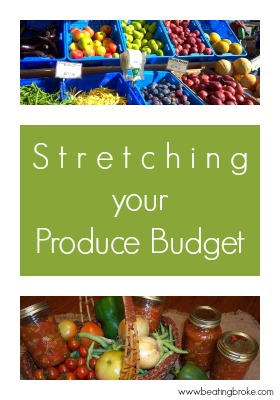
Stretching Your Produce Budget Further

June 12, 2015 By Shane Ede 14 Comments

Anyone who has made a simple budget has struggled with making their food budget fit with the rest of the budget.  If you attempt to eat healthy, one of the biggest components to a food budget is the produce.  Stretching your produce budget can be somewhat difficult.  Growing seasons are short, and the cost of produce keeps going up.  But, there are a few things we can do to stretch that produce budget, and make it a bit easier on your overall budget.

  1. Stretching your produce budgetStock Up on Sale: buying your produce on sale allows for you to stock up when the item is cheaper, then store it until you need it.   Canned produce is really easy to store.  Frozen only requires a freezer.  And if it’s the fresh stuff, there’s a few things you can do to store a surplus when you do pick it up in season and on sale.
  2. Canning for stockpiling: When you’ve got a surplus of produce, one of the best things you can do is can it to preserve it for another day’s use.  Canning only requires a few pieces of equipment, and a little time learning the process, then you can be off to the races filling your pantry shelves with preserved fresh produce to use later in the year when produce is much more expensive.
  3. Freeze it: Every year, around the end of summer, corn pops up in the backs of pickup trucks and in the farmers markets.  Compared to the rest of the year, it’s really cheap, and it tastes so good!  Unless we want to eat nothing but fresh corn, though, the season is fleeting, and we’re left with no other corn but the commercially canned or frozen corn you can get at the supermarket.  It’s just not the same.  Last year, we bought a whole bunch of corn (4-5 dozen), shucked them all, then cut the kernels off and combined them in a huge stockpot with some butter, a little bit of salt, and a little bit of water, and then cooked it for a little while.  Once it was done, we let it cool off, and then filled quart size freezer bags with the corn and froze it.  Now, if we want a little taste of that sweet summer corn, we just grab a bag, heat it backup and eat.  We did similar things with pumpkin, squash, zucchini, and a whole bunch of other summer fruits and veggies.  All it takes is a little bit of prep time and the freezer room to enjoy the flavor of fresh produce all year round.
  4. Grow it: If you already grow a garden every year, this might seem like a no-brainer of a tip.  But, growing your own garden can be an excellent way to stretch your produce budget out.  Last year, we enjoyed an abundance of tomatoes, potatoes, carrots, onions, jalepenos, cucumbers, and even an eggplant or two from our tiny container garden.  This year, we’re planning on consolidating down to a smaller selection in hopes that we’ll have some extras that we can can as well.
  5. Find a Farmer’s Market: Buying your produce from a local farmer can often be just as cheap as buying at the supermarket.  In some cases, if you order ahead, you can get a deal on bulk orders of produce which is great if you are planning on canning any of it.  It’s also fresher since it only had to make the trip from the farm down the road instead of the farm across the country.  It’s not always a great way to stretch the produce budget, but if you want high-quality produce that will last longer before spoiling, it’s a good place to check out.
  6. Pick it Yourself: A reader on twitter commented that I’d forgotten to add the u-pick farms.  I hadn’t really forgotten them, as they just don’t exist in my neck of the woods and the cost to drive to the nearest one would negate the savings.  But, if you have a u-pick farm nearby, it’s an excellent way to get out of the house, pick a ton of fresh produce (fruits usually) and save a pretty big chunk of change.  Many of the farms only charge about 1/3 of the cost at the grocery store!

Extending your produce budget is important, not just when there are droughts, but as a way to provide healthy options for you and your family to eat year round.

What do you do to stretch your produce budget?

Shane Ede

Shane Ede is a business teacher and personal finance blogger.  He holds dual Bachelors degrees in education and computer sciences, as well as a Masters Degree in educational technology.  Shane is passionate about personal finance, literacy and helping others master their money.  When he isn’t enjoying live music, Shane likes spending time with family, barbeque and meteorology.

www.beatingbroke.com

Filed Under: budget, Frugality, General Finance, ShareMe Tagged With: budget, canning, garden, grocery, produce

  • « Previous Page
  • 1
  • …
  • 7
  • 8
  • 9
  • 10
  • 11
  • …
  • 22
  • Next Page »
  • Facebook
  • Pinterest
  • RSS
  • Twitter

Improve Your Credit Score

Money Blogs

  • Budget and the Bees
  • Celebrating Financial Freedom
  • Christian PF
  • Clever Dude
  • Dual Income No Kids
  • Everybody Loves Your Money
  • Financial Panther
  • Gajizmo.com
  • Grocery Coupon Guide
  • Lazy Man and Money
  • Make Money Your Way
  • Money Talks News
  • Personal Profitability
  • PF Blogs
  • Reach Financial Independence
  • Saving Advice
  • The Savvy Scot
  • Yes, I am Cheap

Categories

Disclaimer

Please note that Beating Broke has financial relationships with some of the merchants mentioned here. Beating Broke may be compensated if consumers choose to utilize the links located throughout the content on this site and generate sales for the said merchant.

Visit Our Advertisers

Need to change careers? Consider an Accounting Certificate Program from WTI.
  • Home
  • About
  • We Recommend
  • Contact
  • Our Editorial Commitment