
Beating Broke

Personal Finance from the Broke Perspective

  • Home
  • About
  • We Recommend
  • Contact
  • Privacy Policy

Powered by Genesis

Couples; To Combine Finances or Not?

April 29, 2011 By Shane Ede 12 Comments

Life
Married couples have been doing it for centuries.  Combining their finances is just something they’ve always done.  Call it tradition if you want.  Call it necessity.  Recently, it’s a tradition that has come under fire as being old and outdated.  After all, the reason that the tradition exists is because it was rather usual for the woman in the marriage to stay home and be a homemaker while the husband went off to work and earned the money.  Since the woman wasn’t contributing to the financial inflow, there was no reason for her to have her own account.  What would she put in it?

But, with a new age, comes new standards.  Now, it’s expected that a woman will enter the workforce (or, at least, the contingent workforce).  And she’ll remain there even after marriage.  Not only will she remain in the workforce, but there is a chance that she’ll bring more to the table financially than her husband.  Suddenly, the decision to combine finances isn’t such an easy one.  In fact, combining finances can lead to more arguments than keeping them separated, unless both parties are on the same page financially.  The way I see it, there are three ways you can handle finances as a couple.

Combined accounts. (What we do.)

We came to the conclusion early on in our marriage that combining finances made the most sense for us.  Neither of us made much more than the other, and we both brought about an equal amount of debt to the marriage.  We combined and pay all of our bills and other expenses from one account.  It makes it easier to balance, easier to pay, and avoids having to figure out how much each owes to what bill, or when/how to transfer money from one account to the bill pay account.

Combined account hybrid.

If you want the convenience of combined accounts, but still have a bit of an issue with purchasing things for each other.  Or, just want a “me” account where you can purchase whatever you want, whenever, no questions asked, a combined hybrid set up might make the most sense.  Combine all of your accounts, but open a new account in each of your names.  Those accounts get a set (budgeted) amount deposited into them each month.  Each account is completely hands off to the other partner.  Spend it however you like, as long as the cash is in the account to cover what you spend.

Completely separate.

You don’t like the idea of combined accounts at all.  They should be separate.  Each of you keeps your own account and you either agree on who is paying which bill, or you create a third account that each of you deposits your share of the bills into and pay all bills from that account.

Which is right for you? I can’t say which is right, or which is wrong for you.  It’s something that you need to sit down and discuss with your spouse/partner and decide on.  I think that combined finances are easier, but with automated deposits and bill pay, the separate accounts could be made pretty easy as well.  And, just because you settle on one way, doesn’t mean you can’t change it down the road.  What I will say is that people are sometimes quick to judge based on the decision that you make.  Are you too trusting by combining?  Not trusting enough by leaving things separate?  Perhaps your relationship is doomed if you don’t combine?

The truth of it is this: a majority of divorces have some root in money issues.  Forcing yourselves into a money model that you don’t like won’t help with that statistic.  Be open with each other about money.  Be willing to discuss your finances, both separately and combined, and get yourselves on a path to a solid financial future.  If you do that, it won’t matter which option you choose, it’ll be the right one.

photo credit: Will Folsom

Shane Ede

Shane Ede is a business teacher and personal finance blogger.  He holds dual Bachelors degrees in education and computer sciences, as well as a Masters Degree in educational technology.  Shane is passionate about personal finance, literacy and helping others master their money.  When he isn’t enjoying live music, Shane likes spending time with family, barbeque and meteorology.
www.beatingbroke.com

Filed Under: General Finance, Home, Married Money, ShareMe Tagged With: budget, budgeting, combined finances, couple money, marriage, married money, separate finances

Renting or Buying a Home?

April 18, 2011 By Shane Ede 11 Comments

Which is the better way to go? There are several arguments for both sides with people arguing that the added costs of homeowner-ship making renting the more expensive or that rent paid is money lost that could have been going towards building equity in your home. I’m on the homeowner side of things. We own our home. And, we do have a mortgage.

There are several reasons that we own a home.  One of the biggest is cost.  Our mortgage, taxes, PMI, and insurance all come to only about $500 a month.  To rent a home of equal size, in our area, would cost at least $650, if not more.  It’s more cost effective for us to own, if you only take that into account.  There are added costs to owning a home.  Repairs and maintenance are an added cost that is unavoidable, but I look at it as another investment into the place I live.  And, many of the improvements that we’ve done (see kitchen for instance) would have never been done had the house been a rental, and they’ve greatly improved the livability of the house. When it comes down to it, buying a home just makes sense.

I can clearly see the argument, in some parts of the country (and world) for renting over buying.  I can also see situations where renting is just the smarter thing to do.  But, for most, I just don’t see how it can work out in your favor.  Why put money into someone elses pockets, when you could be putting it into yours?  Even if your house doesn’t appreciate in value at all (or, even depreciates) you’ll still be left with something of some value when you’re done with it.  Over those same 15-30 years of renting, what will you have?  Nothing but a good renter history.

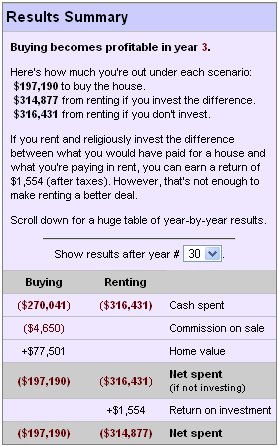
The mathematics of the rent vs. buying can get a bit complicated when people start talking about lost gains on investments and throw in interest, appreciation/depreciation, and the like.  I found this cool calculator that does most of that for you.  Hit the deluxe tab to really throw in a ton of variables.  If you’re a homeowner, punch in your numbers and see if it is worth it for you to buy or to rent.  I put our numbers in (that’s them in the picture), and, as I suspected, it’s better for us to buy vs. rent.  I have played a bit with it, and I think it’s a bit skewed towards buying vs renting, but not so much so that it makes it not fairly accurate.

I think another good thing that the calculator does, is give you a better idea of what the different variables can do to the situation.  Try playing with the appreciation numbers, or the return on investment number, or the length of mortgage, and see what that does to your situation.

Where are you on the rent vs. buy spectrum?  Do you own?  Why, or, why not?

Shane Ede

Shane Ede is a business teacher and personal finance blogger.  He holds dual Bachelors degrees in education and computer sciences, as well as a Masters Degree in educational technology.  Shane is passionate about personal finance, literacy and helping others master their money.  When he isn’t enjoying live music, Shane likes spending time with family, barbeque and meteorology.

www.beatingbroke.com

Filed Under: Home, ShareMe Tagged With: buy, calculator, Home, homeowner, rent

How to Recover From Bad Credit

April 13, 2011 By Shane Ede 7 Comments

If you’re one of the millions of people that has been negatively impacted by the global financial crisis, then you may find that your credit rating has suffered. Realize though that no amount of good advice can be a replacement for responsibility. Living within your means and giving a proper amount of deference to your financial situation will always be better than trying to pick up the pieces after a meltdown. Still, a lot of responsible people have been suffering lately due to no fault of their own, and if you find yourself in this group you will be able to reestablish your credit and recover. In this article we explore what options you have available to recover from bad credit.

  1. Apply for a Secured Credit Card
    These types of credit cards require that you keep some collateral, typically $100-$500 in an account. The nice thing is that after about a year of doing this you can upgrade to a regular credit card. Make sure to check for any hidden fees and that the issuing lender reports to all 3 of the major credit agencies before you apply.
  2. Make Sure All of Your Debts are Paid Off
    If you have recently been denied credit then you are entitled to a free copy of your credit report from one of the three major credit reporting agencies (Experian, Equifax, and TransUnion). These agencies also offer a one-time deal, so if you can, take advantage of that as well. Make sure to pay off any outstanding debts and to challenge anything on there that you did not legitimately incur. It is also possible to write the lenders asking for forgiveness, and have them remove bad marks against you, but it’s not quite standard procedure for them to do so.
  3. Watch Out for Phony Credit Reduction Scams
    There are some legitimate non-profit credit counseling services available that can act as a middle man in dealing with creditors and help you to reduce your debt. There are also a ton of scams out there that will do nothing but put you deeper into debt. Make sure to thoroughly research these types of services before using them.
  4. Get a Small Loan to Help Build Your Credit Further
    Once you are able to reestablish a line of credit, and are paying it off on a monthly basis, don’t expect lenders to just automatically open their coffers to you. Factors they will take into account typically include your monthly income to debt ratio, how much debt you have tied up in high interest accounts, how much savings you have, your credit history for the last 7 years, and other issues related to stability like the number of residences you’ve had.

Make sure to explain the circumstances that lead to your financial troubles, and don’t forget to mention things like you were 1 of several thousand workers to be laid off at your job, or that the company has gone out of business. The better you are able to show the lender that you are financially responsible, the better luck you will have at getting a loan.  Once you’re on the road to recovering from bad credit, learn how to build and use good credit.

Shane Ede

Shane Ede is a business teacher and personal finance blogger.  He holds dual Bachelors degrees in education and computer sciences, as well as a Masters Degree in educational technology.  Shane is passionate about personal finance, literacy and helping others master their money.  When he isn’t enjoying live music, Shane likes spending time with family, barbeque and meteorology.

www.beatingbroke.com

Filed Under: budget, Credit Score Tagged With: credit, credit repair, Credit Score

  • « Previous Page
  • 1
  • …
  • 65
  • 66
  • 67
  • 68
  • 69
  • …
  • 119
  • Next Page »
  • Facebook
  • Pinterest
  • RSS
  • Twitter

Improve Your Credit Score

Money Blogs

  • Celebrating Financial Freedom
  • Christian PF
  • Dual Income No Kids
  • Financial Panther
  • Gajizmo.com
  • Lazy Man and Money
  • Make Money Your Way
  • Money Talks News
  • My Personal Finance Journey
  • Personal Profitability
  • PF Blogs
  • Reach Financial Independence
  • So Over Debt
  • The Savvy Scot
  • Yes, I am Cheap

Categories

Disclaimer

Please note that Beating Broke has financial relationships with some of the merchants mentioned here. Beating Broke may be compensated if consumers choose to utilize the links located throughout the content on this site and generate sales for the said merchant.

Visit Our Advertisers

Need to change careers? Consider an Accounting Certificate Program from WTI.